117333
论文已发表
注册即可获取德孚的最新动态
IF 收录期刊
- 3.6 Breast Cancer (Dove Med Press)
- 4.3 Clin Epidemiol
- 2.6 Cancer Manag Res
- 3.2 Infect Drug Resist
- 4.1 Clin Interv Aging
- 6.1 Drug Des Dev Ther
- 4.1 Int J Chronic Obstr
- 8.7 Int J Nanomed
- 2.5 Int J Women's Health
- 3.2 Neuropsych Dis Treat
- 2.4 OncoTargets Ther
- 2.6 Patient Prefer Adher
- 2.6 Ther Clin Risk Manag
- 3.1 J Pain Res
- 3.5 Diabet Metab Synd Ob
- 4.5 Psychol Res Behav Ma
- 3.4 Nat Sci Sleep
- 2.4 Pharmgenomics Pers Med
- 2.6 Risk Manag Healthc Policy
- 4.6 J Inflamm Res
- 2.3 Int J Gen Med
- 3.9 J Hepatocell Carcinoma
- 3.3 J Asthma Allergy
- 2.5 Clin Cosmet Investig Dermatol
- 3.0 J Multidiscip Healthc

长非编码 RNA 中的遗传变异 H19 导致中国东南部汉族人群乳腺癌风险
Authors Lin Y, Fu F, Chen Y, Qiu W, Lin S, Yang P, Huang M, Wang C
Received 17 November 2016
Accepted for publication 6 August 2017
Published 7 September 2017 Volume 2017:10 Pages 4369—4378
DOI https://doi.org/10.2147/OTT.S127962
Checked for plagiarism Yes
Review by Single-blind
Peer reviewers approved by Dr Amy Norman
Peer reviewer comments 4
Editor who approved publication: Prof. Dr. Geoffrey Pietersz
Abstract: The
long noncoding RNA (lncRNA) H19 is a maternally
expressed imprinted gene that plays important roles in tumorigenesis,
progression, and metastasis. However, the association between polymorphisms
on H19 and breast cancer (BC)
susceptibility has remained obscure. In this case–control study, we assessed
the interaction between two lncRNA H19 single-nucleotide
polymorphisms (SNPs) (rs217727 C>T, rs2839698 C>T) and the risk of BC in
a Chinese Han population. In total, 1,005 BC cases and 1,020 healthy controls
were enrolled in this study. Correlations between genotypes and BC risk were
evaluated by multivariate logistic regression to estimate odds ratios (ORs) and
95% confidence intervals (CIs). False-positive report probability calculation
was also utilized to identify false-positive associations. We observed that the
rs217727 T variant was consistently significantly associated with an increased
risk of BC in both codominant and dominant models (CT vs CC, OR 1.25, 95% CI
1.03–1.51; TT vs CC, OR 1.56, 95% CI 1.15–2.09; CT + TT vs CC, OR 1.31, 95% CI 1.09–1.57),
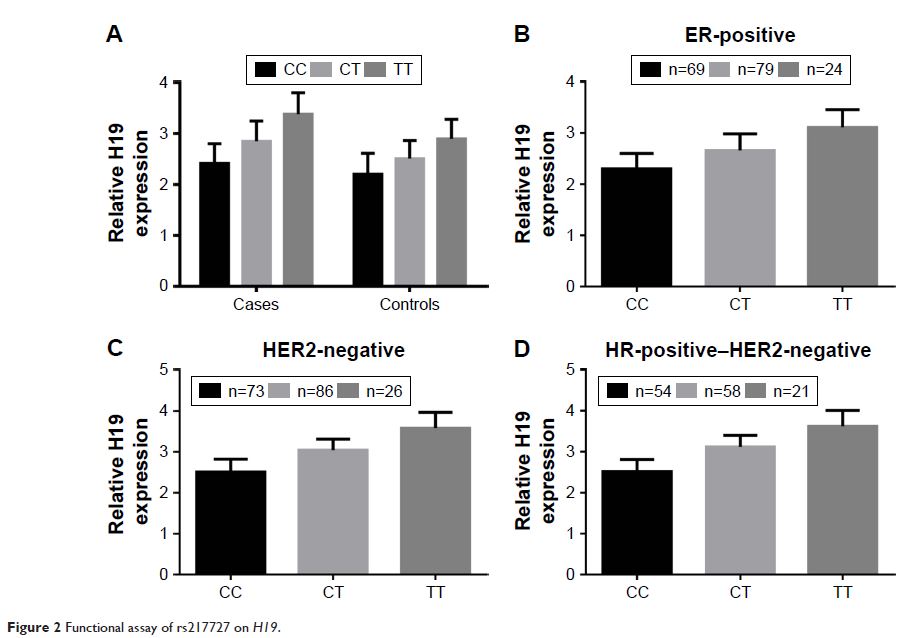
and all associations remained significant after Bonferroni correction (P <0.025). Subsequent stratified
analyses also revealed that associations between BC risk and rs217727 genotypes
were more profound in patients with estrogen receptor-positive, human epidermal
growth factor receptor 2 (HER2)-negative, and hormone
receptor-positive–HER2-negative molecular subtypes (all passed the threshold
for Bonferroni correction, P <0.005). These
findings extend available data on the association of H19 polymorphisms and BC
susceptibility. Based on these results, we encourage further large-scale
studies and functional research to confirm our findings and better elucidate
the underlying biological mechanisms.
Keywords: breast cancer, H19 , lncRNA,
polymorphisms, genetic susceptibility