117333
论文已发表
注册即可获取德孚的最新动态
IF 收录期刊
- 3.6 Breast Cancer (Dove Med Press)
- 4.3 Clin Epidemiol
- 2.6 Cancer Manag Res
- 3.2 Infect Drug Resist
- 4.1 Clin Interv Aging
- 6.1 Drug Des Dev Ther
- 4.1 Int J Chronic Obstr
- 8.7 Int J Nanomed
- 2.5 Int J Women's Health
- 3.2 Neuropsych Dis Treat
- 2.4 OncoTargets Ther
- 2.6 Patient Prefer Adher
- 2.6 Ther Clin Risk Manag
- 3.1 J Pain Res
- 3.5 Diabet Metab Synd Ob
- 4.5 Psychol Res Behav Ma
- 3.4 Nat Sci Sleep
- 2.4 Pharmgenomics Pers Med
- 2.6 Risk Manag Healthc Policy
- 4.6 J Inflamm Res
- 2.3 Int J Gen Med
- 3.9 J Hepatocell Carcinoma
- 3.3 J Asthma Allergy
- 2.5 Clin Cosmet Investig Dermatol
- 3.0 J Multidiscip Healthc

石墨烯 (Graphene) 材料诱导程序性细胞死亡的机制:细胞凋亡、自噬和程序性坏死的综述
Authors Ou L, Lin S, Song B, Liu J, Lai R, Shao L
Received 26 April 2017
Accepted for publication 13 July 2017
Published 7 September 2017 Volume 2017:12 Pages 6633—6646
DOI https://doi.org/10.2147/IJN.S140526
Checked for plagiarism Yes
Review by Single-blind
Peer reviewers approved by Dr Thiruganesh Ramasamy
Peer reviewer comments 2
Editor who approved publication: Dr Linlin Sun
Abstract: Graphene-based
materials (GBMs) are widely used in many fields, including biomedicine. To
date, much attention had been paid to the potential unexpected toxic effects of
GBMs. Here, we review the recent literature regarding the impact of GBMs on
programmed cell death (PCD). Apoptosis, autophagy, and programmed necrosis are
three major PCDs. Mechanistic studies demonstrated that the mitochondrial
pathways and MAPKs (JNK, ERK, and p38)- and TGF-β-related signaling pathways
are implicated in GBMs-induced apoptosis. Autophagy, unlike apoptosis and
necroptosis which are already clear cell death types, plays a vital
pro-survival role in cell homeostasis, so its role in cell death should be
carefully considered. However, GBMs always induce unrestrained autophagy
accelerating cell death. GBMs trigger autophagy through inducing autophagosome
accumulation and lysosome impairment. Mitochondrial dysfunction, ER stress,
TLRs signaling pathways, and p38 MAPK and NF-κB pathways participate in
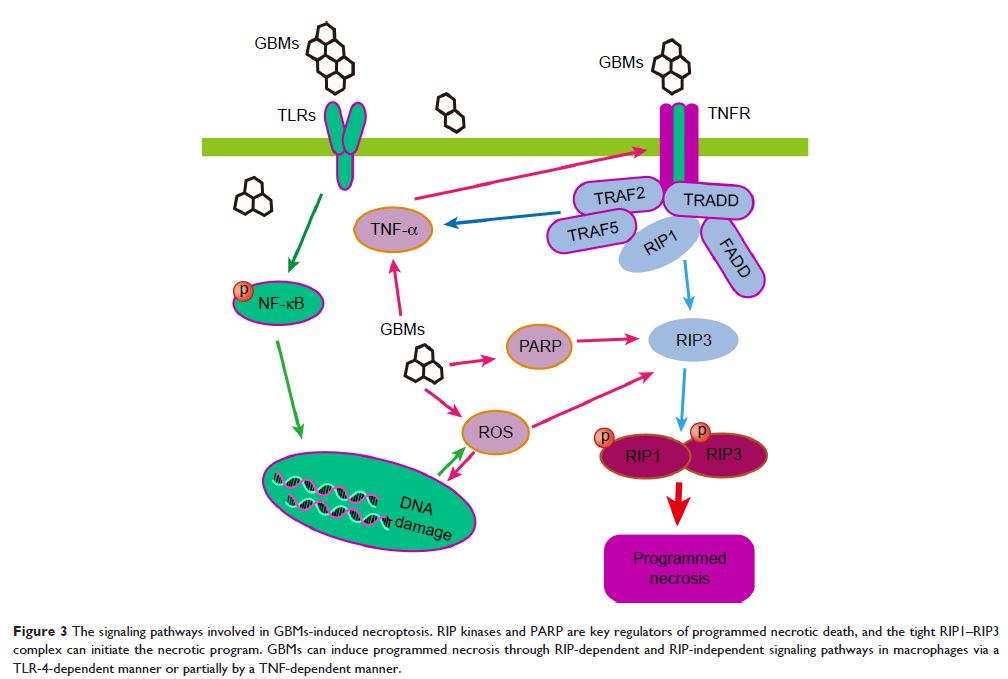
GBMs-induced autophagy. Programmed necrosis can be activated by RIP kinases, PARP,
and TLR-4 signaling in macrophages after GBMs exposure. Though apoptosis,
autophagy, and necroptosis are distinguished by some characteristics, their
numerous signaling pathways comprise an interconnected network and correlate
with each other, such as the TLRs, p53 signaling pathways, and the Beclin-1 and
Bcl-2 interaction. A better understanding of the mechanisms of PCD induced by
GBMs may allow for a thorough study of the toxicology of GBMs and a more
precise determination of the consequences of human exposure to GBMs. These
determinations will also benefit safety assessments of the biomedical and
therapeutic applications of GBMs.
Keywords: graphene based materials, cell toxicity, programmed cell death,
mechanisms