117333
论文已发表
注册即可获取德孚的最新动态
IF 收录期刊
- 3.6 Breast Cancer (Dove Med Press)
- 4.3 Clin Epidemiol
- 2.6 Cancer Manag Res
- 3.2 Infect Drug Resist
- 4.1 Clin Interv Aging
- 6.1 Drug Des Dev Ther
- 4.1 Int J Chronic Obstr
- 8.7 Int J Nanomed
- 2.5 Int J Women's Health
- 3.2 Neuropsych Dis Treat
- 2.4 OncoTargets Ther
- 2.6 Patient Prefer Adher
- 2.6 Ther Clin Risk Manag
- 3.1 J Pain Res
- 3.5 Diabet Metab Synd Ob
- 4.5 Psychol Res Behav Ma
- 3.4 Nat Sci Sleep
- 2.4 Pharmgenomics Pers Med
- 2.6 Risk Manag Healthc Policy
- 4.6 J Inflamm Res
- 2.3 Int J Gen Med
- 3.9 J Hepatocell Carcinoma
- 3.3 J Asthma Allergy
- 2.5 Clin Cosmet Investig Dermatol
- 3.0 J Multidiscip Healthc

利用磁共振成像可见的聚合物囊泡进行标记的间充质干细胞在脑缺血治疗中的长期作用
Authors Duan X, Lu L, Wang Y, Zhang F, Mao J, Cao M, Lin B, Zhang X, Shuai X, Shen J
Received 19 July 2017
Accepted for publication 16 August 2017
Published 8 September 2017 Volume 2017:12 Pages 6705—6719
DOI https://doi.org/10.2147/IJN.S146742
Checked for plagiarism Yes
Review by Single-blind
Peer reviewers approved by Dr Govarthanan Muthusamy
Peer reviewer comments 3
Editor who approved publication: Professor Dongwoo Khang
Abstract: Understanding
the long-term fate and potential mechanisms of mesenchymal stem cells (MSCs)
after transplantation is essential for improving functional benefits of stem
cell-based stroke treatment. Magnetic resonance imaging (MRI) is considered an
attractive and clinically translatable tool for longitudinal tracking of stem
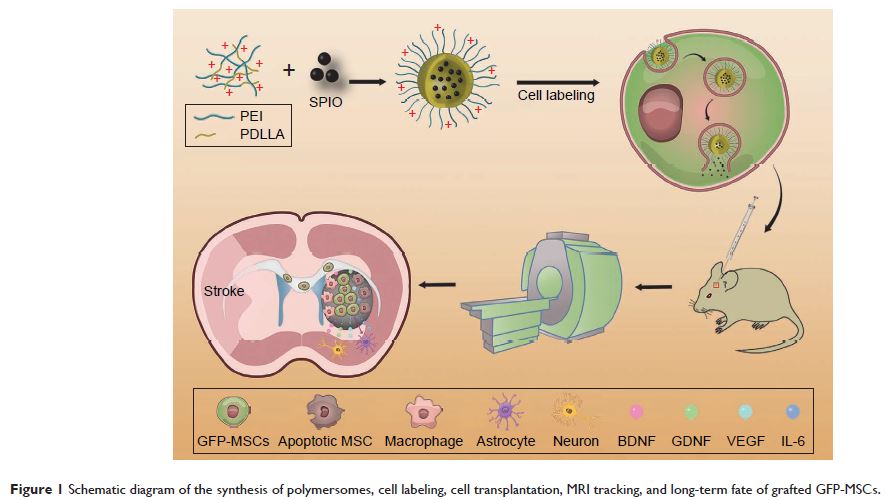
cells, but certain controversies have arisen in this regard. In this study, we
used SPION-loaded cationic polymersomes to label green fluorescent protein
(GFP)-expressing MSCs to determine whether MRI can accurately reflect survival,
long-term fate, and potential mechanisms of MSCs in ischemic stroke therapy.
Our results showed that MSCs could improve the functional outcome and reduce
the infarct volume of stroke in the brain. In vivo MRI can verify the
biodistribution and migration of grafted cells when pre-labeled with
SPION-loaded polymersome. The dynamic change of low signal volume on MRI can reflect
the tendency of cell survival and apoptosis, but may overestimate long-term
survival owing to the presence of iron-laden macrophages around cell graft.
Only a small fraction of grafted cells survived up to 8 weeks after
transplantation. A minority of these surviving cells were differentiated into
astrocytes, but not into neurons. MSCs might exert their therapeutic effect via
secreting paracrine factors rather than directing cell replacement through
differentiation into neuronal and/or glial phenotypes.
Keywords: mesenchymal stem cells, magnetic resonance imaging,
superparamagnetic iron oxide nanoparticles, polymersome, ischemic stroke, green
fluorescence protein