119942
论文已发表
注册即可获取德孚的最新动态
IF 收录期刊
- 3.6 Breast Cancer (Dove Med Press)
- 4.3 Clin Epidemiol
- 2.6 Cancer Manag Res
- 3.2 Infect Drug Resist
- 4.1 Clin Interv Aging
- 6.1 Drug Des Dev Ther
- 4.1 Int J Chronic Obstr
- 8.7 Int J Nanomed
- 2.5 Int J Women's Health
- 3.2 Neuropsych Dis Treat
- 2.4 OncoTargets Ther
- 2.6 Patient Prefer Adher
- 2.6 Ther Clin Risk Manag
- 3.1 J Pain Res
- 3.5 Diabet Metab Synd Ob
- 4.5 Psychol Res Behav Ma
- 3.4 Nat Sci Sleep
- 2.4 Pharmgenomics Pers Med
- 2.6 Risk Manag Healthc Policy
- 4.6 J Inflamm Res
- 2.3 Int J Gen Med
- 3.9 J Hepatocell Carcinoma
- 3.3 J Asthma Allergy
- 2.5 Clin Cosmet Investig Dermatol
- 3.0 J Multidiscip Healthc

RASSF1A 高甲基化与 ASXL1 突变相关,表明非 M3 型急性骨髓性白血病的不良治疗结果
Authors Liu F, Gong M, Gao L, Cai X, Zhang H, Ma Y
Received 24 May 2017
Accepted for publication 20 July 2017
Published 22 August 2017 Volume 2017:10 Pages 4143—4151
DOI https://doi.org/10.2147/OTT.S142528
Checked for plagiarism Yes
Review by Single-blind
Peer reviewers approved by Dr Colin Mak
Peer reviewer comments 2
Editor who approved publication: Dr Ingrid Espinoza
Objective: The
purpose of this study was to evaluate the frequency of RASSF1A hypermethylation in patients
with acute myeloid leukemia (AML), in an attempt to modify the current
molecular model for disease prognosis.
Materials and
methods: Aberrant RASSF1A promoter methylation
levels were assessed in 226 newly diagnosed non-M3 AML patients and 30 apparently
healthy controls, by quantitative methylation-specific polymerase chain
reaction. Meanwhile, RASSF1A mRNA
levels were detected by real-time quantitative polymerase chain reaction.
Furthermore, hematological characteristics, cytogenetic abnormalities, and
genetic aberrations were assessed. Finally, associations of RASSF1A hypermethylation with
clinical outcomes were evaluated.
Results: RASSF1A hypermethylation was
observed in 23.0% of patients with non-M3 AML (52/226), but not in controls.
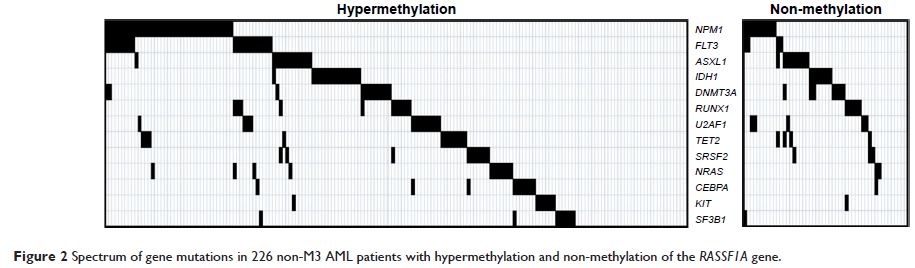
Meanwhile, hypermethylation of the RASSF1A promoter
was significantly associated with ASXL1 mutation.
Furthermore, the log-rank test revealed that RASSF1A hypermethylation
indicated decreased relapse-free survival (RFS) and overall survival (OS) in
patients with non-M3 AML (P =0.012 and P =0.014, respectively). In
multivariate analysis, RASSF1A hypermethylation
was an independent prognostic factor for RFS (P =0.040),
but not for OS (P =0.060).
Conclusion: Hypermethylation of the RASSF1A promoter
is associated with ASXL1 mutation
in non-M3 AML patients, likely indicating poor outcome. These findings provide
a molecular basis for stratified diagnosis and prognostic evaluation.
Keywords: RASSF1A , hypermethylation, acute
myeloid leukemia, clinical outcome, survival