119942
论文已发表
注册即可获取德孚的最新动态
IF 收录期刊
- 3.6 Breast Cancer (Dove Med Press)
- 4.3 Clin Epidemiol
- 2.6 Cancer Manag Res
- 3.2 Infect Drug Resist
- 4.1 Clin Interv Aging
- 6.1 Drug Des Dev Ther
- 4.1 Int J Chronic Obstr
- 8.7 Int J Nanomed
- 2.5 Int J Women's Health
- 3.2 Neuropsych Dis Treat
- 2.4 OncoTargets Ther
- 2.6 Patient Prefer Adher
- 2.6 Ther Clin Risk Manag
- 3.1 J Pain Res
- 3.5 Diabet Metab Synd Ob
- 4.5 Psychol Res Behav Ma
- 3.4 Nat Sci Sleep
- 2.4 Pharmgenomics Pers Med
- 2.6 Risk Manag Healthc Policy
- 4.6 J Inflamm Res
- 2.3 Int J Gen Med
- 3.9 J Hepatocell Carcinoma
- 3.3 J Asthma Allergy
- 2.5 Clin Cosmet Investig Dermatol
- 3.0 J Multidiscip Healthc

纳米银对聚己内酯纳米纤维膜的优化和整合,可用于体外和体内细菌抑制和伤口愈合
Authors Liu M, Luo G, Wang Y, He W, Liu T, Zhou D, Hu X, Xing M, Wu J
Received 28 April 2017
Accepted for publication 9 August 2017
Published 12 September 2017 Volume 2017:12 Pages 6827—6840
DOI https://doi.org/10.2147/IJN.S140648
Checked for plagiarism Yes
Review by Single-blind
Peer reviewers approved by Dr Alexander Kharlamov
Peer reviewer comments 2
Editor who approved publication: Dr Linlin Sun
Abstract: Bacterial infection is a major hurdle to wound healing, and the
overuse of antibiotics have led to global issue, such as emergence of
multidrug-resistant bacteria, even “super bacteria”. On the contrary,
nanosilver (NS) can kill bacteria without causing resistant bacterial strains.
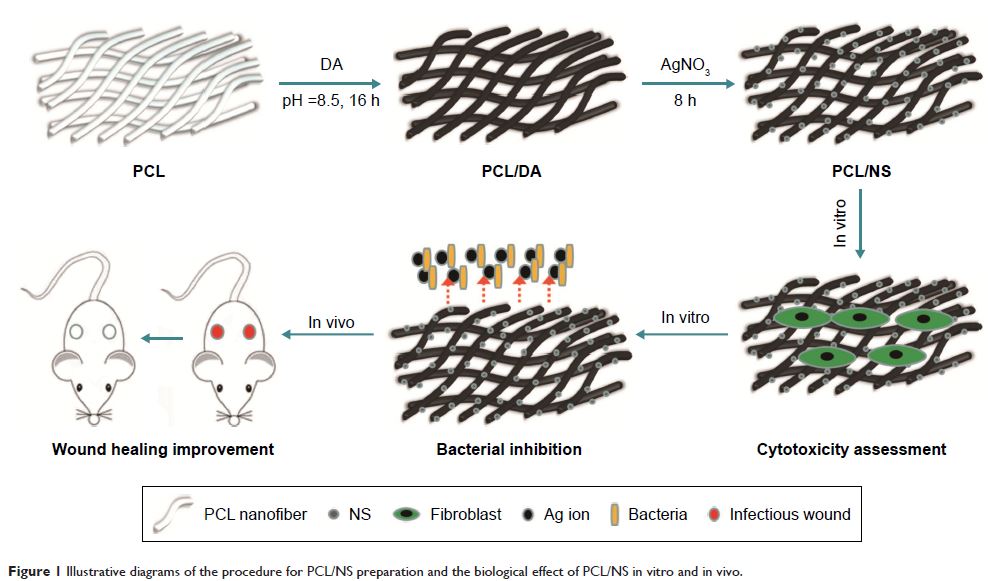
In this study, NS was simply generated in situ on the polycaprolactone (PCL)
nanofibrous mesh using an environmentally benign and mussel-inspired dopamine
(DA). Scanning electron microscopy showed that NS uniformly formed on the
nanofibers of PCL mesh. Fourier transform infrared spectroscopy revealed the
step-by-step preparation of pristine PCL mesh, including DA coating and NS
formation, which were further verified by water contact angle changing from
hydrophobic to hydrophilic. To optimize the NS dose, the antibacterial activity
of PCL/NS against Staphylococcus aureus , Escherichia coli and Acinetobacter baumannii was
detected by bacterial suspension assay, and the cytotoxicity of NS was
evaluated using cellular morphology observation and Cell Counting Kit-8 (CCK8)
assay. Then, inductively coupled plasma atomic emission spectrometry exhibited
that the optimized PCL/NS had a safe and sustained silver release. Moreover,
PCL/NS could effectively inhibit bacterial infection in an infectious murine
full-thickness skin wound model. As demonstrated by the enhanced level of proliferating
cell nuclear antigen (PCNA) in keratinocytes and longer length of neo-formed
epidermis, PCL/NS accelerated wound healing by promoting re-epithelialization
via enhancing keratinocyte proliferation in infectious wounds.
Keywords: polycaprolactone
nanofibrous mesh, mussel inspired, nanosilver, anti-infection activity, wound
healing, re-epithelialization