119661
论文已发表
注册即可获取德孚的最新动态
IF 收录期刊
- 3.6 Breast Cancer (Dove Med Press)
- 4.3 Clin Epidemiol
- 2.6 Cancer Manag Res
- 3.2 Infect Drug Resist
- 4.1 Clin Interv Aging
- 6.1 Drug Des Dev Ther
- 4.1 Int J Chronic Obstr
- 8.7 Int J Nanomed
- 2.5 Int J Women's Health
- 3.2 Neuropsych Dis Treat
- 2.4 OncoTargets Ther
- 2.6 Patient Prefer Adher
- 2.6 Ther Clin Risk Manag
- 3.1 J Pain Res
- 3.5 Diabet Metab Synd Ob
- 4.5 Psychol Res Behav Ma
- 3.4 Nat Sci Sleep
- 2.4 Pharmgenomics Pers Med
- 2.6 Risk Manag Healthc Policy
- 4.6 J Inflamm Res
- 2.3 Int J Gen Med
- 3.9 J Hepatocell Carcinoma
- 3.3 J Asthma Allergy
- 2.5 Clin Cosmet Investig Dermatol
- 3.0 J Multidiscip Healthc

肝细胞癌细胞中 A20 下调增加 IFN-γ 的细胞毒性
Authors Yin L, Fang Z, Shen N, Qiu Y, Li A, Zhang Y
Received 2 March 2017
Accepted for publication 22 June 2017
Published 26 September 2017 Volume 2017:11 Pages 2841—2850
DOI https://doi.org/10.2147/DDDT.S135993
Checked for plagiarism Yes
Review by Single-blind
Peer reviewers approved by Dr Venkateshwar Madka
Peer reviewer comments 2
Editor who approved publication: Professor Jianbo Sun
Abstract: Hepatocellular carcinoma
(HCC) is a highly fatal disease mandating development of novel, effective
therapeutic strategy. Interferon-gamma (IFN-γ) is a pleiotropic cytokine with
immunomodulatory, antiviral, and antitumor effects. Although IFN-γ is a
promising antitumor agent, its application is limited by resistance in tumor cells.
A20 is a zinc-finger protein that was initially identified as a gene product
induced by tumor necrosis factor α in human umbilical vein endothelial cells.
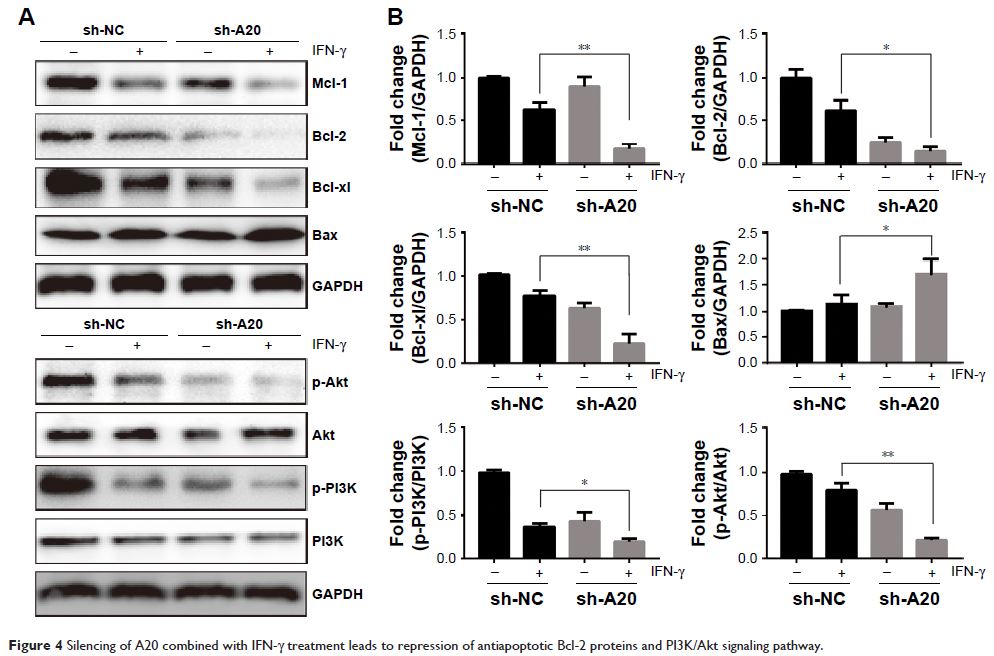
In this study, we found that silencing of A20 combined with IFN-γ significantly
represses cell viability, and induces apoptosis and cell-cycle arrest in HCC
cells. By investigating mechanisms implicated in A20 and IFN-γ-mediated
signaling pathways, we revealed that the phosphoinositide 3-kinase/Akt
signaling pathway and antiapoptotic B-cell lymphoma 2 proteins were repressed.
Moreover, we also found that phosphorylation of STAT1 and STAT3 was
significantly enhanced after the downregulation of A20 in combination with
treatment of IFN-γ. Inhibitor of STAT1 but not STAT3 could block the antitumor
effect of IFN-γ. Therefore, targeting A20 enhances the cytotoxicity of IFN-γ
against HCC cells and may present a promising therapeutic strategy for HCC.
Keywords: IFN-γ, A20,
hepatocellular carcinoma, PI3K/Akt, STAT1, STAT3