119661
论文已发表
注册即可获取德孚的最新动态
IF 收录期刊
- 3.6 Breast Cancer (Dove Med Press)
- 4.3 Clin Epidemiol
- 2.6 Cancer Manag Res
- 3.2 Infect Drug Resist
- 4.1 Clin Interv Aging
- 6.1 Drug Des Dev Ther
- 4.1 Int J Chronic Obstr
- 8.7 Int J Nanomed
- 2.5 Int J Women's Health
- 3.2 Neuropsych Dis Treat
- 2.4 OncoTargets Ther
- 2.6 Patient Prefer Adher
- 2.6 Ther Clin Risk Manag
- 3.1 J Pain Res
- 3.5 Diabet Metab Synd Ob
- 4.5 Psychol Res Behav Ma
- 3.4 Nat Sci Sleep
- 2.4 Pharmgenomics Pers Med
- 2.6 Risk Manag Healthc Policy
- 4.6 J Inflamm Res
- 2.3 Int J Gen Med
- 3.9 J Hepatocell Carcinoma
- 3.3 J Asthma Allergy
- 2.5 Clin Cosmet Investig Dermatol
- 3.0 J Multidiscip Healthc

与食管鳞状细胞癌相关的静坐时间、职业和娱乐体力活动
Authors Chen P, Song Q, Han J, Xu H, Chen T, Xu J, Cheng Y
Received 29 July 2017
Accepted for publication 6 September 2017
Published 27 September 2017 Volume 2017:10 Pages 4787—4794
DOI https://doi.org/10.2147/OTT.S147711
Checked for plagiarism Yes
Review by Single-blind
Peer reviewers approved by Dr Colin Mak
Peer reviewer comments 4
Editor who approved publication: Dr Ingrid Espinoza
Backgrounds: Sitting
time and physical activity are associated with cancer risk; however, their
roles in the development of esophageal squamous cell carcinoma (ESCC) are
inconclusive. This study aimed to investigate the effects of total sitting
time, occupational activity time (OAT), and recreational activity time (RAT) on
ESCC risk.
Methods: Five hundred fifty-seven ESCC patients and 543 healthy controls matched
by sex and age were recruited for this study. Conditional logistic regression
was performed to obtain odds ratios (ORs) and 95% confidence intervals (CIs).
Results: Longer total sitting time (adjusted OR [AOR] 2.54, 95% CI 1.58–4.09) and
longer OAT (AOR 2.90, 95% CI 2.11–3.99) were associated with higher ESCC risk,
while longer RAT (AOR 0.27, 95% CI 0.19–0.38) could reduce ESCC risk. When the
body mass index was incorporated into the multivariable models, the results
changed slightly. In risk estimation according to sex, the same trends were
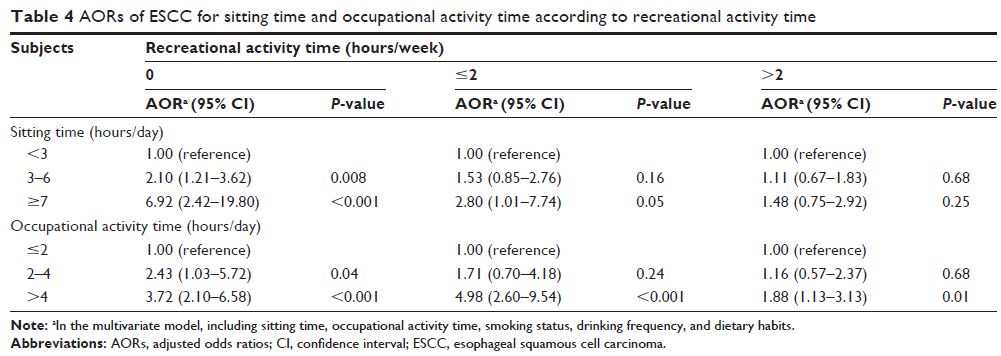
observed in both men and women. Furthermore, longer RAT could completely or
partially diminish the impacts of longer sitting time and OAT on increasing
ESCC risk.
Conclusion: Long sitting time and long OAT can increase the risk of ESCC, while long
RAT is significantly associated with decreased ESCC risk.
Keywords: esophageal squamous cell carcinoma, sitting time, physical activity,
cancer epidemiology, carcinogenesis