119942
论文已发表
注册即可获取德孚的最新动态
IF 收录期刊
- 3.6 Breast Cancer (Dove Med Press)
- 4.3 Clin Epidemiol
- 2.6 Cancer Manag Res
- 3.2 Infect Drug Resist
- 4.1 Clin Interv Aging
- 6.1 Drug Des Dev Ther
- 4.1 Int J Chronic Obstr
- 8.7 Int J Nanomed
- 2.5 Int J Women's Health
- 3.2 Neuropsych Dis Treat
- 2.4 OncoTargets Ther
- 2.6 Patient Prefer Adher
- 2.6 Ther Clin Risk Manag
- 3.1 J Pain Res
- 3.5 Diabet Metab Synd Ob
- 4.5 Psychol Res Behav Ma
- 3.4 Nat Sci Sleep
- 2.4 Pharmgenomics Pers Med
- 2.6 Risk Manag Healthc Policy
- 4.6 J Inflamm Res
- 2.3 Int J Gen Med
- 3.9 J Hepatocell Carcinoma
- 3.3 J Asthma Allergy
- 2.5 Clin Cosmet Investig Dermatol
- 3.0 J Multidiscip Healthc

在骨质疏松条件下,加载 IGF1 并涂覆在钛植入物上的逐层聚电解质多层用于骨整合
Authors Xing H, Wang X, Xiao SS, Zhang G, Li M, Wang P, Shi Q, Qiao P, E L, Liu H
Received 1 August 2017
Accepted for publication 13 September 2017
Published 19 October 2017 Volume 2017:12 Pages 7709—7720
DOI https://doi.org/10.2147/IJN.S148001
Checked for plagiarism Yes
Review by Single-blind
Peer reviewers approved by Dr Amy Norman
Peer reviewer comments 2
Editor who approved publication: Professor Dongwoo Khang
Purpose: Titanium implant is a widely used method for dental prosthesis
restoration. Nevertheless, in patients with systemic diseases, including
osteoporosis, diabetes, and cancer, the success rate of the implant is greatly
reduced. This study investigates a new implant material loaded with
insulin-like growth factor 1 (IGF1), which could potentially improve the
implant success rate, accelerate the occurrence of osseointegration, and
provide a new strategy for implant treatment in osteoporotic patients.
Materials and methods: Biofunctionalized polyelectrolyte multilayers (PEMs)
with polyethylenimine as the excitation layer and gelatin/chitosan loaded with
IGF1 were prepared on the surface of titanium implant by layer-by-layer
self-assembly technique. The physical and chemical properties of the
biofunctionalized PEMs, the biological characteristics of bone marrow
mesenchymal stem cells (BMMSCs), and bone implant contact correlation test
indexes were detected and analyzed in vitro and in vivo using osteoporosis rat
model.
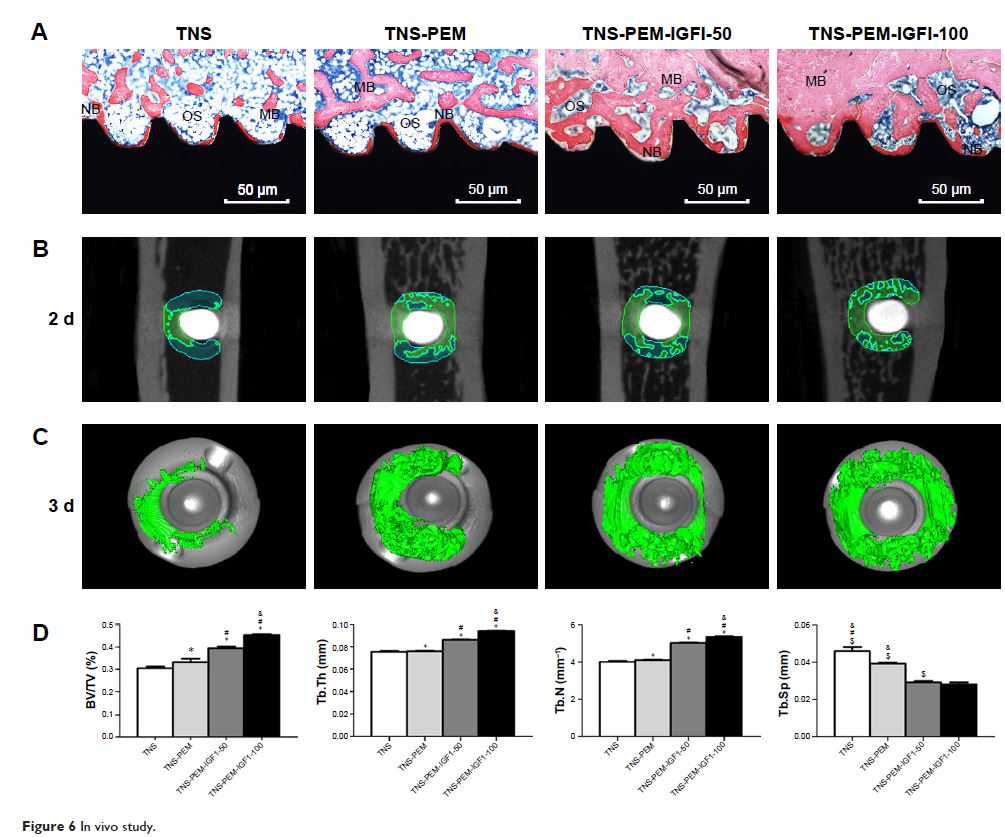
Results: PEMs coatings loaded with IGF1 (TNS-PEM-IGF1-100)
implant promoted the early stage of BMMSCs adhesion. Under the action of body
fluids, the active coating showed sustained release of growth factors, which in
turn promoted the proliferation and differentiation of BMMSCs and the
extracellular matrix. At 8 weeks from implant surgery, the new bone around the
implants was examined using micro-CT and acid fuchsin/methylene blue staining.
The new bone formation increased with time in each group, while the TNS-PEM-IGF1-100
group showed the highest thickness and continuity.
Conclusion: TNS-PEM-IGF1-100 new implants can promote
osseointegration in osteoporotic conditions both in vivo and in vitro and
provide a new strategy for implant repair in osteoporotic patients.
Keywords: osseointegration,
layer by layer, polyelectrolyte multilayers, IGF1, titanium implant,
osteoporosis