117518
论文已发表
注册即可获取德孚的最新动态
IF 收录期刊
- 3.6 Breast Cancer (Dove Med Press)
- 4.3 Clin Epidemiol
- 2.6 Cancer Manag Res
- 3.2 Infect Drug Resist
- 4.1 Clin Interv Aging
- 6.1 Drug Des Dev Ther
- 4.1 Int J Chronic Obstr
- 8.7 Int J Nanomed
- 2.5 Int J Women's Health
- 3.2 Neuropsych Dis Treat
- 2.4 OncoTargets Ther
- 2.6 Patient Prefer Adher
- 2.6 Ther Clin Risk Manag
- 3.1 J Pain Res
- 3.5 Diabet Metab Synd Ob
- 4.5 Psychol Res Behav Ma
- 3.4 Nat Sci Sleep
- 2.4 Pharmgenomics Pers Med
- 2.6 Risk Manag Healthc Policy
- 4.6 J Inflamm Res
- 2.3 Int J Gen Med
- 3.9 J Hepatocell Carcinoma
- 3.3 J Asthma Allergy
- 2.5 Clin Cosmet Investig Dermatol
- 3.0 J Multidiscip Healthc

LncRNA 的表达及其在骨肉瘤中的意义:系统综述和荟萃分析
Authors Wang Y, Huang YL, Xiang P, Tian W
Received 24 August 2017
Accepted for publication 4 October 2017
Published 9 November 2017 Volume 2017:10 Pages 5355—5361
DOI https://doi.org/10.2147/OTT.S149889
Checked for plagiarism Yes
Review by Single-blind
Peer reviewers approved by Dr Akshita Wason
Peer reviewer comments 2
Editor who approved publication: Dr Tohru Yamada
Purpose: Osteosarcoma is the most prevalent primary bone tumor in children,
adolescents, and older adults, typically presenting with poor survival
outcomes. In recent years, ample evidence has shown that many long noncoding
RNAs (lncRNAs) have been aberrantly expressed in osteosarcoma, demonstrating
their potential to serve as prognostic markers. In this study, we performed a
meta-analysis on four lncRNAs (TUG1, UCA1, BCAR4, and HULC) to systematically
evaluate their prognostic value in osteosarcoma.
Materials and methods: The eligible articles were systematically searched in
PubMed, Web of Science, Embase, and Elsevier ScienceDirect (up to September 22,
2017), and one meta-analysis concerning the association between lncRNA
expression and the overall survival (OS) of osteosarcoma patients was
performed. Survival outcomes were analyzed by OS. Subgroup analyses were
performed.
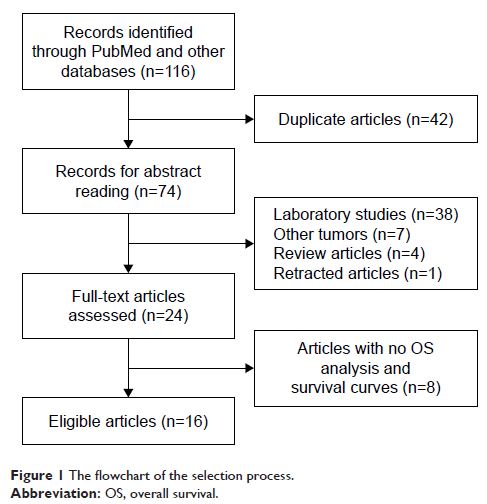
Results: A total of 1,361 patients with osteosarcoma and 12
lncRNAs from 16 articles were included in the study. Of the listed lncRNAs, the
high expression of 10 lncRNAs indicated worse survival outcomes, while only two
lncRNAs were shown to positively affect patients’ OS.
Conclusion: This meta-analysis indicated that the abnormally
expressed lncRNAs might significantly affect the survival of osteosarcoma
patients. Combined use of these lncRNAs may serve as potential novel biomarkers
for the indication of clinical outcomes of osteosarcoma patients as well as the
selection of adjuvant chemotherapy strategies for clinical treatment of this
disease.
Keywords: lncRNAs,
osteosarcoma, prognosis, meta-analysis