117518
论文已发表
注册即可获取德孚的最新动态
IF 收录期刊
- 3.6 Breast Cancer (Dove Med Press)
- 4.3 Clin Epidemiol
- 2.6 Cancer Manag Res
- 3.2 Infect Drug Resist
- 4.1 Clin Interv Aging
- 6.1 Drug Des Dev Ther
- 4.1 Int J Chronic Obstr
- 8.7 Int J Nanomed
- 2.5 Int J Women's Health
- 3.2 Neuropsych Dis Treat
- 2.4 OncoTargets Ther
- 2.6 Patient Prefer Adher
- 2.6 Ther Clin Risk Manag
- 3.1 J Pain Res
- 3.5 Diabet Metab Synd Ob
- 4.5 Psychol Res Behav Ma
- 3.4 Nat Sci Sleep
- 2.4 Pharmgenomics Pers Med
- 2.6 Risk Manag Healthc Policy
- 4.6 J Inflamm Res
- 2.3 Int J Gen Med
- 3.9 J Hepatocell Carcinoma
- 3.3 J Asthma Allergy
- 2.5 Clin Cosmet Investig Dermatol
- 3.0 J Multidiscip Healthc

具有糖脂结构的聚合物胶束递送 A-317491 对子宫内膜异位症疼痛的影响
Authors Yuan M, Ding S, Meng TT, Lu B, Shao S, Zhang X, Yuan H, Hu F
Received 16 July 2017
Accepted for publication 17 September 2017
Published 9 November 2017 Volume 2017:12 Pages 8171—8183
DOI https://doi.org/10.2147/IJN.S146569
Checked for plagiarism Yes
Review by Single-blind
Peer reviewers approved by Dr Colin Mak
Peer reviewer comments 2
Editor who approved publication: Dr Linlin Sun
Abstract: Endometriosis is a common gynecological disease with a lack of
effective clinical treatment. Current therapy often results in endometriosis
pain recurrence and serious side effects. P2X3 receptor,
an adenosine triphosphate (ATP)-gated ion channel, might be implicated in
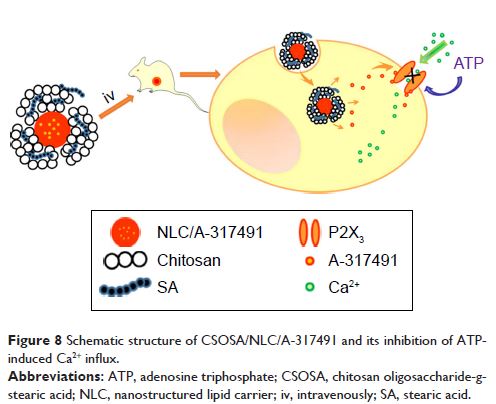
endometriosis pain. In this study, chitosan oligosaccharide-g-stearic acid
(CSOSA) polymer micelles-coated nanostructured lipid carriers (NLCs) were
developed as a novel delivery system for A-317491, a selective P2X3 receptor antagonist for endometriosis pain
therapy. A-317491-loaded NLC (NLC/A-317491) could be coated by CSOSA micelles
to form CSOSA/NLC/A-317491 nanoparticles. Pheochromocytoma PC12 cells, which
highly expressed P2X3 receptors, were used as a
cell model, and the CSOSA/NLC/A-317491 partly blocked the Ca2+ influx induced by ATP stimulation. In nude
mouse and rat endometriotic models, CSOSA/NLC could accumulate into
endometriotic lesions after vein injection. In endometriotic rats,
CSOSA/NLC/A-317491 reversed mechanical and heat hyperalgesia with long-term
efficacy, which might be attributed to the massive CSOSA/NLC/A-317491
distribution in the endometriotic lesions. In conclusion, A-317491 delivered by
CSOSA/NLC nanoparticles attenuated endometriosis pain in rats, and
CSOSA/NLC/A-317491 could be used as an effective treatment strategy for P2X3-targeted therapy in endometriosis pain.
Keywords: glycolipid-like
polymer, A-317491, nanostructured lipid carriers, endometriosis pain, P2X3 receptor