117333
论文已发表
注册即可获取德孚的最新动态
IF 收录期刊
- 3.6 Breast Cancer (Dove Med Press)
- 4.3 Clin Epidemiol
- 2.6 Cancer Manag Res
- 3.2 Infect Drug Resist
- 4.1 Clin Interv Aging
- 6.1 Drug Des Dev Ther
- 4.1 Int J Chronic Obstr
- 8.7 Int J Nanomed
- 2.5 Int J Women's Health
- 3.2 Neuropsych Dis Treat
- 2.4 OncoTargets Ther
- 2.6 Patient Prefer Adher
- 2.6 Ther Clin Risk Manag
- 3.1 J Pain Res
- 3.5 Diabet Metab Synd Ob
- 4.5 Psychol Res Behav Ma
- 3.4 Nat Sci Sleep
- 2.4 Pharmgenomics Pers Med
- 2.6 Risk Manag Healthc Policy
- 4.6 J Inflamm Res
- 2.3 Int J Gen Med
- 3.9 J Hepatocell Carcinoma
- 3.3 J Asthma Allergy
- 2.5 Clin Cosmet Investig Dermatol
- 3.0 J Multidiscip Healthc

集体认知行为治疗失眠症:一个横断面病例对照研究
Authors Mao H, Ji Y, Xu Y, Tang G, Yu Z, Xu L, Shen C, Wang W
Received 21 August 2017
Accepted for publication 18 October 2017
Published 21 November 2017 Volume 2017:13 Pages 2841—2848
DOI https://doi.org/10.2147/NDT.S149610
Checked for plagiarism Yes
Review by Single-blind
Peer reviewers approved by Dr Papan Thaipisuttikul
Peer reviewer comments 3
Editor who approved publication: Professor Wai Kwong Tang
Background: Group cognitive–behavioral therapy (GCBT) might meet the considerable
treatment demand of insomnia, but its effectiveness needs to be addressed.
Participants: This study recruited 27 insomnia patients treated with 16-weeks of
zolpidem (zolpidem group), 26 patients treated with 4-weeks of zolpidem and
also treated with 12-weeks of GCBT (GCBT group), and 31 healthy control
volunteers.
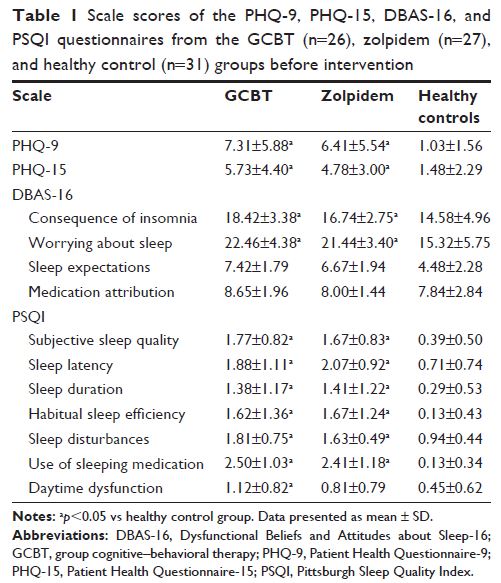
Methods: Before treatment and 16 weeks after intervention, participants were
evaluated using the Patient Health Questionnaires (Patient Health Questionnaire-9
[PHQ-9] and Patient Health Questionnaire-15 [PHQ-15]), the Dysfunctional
Beliefs and Attitudes about Sleep-16 (DBAS-16), and the Pittsburgh Sleep
Quality Index (PSQI).
Results: Compared to the zolpidem and healthy control groups, the scale
scores of PHQ-9, PHQ-15, DBAS-16 and PSQI were significantly reduced after
intervention in the GCBT group. Regarding the score changes, there were
correlations between PSQI, DBAS-16, PHQ-9, and PHQ-15 scales in the zolpidem
group, but there were limited correlations between PSQI and some DBAS-16 scales
in the GCBT group.
Conclusion: Our results indicate that GCBT is effective to treat insomnia by
improving sleep quality and reducing emotional and somatic disturbances; thus,
the study supports the advocacy of applying group psychotherapy to the
disorder.
Keywords: cognitive–behavioral therapy, group psychotherapy, insomnia