117333
论文已发表
注册即可获取德孚的最新动态
IF 收录期刊
- 3.6 Breast Cancer (Dove Med Press)
- 4.3 Clin Epidemiol
- 2.6 Cancer Manag Res
- 3.2 Infect Drug Resist
- 4.1 Clin Interv Aging
- 6.1 Drug Des Dev Ther
- 4.1 Int J Chronic Obstr
- 8.7 Int J Nanomed
- 2.5 Int J Women's Health
- 3.2 Neuropsych Dis Treat
- 2.4 OncoTargets Ther
- 2.6 Patient Prefer Adher
- 2.6 Ther Clin Risk Manag
- 3.1 J Pain Res
- 3.5 Diabet Metab Synd Ob
- 4.5 Psychol Res Behav Ma
- 3.4 Nat Sci Sleep
- 2.4 Pharmgenomics Pers Med
- 2.6 Risk Manag Healthc Policy
- 4.6 J Inflamm Res
- 2.3 Int J Gen Med
- 3.9 J Hepatocell Carcinoma
- 3.3 J Asthma Allergy
- 2.5 Clin Cosmet Investig Dermatol
- 3.0 J Multidiscip Healthc

氧化还原反应性 F127-叶酸/F127-二硫键接-D-α-生育酚聚乙二醇 1000 琥珀酸酯/P123 的混合胶束(负载紫杉醇)用于逆转肿瘤中的多药物抗性
Authors Lin J, Zhao CY, Liu CJ, Fu SY, Han LY, Lu XP, Yang CR
Received 23 September 2017
Accepted for publication 7 December 2017
Published 7 February 2018 Volume 2018:13 Pages 805—830
DOI https://doi.org/10.2147/IJN.S152395
Checked for plagiarism Yes
Review by Single-blind
Peer reviewers approved by Dr Govarthanan Muthusamy
Peer reviewer comments 3
Editor who approved publication: Dr Linlin Sun
Introduction: The
development of nanodrug carriers utilizing tumor microenvironment has become a
hotspot in reversing multidrug resistance (MDR).
Materials and
methods: This study synthesized a
redox-sensitive copolymer, Pluronic F127-disulfide bond-D-α-tocopheryl
polyethylene glycol 1000 succinate (FSST), through the connection of the
reduction-sensitive disulfide bond between F127 and D-α-tocopheryl polyethylene
glycol 1000 succinate. This polymer could induce the elevation of reactive
oxygen species (ROS) levels, ultimately resulting in cytotoxicity. Moreover,
the redox-responsive mixed micelles, F127-folate (FA)/FSST/P123 (FFSSTP), based
on FSST, Pluronic F127-FA, and Pluronic P123, were prepared to load paclitaxel
(PTX).
Results: The in vitro release study demonstrated that FFSSTP/PTX
accelerated the PTX release through the breakage of disulfide bond in reductive
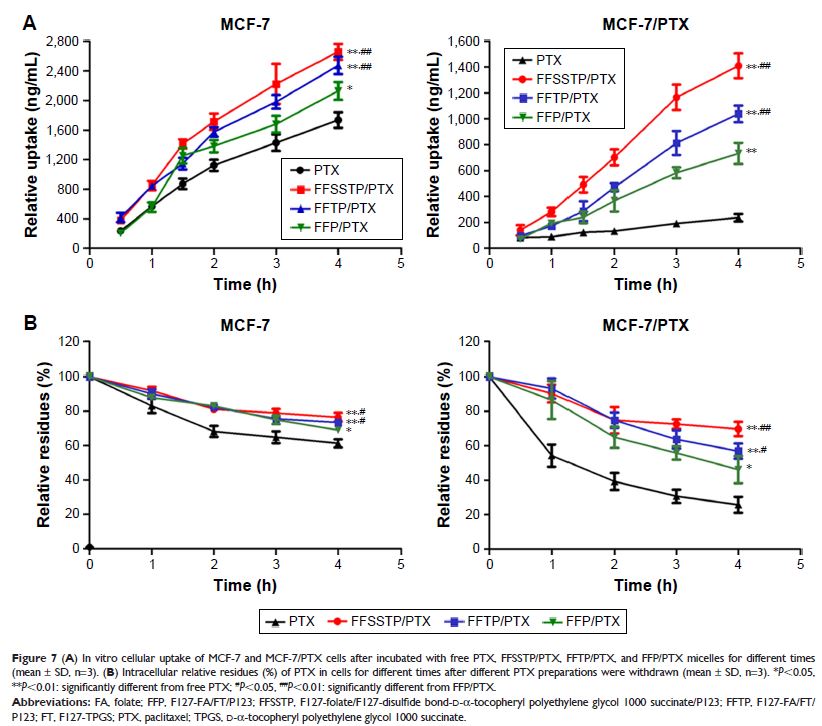
environment. In cellular experiment, FFSSTP/PTX induced significant apoptosis
in PTX-resistant MCF-7/PTX cells through inhibiting adenosine triphosphate
(ATP)-binding cassette proteins from pumping out PTX by interfering with the
mitochondrial function and ATP synthesis. Furthermore, FFSSTP/PTX induced
apoptosis through elevating the intracellular levels of ROS.
Conclusion: FFSSTP could become a potential carrier for the treatment of MDR
tumors.
Keywords: redox responsive, mixed micelles, multidrug resistance,
paclitaxel, tumor microenvironment