117333
论文已发表
注册即可获取德孚的最新动态
IF 收录期刊
- 3.6 Breast Cancer (Dove Med Press)
- 4.3 Clin Epidemiol
- 2.6 Cancer Manag Res
- 3.2 Infect Drug Resist
- 4.1 Clin Interv Aging
- 6.1 Drug Des Dev Ther
- 4.1 Int J Chronic Obstr
- 8.7 Int J Nanomed
- 2.5 Int J Women's Health
- 3.2 Neuropsych Dis Treat
- 2.4 OncoTargets Ther
- 2.6 Patient Prefer Adher
- 2.6 Ther Clin Risk Manag
- 3.1 J Pain Res
- 3.5 Diabet Metab Synd Ob
- 4.5 Psychol Res Behav Ma
- 3.4 Nat Sci Sleep
- 2.4 Pharmgenomics Pers Med
- 2.6 Risk Manag Healthc Policy
- 4.6 J Inflamm Res
- 2.3 Int J Gen Med
- 3.9 J Hepatocell Carcinoma
- 3.3 J Asthma Allergy
- 2.5 Clin Cosmet Investig Dermatol
- 3.0 J Multidiscip Healthc

高水平的 8-OHdG 是中风卒中后幸存者卒中后抑郁的独立预测因子
Authors Liu ZH, Cai Y, He J
Received 25 October 2017
Accepted for publication 9 January 2018
Published 19 February 2018 Volume 2018:14 Pages 587—596
DOI https://doi.org/10.2147/NDT.S155144
Checked for plagiarism Yes
Review by Single-blind
Peer reviewers approved by Prof. Dr. Roumen Kirov
Peer reviewer comments 3
Editor who approved publication: Professor Wai Kwong Tang
Purpose: Although
previous studies have investigated oxidative stress biomarkers in association
with depression in non-stroke subjects, the association between oxidative
deoxyribonucleic acid damage and post-stroke depression (PSD) remains
unelucidated.
Patients and
methods: Two hundred forty-one first-ever
ischemic stroke patients were consecutively recruited within the first 24 h of
stroke onset and were followed up at 1 month. Serum 8-hydroxy-2'-deoxyguanosine
(8-OHdG) and catalase (CAT) levels were measured within 24 h of admission using
a commercially available enzyme-linked immunosorbent assay. The 17-item
Hamilton Depression Scale was used to evaluate depressive symptoms. Diagnosis
of PSD was made in line with the Diagnostic and Statistical
Manual of Mental Disorders , 4th edition criteria for depression.
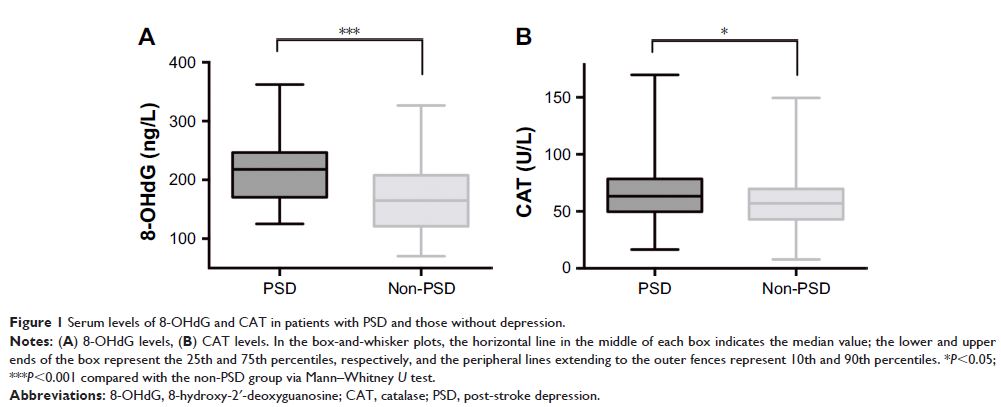
Results: Serum levels of 8-OHdG (P <0.001) and CAT
(P =0.025) increased in depressed
patients at admission. A positive correlation was found between the 8-OHdG and
CAT levels in both the total stroke patients (r =0.320, P <0.001) and the depressed
patients (r =0.300, P =0.012). The 8-OHdG levels were
positively correlated with the 17-item Hamilton Depression Scale scores (r =0.129, P =0.046) in depressed patients.
Multivariate analyses found that 8-OHdG levels ≥200.0 ng/L were independently
associated with PSD (odds ratio, 7.477; 95% CI, 3.342–16.289, P <0.001) after adjusting for
possible relevant confounders.
Conclusion: Higher serum 8-OHdG levels at admission were found to be
correlated with PSD 1 month after stroke.
Keywords: oxidative stress, 8-hydroxy-2'-deoxyguanosine, catalase,
depression, stroke