117333
论文已发表
注册即可获取德孚的最新动态
IF 收录期刊
- 3.6 Breast Cancer (Dove Med Press)
- 4.3 Clin Epidemiol
- 2.6 Cancer Manag Res
- 3.2 Infect Drug Resist
- 4.1 Clin Interv Aging
- 6.1 Drug Des Dev Ther
- 4.1 Int J Chronic Obstr
- 8.7 Int J Nanomed
- 2.5 Int J Women's Health
- 3.2 Neuropsych Dis Treat
- 2.4 OncoTargets Ther
- 2.6 Patient Prefer Adher
- 2.6 Ther Clin Risk Manag
- 3.1 J Pain Res
- 3.5 Diabet Metab Synd Ob
- 4.5 Psychol Res Behav Ma
- 3.4 Nat Sci Sleep
- 2.4 Pharmgenomics Pers Med
- 2.6 Risk Manag Healthc Policy
- 4.6 J Inflamm Res
- 2.3 Int J Gen Med
- 3.9 J Hepatocell Carcinoma
- 3.3 J Asthma Allergy
- 2.5 Clin Cosmet Investig Dermatol
- 3.0 J Multidiscip Healthc

SIRT1 过表达通过抑制 NF-κB 信号传导来保护非小细胞肺癌细胞,避免发生骨桥蛋白诱导的上皮 - 间充质转变
Authors Li X, Jiang Z, Li XM, Zhang X
Received 15 March 2017
Accepted for publication 5 May 2017
Published 2 March 2018 Volume 2018:11 Pages 1157—1171
DOI https://doi.org/10.2147/OTT.S137146
Checked for plagiarism Yes
Review by Single-blind
Peer reviewers approved by Dr Akshita Wason
Peer reviewer comments 2
Editor who approved publication: Dr XuYu Yang
Abstract: Osteopontin
(OPN) is a promoter for tumor progression. It has been reported to promote
non-small cell lung cancer (NSCLC) progression via the activation of nuclear
factor-κB (NF-κB) signaling. As the increased acetylation of NF-κB p65 is linked
to NF-κB activation, the regulation of NF-κB p65 acetylation could be a
potential treatment target for OPN-induced NSCLC progression. Sirtuin 1 (SIRT1)
is a deacetylase, and the role of SIRT1 in tumor progression is still
controversial. The effect and mechanism of SIRT1 on OPN-induced tumor
progression remains unknown. The results presented in this research
demonstrated that OPN inhibited SIRT1 expression and promoted NF-κB p65
acetylation in NSCLC cell lines (A549 and NCI-H358). In this article, overexpression
of SIRT1 was induced by infection of SIRT1-overexpressing lentiviral vectors.
The overexpression of SIRT1 protected NSCLC cells against OPN-induced NF-κB p65
acetylation and epithelial-mesenchymal transition (EMT), as indicated by the
reduction of OPN-induced changes in the expression levels of EMT-related
markers and cellular morphology. Furthermore, SIRT1 overexpression
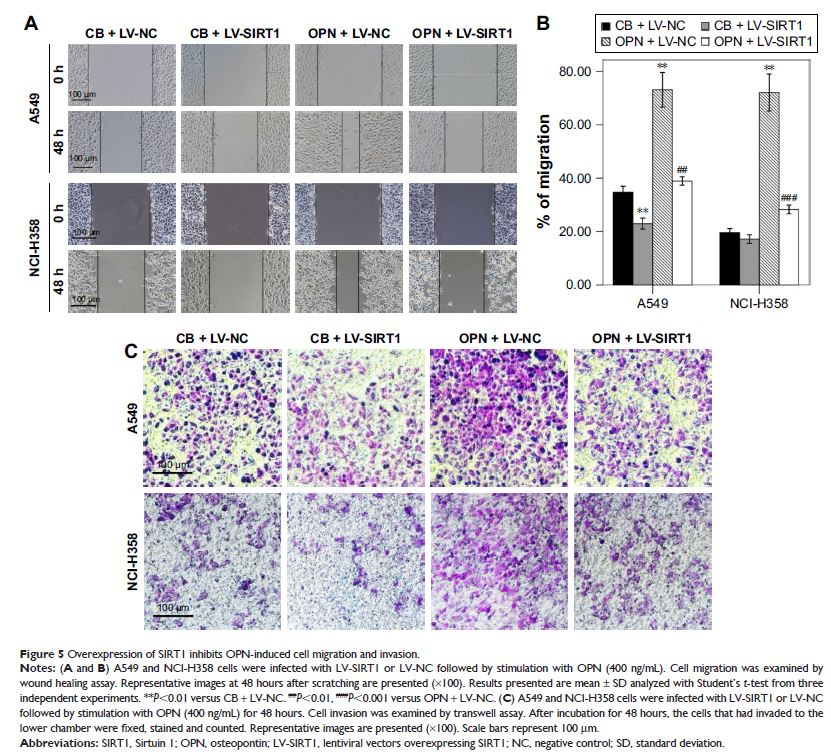
significantly attenuated OPN-induced cell proliferation, migration and
invasion. Moreover, overexpression of SIRT1 inhibited OPN-induced NF-κB
activation. As OPN induced NSCLC cell EMT through activation of NF-κB
signaling, OPN-induced SIRT1 downregulation may play an important role in NSCLC
cell EMT via NF-κB signaling. The results suggest that SIRT1 could be a tumor
suppressor to attenuate OPN-induced NSCLC progression through the regulation of
NF-κB signaling.
Keywords: OPN, SIRT1, EMT, NF-κB, NSCLC