117333
论文已发表
注册即可获取德孚的最新动态
IF 收录期刊
- 3.6 Breast Cancer (Dove Med Press)
- 4.3 Clin Epidemiol
- 2.6 Cancer Manag Res
- 3.2 Infect Drug Resist
- 4.1 Clin Interv Aging
- 6.1 Drug Des Dev Ther
- 4.1 Int J Chronic Obstr
- 8.7 Int J Nanomed
- 2.5 Int J Women's Health
- 3.2 Neuropsych Dis Treat
- 2.4 OncoTargets Ther
- 2.6 Patient Prefer Adher
- 2.6 Ther Clin Risk Manag
- 3.1 J Pain Res
- 3.5 Diabet Metab Synd Ob
- 4.5 Psychol Res Behav Ma
- 3.4 Nat Sci Sleep
- 2.4 Pharmgenomics Pers Med
- 2.6 Risk Manag Healthc Policy
- 4.6 J Inflamm Res
- 2.3 Int J Gen Med
- 3.9 J Hepatocell Carcinoma
- 3.3 J Asthma Allergy
- 2.5 Clin Cosmet Investig Dermatol
- 3.0 J Multidiscip Healthc

将 Tenuigenin 和 β-细辛醚结合应用可提高美金刚对治疗中度至重度阿尔茨海默病的疗效
Authors Chang W, Teng J
Received 30 October 2017
Accepted for publication 8 December 2017
Published 5 March 2018 Volume 2018:12 Pages 455—462
DOI https://doi.org/10.2147/DDDT.S155567
Checked for plagiarism Yes
Review by Single-blind
Peer reviewers approved by Dr Salvatore Bongarzone
Peer reviewer comments 2
Editor who approved publication: Dr Tuo Deng
Background: Alzheimer’s disease (AD) is a slowly progressive neurodegenerative
disease which cannot be cured at present. The aim of this study was to assess
whether the combined application of β-asarone and tenuigenin could improve the
efficacy of memantine in treating moderate-to-severe AD.
Patients and methods: One hundred and fifty-two patients with
moderate-to-severe AD were recruited and assigned to two groups. Patients in
the experiment group received β-asarone 10 mg/d, tenuigenin 10 mg/d, and
memantine 5–20 mg/d. Patients in the control group only received memantine 5–20
mg/d. The Mini Mental State Examination (MMSE), Clinical Dementia Rating Scale
(CDR), and Activities of Daily Living (ADL) were used to assess the therapeutic
effects. The drug-related adverse events were used to assess the safety and
acceptability. Treatment was continued for 12 weeks.
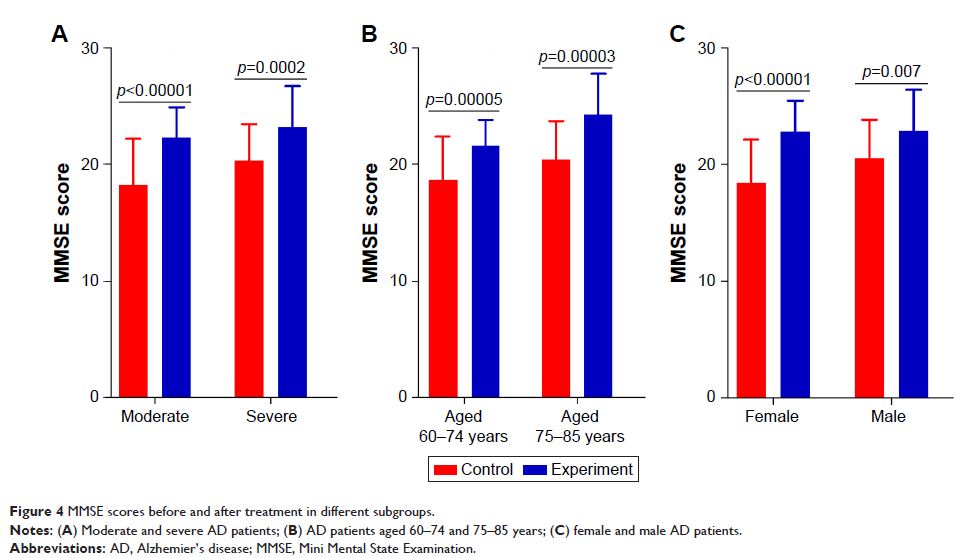
Results: After 12 weeks of treatment, the average MMSE scores,
ADL scores, and CDR scores in the two groups were significantly improved. But,
compared to the control group, the experimental group had a significantly
higher average MMSE score (p <0.00001),
lower average ADL score (p =0.00002), and
lower average CDR score (p =0.030).
Meanwhile, the rates of adverse events were similar between the two groups.
Subgroup analysis indicated that the most likely candidates to benefit from
this novel method might be the 60–74-years-old male patients with moderate AD.
Conclusion: These results demonstrated that the combined
application of β-asarone and tenuigenin could improve the efficacy of memantine
in treating moderate-to-severe AD. The clinical applicability of this novel
method showed greater promise and should be further explored.
Keywords: Alzheimer’s
disease, memantine, β-asarone, tenuigenin