117333
论文已发表
注册即可获取德孚的最新动态
IF 收录期刊
- 3.6 Breast Cancer (Dove Med Press)
- 4.3 Clin Epidemiol
- 2.6 Cancer Manag Res
- 3.2 Infect Drug Resist
- 4.1 Clin Interv Aging
- 6.1 Drug Des Dev Ther
- 4.1 Int J Chronic Obstr
- 8.7 Int J Nanomed
- 2.5 Int J Women's Health
- 3.2 Neuropsych Dis Treat
- 2.4 OncoTargets Ther
- 2.6 Patient Prefer Adher
- 2.6 Ther Clin Risk Manag
- 3.1 J Pain Res
- 3.5 Diabet Metab Synd Ob
- 4.5 Psychol Res Behav Ma
- 3.4 Nat Sci Sleep
- 2.4 Pharmgenomics Pers Med
- 2.6 Risk Manag Healthc Policy
- 4.6 J Inflamm Res
- 2.3 Int J Gen Med
- 3.9 J Hepatocell Carcinoma
- 3.3 J Asthma Allergy
- 2.5 Clin Cosmet Investig Dermatol
- 3.0 J Multidiscip Healthc

首发脑梗死急性期认知功能障碍与长期假性球病变进展的相关性
Authors Wang Y, Wang Y, Ma W, Lu S, Chen J, Cao L
Received 6 January 2018
Accepted for publication 1 February 2018
Published 28 March 2018 Volume 2018:14 Pages 871—877
DOI https://doi.org/10.2147/NDT.S161792
Checked for plagiarism Yes
Review by Single-blind
Peer reviewers approved by Dr Justinn Cochran
Peer reviewer comments 2
Editor who approved publication: Professor Wai Kwong Tang
Purpose: The relationship between cognitive impairment during the acute phase of
first cerebral infarction and the development of long-term pseudobulbar affect
(PBA) has not been elucidated. Therefore, in this study, we aimed to determine
if cognitive impairment during the acute phase of cerebral infarction will
increase the risk of long-term post-infarction PBA.
Patients and
methods: This was a nested case–control study
using a prospective approach.
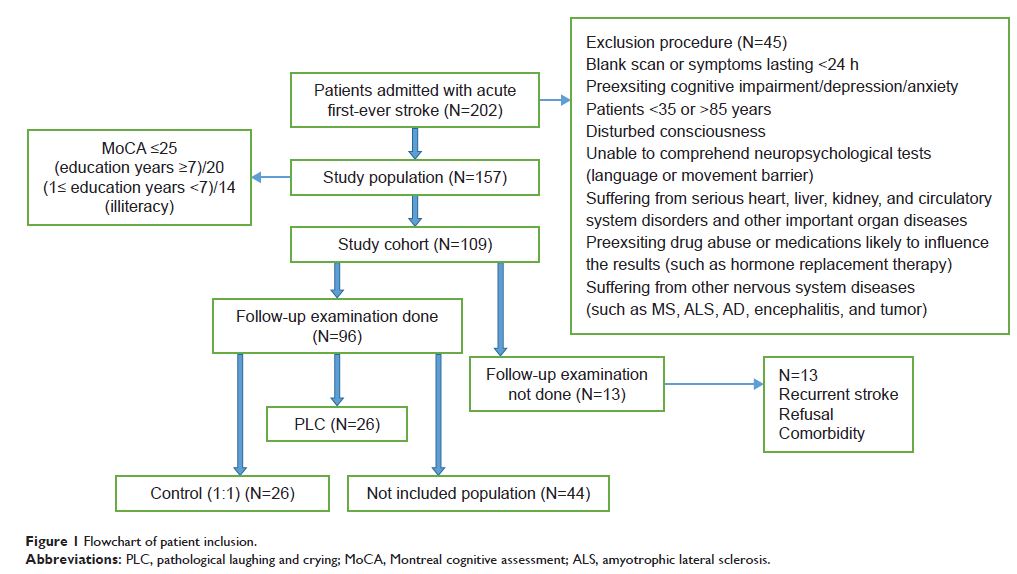
A consecutive multicenter matched 1:1
case–control study of cognitive impairment cases following acute cerebral
infarction (N=26) with 26 sex-, education years-, and age-matched controls.
Univariate and multivariate conditional logistic regression analyses were
performed to study the clinical features and changes in cognitive domain as
well as the risk factors for PBA.
Results: Long-term PBA was independently predicted by low Montreal cognitive
assessment (MoCA) scores at baseline. Multivariable regression models showed
that post-infarction low MoCA scores remained independent predictors of
long-term PBA (odds ratio [OR]=0.72; 95% confidence interval [CI]=0.54–0.95; P =0.018). Among all
cognitive disorders, digit span test (DST) scores (OR=0.39; 95%
CI=0.16–0.91, P =0.030), StroopC
time (OR=1.15; 95% CI=1.01–1.31; P =0.037), and
clock-drawing task (CDT) scores (OR=0.62; 95% CI=0.42–0.90; P =0.013) were found to be the independent
risk factors for PBA.
Conclusion: Cognitive impairment during the acute phase of cerebral infarction
increased the risk of cerebral infarction-induced long-term PBA. Development of
PBA was closely associated with executive function, attention, and visuospatial
disorder.
Keywords: cognitive impairment, pseudobulbar affect, cerebral infarction,
neuropsychological tests, cognitive domain