117518
论文已发表
注册即可获取德孚的最新动态
IF 收录期刊
- 3.6 Breast Cancer (Dove Med Press)
- 4.3 Clin Epidemiol
- 2.6 Cancer Manag Res
- 3.2 Infect Drug Resist
- 4.1 Clin Interv Aging
- 6.1 Drug Des Dev Ther
- 4.1 Int J Chronic Obstr
- 8.7 Int J Nanomed
- 2.5 Int J Women's Health
- 3.2 Neuropsych Dis Treat
- 2.4 OncoTargets Ther
- 2.6 Patient Prefer Adher
- 2.6 Ther Clin Risk Manag
- 3.1 J Pain Res
- 3.5 Diabet Metab Synd Ob
- 4.5 Psychol Res Behav Ma
- 3.4 Nat Sci Sleep
- 2.4 Pharmgenomics Pers Med
- 2.6 Risk Manag Healthc Policy
- 4.6 J Inflamm Res
- 2.3 Int J Gen Med
- 3.9 J Hepatocell Carcinoma
- 3.3 J Asthma Allergy
- 2.5 Clin Cosmet Investig Dermatol
- 3.0 J Multidiscip Healthc

Variation of diagnostic performance of fecal immunochemical testing for hemoglobin by sex and age: results from a large screening cohort
Authors Brenner H, Qian J, Werner S
Received 30 October 2017
Accepted for publication 31 December 2017
Published 5 April 2018 Volume 2018:10 Pages 381—389
DOI https://doi.org/10.2147/CLEP.S155548
Checked for plagiarism Yes
Review by Single-blind
Peer reviewers approved by Dr Cristina Weinberg
Peer reviewer comments 3
Editor who approved publication: Professor Vera Ehrenstein
Objective: Fecal immunochemical tests (FITs) for hemoglobin in stool are
increasingly used for colorectal cancer screening. Reported sensitivities and
specificities have strongly varied between studies, but it is unclear to what
extent such variation reflects differences between tests or between study
population characteristics. We aimed to evaluate the key parameters of FIT
performance for detecting advanced neoplasia (AN) according to sex and age.
Methods: Sex- and age-specific sensitivity, specificity, positive predictive
values (PPVs) and negative predictive values (NPVs) for detecting AN of a
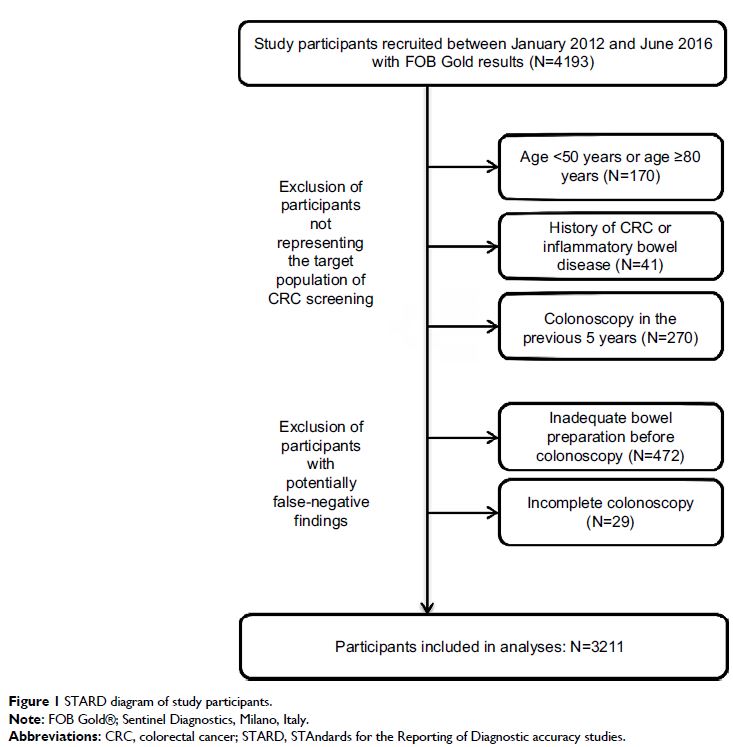
quantitative FIT (FOB Gold®) were evaluated among 3211 men and women aged 50–79
years who underwent screening colonoscopy in Germany.
Results: At the cutoff recommended by the manufacturer (17 µg hemoglobin/g
feces), sensitivity was higher (51.2% versus 34.7%, p =0.004) and specificity was lower
(91.0% versus 94.8%, p <0.001) among
65–79 year-old participants compared with 50–64 year-old participants. PPVs and
NPVs did not differ significantly between age groups. However, higher NPVs were
observed among women compared with men (94.7% versus 92.5%, p =0.015). Specificity was also
higher among women compared with men (94.7% versus 92.3%, p =0.007), while there was only a
little variation in sensitivity (40.3% versus 41.8%, p =0.789) according to sex. In
joint stratification by both factors, sensitivity ranged from 34.1% (95% CI
24.2%–45.2%) in 50–64 year-old women to 51.4% (95% CI 39.3%–63.3%) in 65–79
year-old men (p =0.029). The observed age and sex
differences were highly consistent across a wide range of alternative cutoffs
from 10 to 50 µg hemoglobin/g feces.
Conclusion: There are major differences in diagnostic performance parameters
according to sex and age, which should receive careful attention in the
interpretation and comparison of results of FIT-based colorectal cancer
screening studies.
Keywords: colorectal cancer, fecal immunochemical tests, hemoglobin,
screening