117518
论文已发表
注册即可获取德孚的最新动态
IF 收录期刊
- 3.6 Breast Cancer (Dove Med Press)
- 4.3 Clin Epidemiol
- 2.6 Cancer Manag Res
- 3.2 Infect Drug Resist
- 4.1 Clin Interv Aging
- 6.1 Drug Des Dev Ther
- 4.1 Int J Chronic Obstr
- 8.7 Int J Nanomed
- 2.5 Int J Women's Health
- 3.2 Neuropsych Dis Treat
- 2.4 OncoTargets Ther
- 2.6 Patient Prefer Adher
- 2.6 Ther Clin Risk Manag
- 3.1 J Pain Res
- 3.5 Diabet Metab Synd Ob
- 4.5 Psychol Res Behav Ma
- 3.4 Nat Sci Sleep
- 2.4 Pharmgenomics Pers Med
- 2.6 Risk Manag Healthc Policy
- 4.6 J Inflamm Res
- 2.3 Int J Gen Med
- 3.9 J Hepatocell Carcinoma
- 3.3 J Asthma Allergy
- 2.5 Clin Cosmet Investig Dermatol
- 3.0 J Multidiscip Healthc

呼出气一氧化氮和痰嗜酸粒细胞都与不受控制的哮喘有关
Authors Gao J, Chen ZC, Jie X, Ye RH, Wu F
Received 27 October 2017
Accepted for publication 4 December 2017
Published 10 April 2018 Volume 2018:11 Pages 73—79
DOI https://doi.org/10.2147/JAA.S155379
Checked for plagiarism Yes
Review by Single-blind
Peer reviewers approved by Dr Colin Mak
Peer reviewer comments 3
Editor who approved publication: Dr Luis Garcia-Marcos
Background: Sputum eosinophil and fractional exhaled nitric oxide (FeNO),
noninvasive biomarkers of local eosinophilic airway inflammation, can be used
to assess asthma outcome. Nevertheless, the clinical application of the
association between FeNO and sputum eosinophil is controversial. The aim of the
study was to investigate the predictive relationship between FeNO and sputum
eosinophil in uncontrolled asthmatic patients and the correlation between
sputum eosinophil and FeNO in bronchial reversibility and bronchial
hyperresponsiveness (BHR).
Methods: A total of 69 uncontrolled asthmatic patients were included in the
study. All patients underwent a clinical assessment on the same day as follows:
FeNO, spirometry with BHR or bronchodilator reversibility test and induced
sputum in turn. Eosinophilic airway inflammation was defined as sputum
eosinophil percentage (≥2.5%)/FeNO level (≥32 parts per billion [ppb]).
Results: FeNO level and sputum neutrophilic percentage were higher in the
sputum eosinophilia group compared to those without (49 versus 27, p =0.011; 71.12 versus 87.67, p =0.012, respectively).
Sputum eosinophil percentage was higher with raised FeNO level compared to
those without (10.3% versus 2.75%, p =0.03). A
significant correlation was observed between sputum eosinophil percentage and
FeNO level (r =0.4016; p =0.0006). There were no
significant relationships between sputum eosinophilic percentage and
provocative dose (PD20)/∆FEV1 (improvement in a
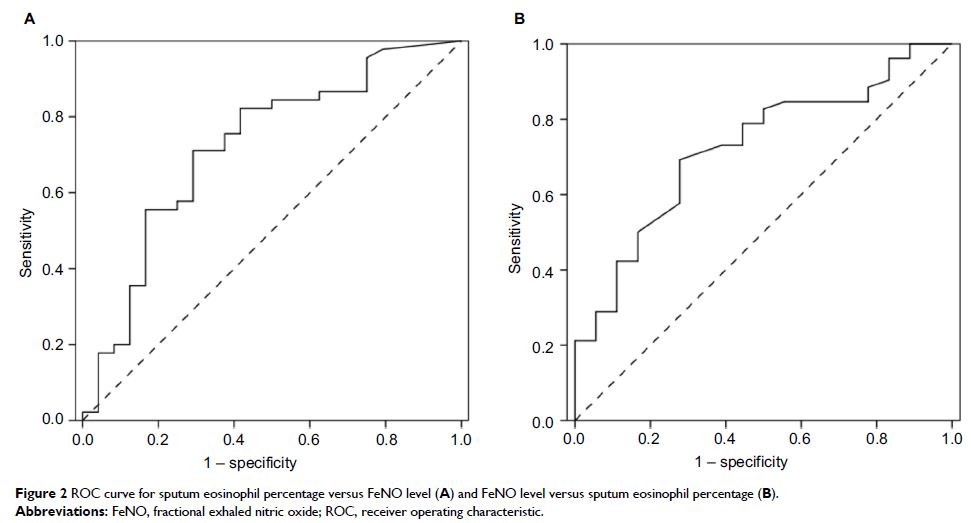
forced expiratory volume in 1 second [FEV1] after 400μg of salbutamol), FeNO levels and PD20/∆FEV1. The FeNO level of
35.5 ppb was effective in assessing sputum eosinophilia, with a receiver
operating characteristic area under curve (AUC) of 0.707 (p =0.011; 95% confidence interval
[CI] 0.573–0.841), and 4.36% was the best diagnostic cutoff value of sputum
eosinophil percentage for the FeNO level of 32 ppb (AUC 0.721; 95% CI
0.59–0.852).
Conclusion: FeNO level can accurately detect eosinophilic asthma but has limited
value to assess noneosinophilic asthma in uncontrolled stage. Further studies
are required to validate the use of FeNO level to determine an optimal cutoff
for sputum eosinophilia that could be used in clinical practice.
Keywords: FeNO, sputum eosinophil, bronchial reversibility, BHR, asthma