117518
论文已发表
注册即可获取德孚的最新动态
IF 收录期刊
- 3.6 Breast Cancer (Dove Med Press)
- 4.3 Clin Epidemiol
- 2.6 Cancer Manag Res
- 3.2 Infect Drug Resist
- 4.1 Clin Interv Aging
- 6.1 Drug Des Dev Ther
- 4.1 Int J Chronic Obstr
- 8.7 Int J Nanomed
- 2.5 Int J Women's Health
- 3.2 Neuropsych Dis Treat
- 2.4 OncoTargets Ther
- 2.6 Patient Prefer Adher
- 2.6 Ther Clin Risk Manag
- 3.1 J Pain Res
- 3.5 Diabet Metab Synd Ob
- 4.5 Psychol Res Behav Ma
- 3.4 Nat Sci Sleep
- 2.4 Pharmgenomics Pers Med
- 2.6 Risk Manag Healthc Policy
- 4.6 J Inflamm Res
- 2.3 Int J Gen Med
- 3.9 J Hepatocell Carcinoma
- 3.3 J Asthma Allergy
- 2.5 Clin Cosmet Investig Dermatol
- 3.0 J Multidiscip Healthc

双功能噬菌体与光敏剂缀合用于白色念珠菌 - 靶向光动力钝化作用
Authors Dong S, Shi H, Zhang X, Chen X, Cao D, Mao C, Gao X, Wang L
Received 12 November 2017
Accepted for publication 24 January 2018
Published 11 April 2018 Volume 2018:13 Pages 2199—2216
DOI https://doi.org/10.2147/IJN.S156815
Checked for plagiarism Yes
Review by Single-blind
Peer reviewers approved by Dr Farooq Shiekh
Peer reviewer comments 3
Editor who approved publication: Dr Linlin Sun
Background: Candida
albicans is the most prevalent fungal pathogen of
the human microbiota, causing infections ranging from superficial infections of
the skin to life-threatening systemic infections. Due to the increasing
occurrence of antibiotic-resistant C. albicans strains,
new approaches to control this pathogen are needed. Photodynamic inactivation
is an emerging alternative to treat infections based on the interactions
between visible light and photosensitisers, in which pheophorbide a (PPA) is a
chlorophyll-based photosensitizer that could induce cell death after light
irradiation. Due to PPA’s phototoxicity and low efficiency, the main challenge
is to implement photosensitizer cell targeting and attacking.
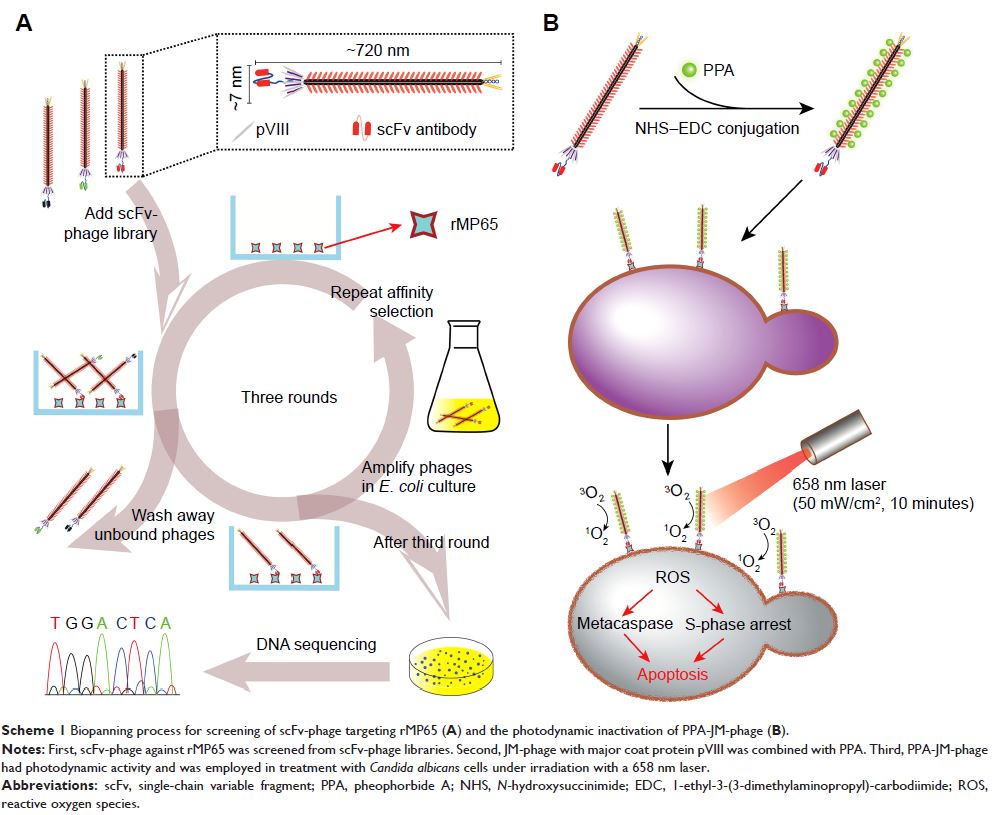
Methods: In this study, PPA was conjugated with JM-phage
by EDC/NHS crosslinking. UV-Vis spectra was used to determine the optimum
conjugation percentages of PPA and JM-phage complex for photodynamic
inactivation. After photodynamic inactivation, the efficacy of PPA-JM-phage was
assessed by performing in vitro experiments, such as MTS assay, scanning electron
microscopy, measurement of dysfunctional mitochondria, ROS accumulation, S cell
arrest and apoptotic pathway.
Results: A single-chain variable-fragment phage (JM) with high
affinity to MP65 was screened from human single-fold single-chain variable-fragment
libraries and designed as a binding target for C.
albicans cells. Subsequently, PPa was integrated into JM phage
to generate a combined nanoscale material, which was called PPA-JM-phage. After
photodynamic inactivation, the growth of C.
albicans was inhibited by PPA-JM-phage and apoptosis was observed.
Scanning electron microscopy analysis revealed shrinking and rupturing of C. albicans . We also found that
depolarization of mitochondrial membrane potential was decreased and
intracellular reactive oxygen species levels were elevated significantly
in C. albicans inhibited by
PPA-JM-phage. Additionally, PPA-JM-phage also lead to S-phase arrest, and
metacaspase activation resulting from mitochondrial dysfunction was also found
to be involved in C. albicans apoptosis.
Conclusion: PPa-JM-phage may induce C. albicans apoptosis through
a caspase-dependent pathway and the results herein shed light on the potential
application of phtototherapeutic nanostructures in fungal inactivation.
Keywords: PPA, phage,
photodynamic therapy, apoptosis, metacaspase