117518
论文已发表
注册即可获取德孚的最新动态
IF 收录期刊
- 3.6 Breast Cancer (Dove Med Press)
- 4.3 Clin Epidemiol
- 2.6 Cancer Manag Res
- 3.2 Infect Drug Resist
- 4.1 Clin Interv Aging
- 6.1 Drug Des Dev Ther
- 4.1 Int J Chronic Obstr
- 8.7 Int J Nanomed
- 2.5 Int J Women's Health
- 3.2 Neuropsych Dis Treat
- 2.4 OncoTargets Ther
- 2.6 Patient Prefer Adher
- 2.6 Ther Clin Risk Manag
- 3.1 J Pain Res
- 3.5 Diabet Metab Synd Ob
- 4.5 Psychol Res Behav Ma
- 3.4 Nat Sci Sleep
- 2.4 Pharmgenomics Pers Med
- 2.6 Risk Manag Healthc Policy
- 4.6 J Inflamm Res
- 2.3 Int J Gen Med
- 3.9 J Hepatocell Carcinoma
- 3.3 J Asthma Allergy
- 2.5 Clin Cosmet Investig Dermatol
- 3.0 J Multidiscip Healthc

二萜银杏内酯在前额叶皮质中发挥与代谢产物有关的抗抑郁作用
Authors Hu Q, Shen P, Bai S, Dong M, Liang Z, Chen Z, Wang W, Wang H, Gui S, Li P, Xie P
Received 3 January 2018
Accepted for publication 23 February 2018
Published 13 April 2018 Volume 2018:14 Pages 999—1011
DOI https://doi.org/10.2147/NDT.S161351
Checked for plagiarism Yes
Review by Single-blind
Peer reviewers approved by Dr Andrew Yee
Peer reviewer comments 2
Editor who approved publication: Professor Wai Kwong Tang
Purpose: Ginkgo biloba extract (GBE)
contains diterpene ginkgolides (DGs), which have been shown to have
neuroprotective effects by a number of previous studies. We previously
demonstrated part of the action of DG. However, the impact of DG on the
prefrontal cortex (PFC) remains unclear. Here, we evaluated the effects of DG
and venlafaxine (for comparison) on behavioral and metabolite changes in the
PFC using mice models and gas chromatography–mass spectrometry-based metabolomics.
Materials and
methods: Mice were randomly divided into
control (saline), DG (12.18 mg/kg) and venlafaxine (16 mg/kg) groups. After 2
weeks of treatment, depression and anxiety-related behavioral tests were
performed. Metabolic profiles of the PFC were detected by gas
chromatography–mass spectrometry.
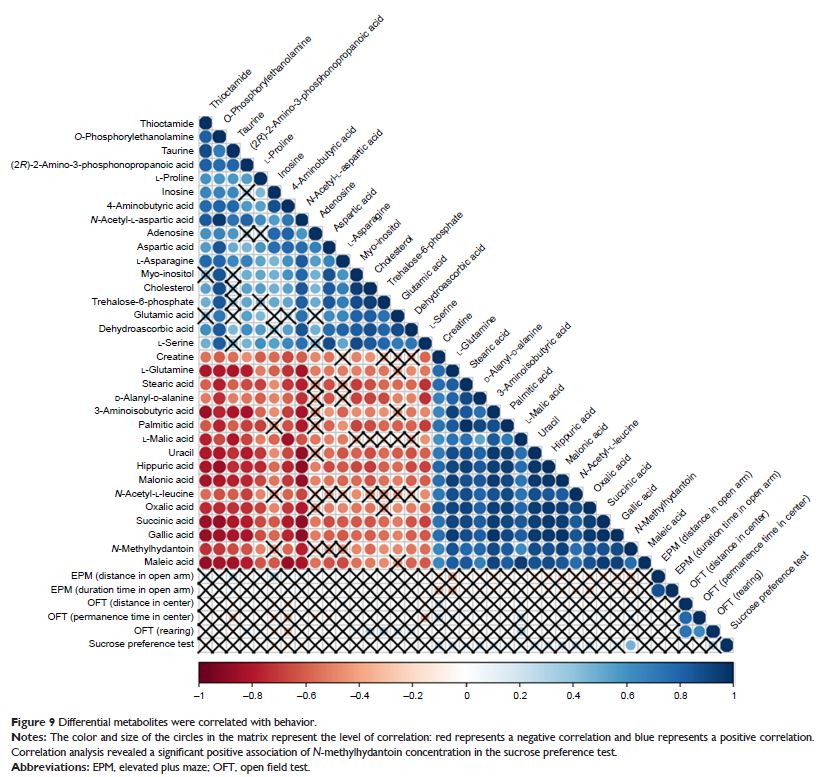
Results: The DG group exhibited positive effects in the sucrose preference test.
The differential metabolites were mainly related to amino acid metabolism,
energy metabolism and lipid metabolism. The results indicated that the DG group
exhibited perturbed lipid metabolism, molecular transport and small-molecule
biochemistry in the PFC. Compared with the control group, pathway analysis
indicated that venlafaxine and DG had similar effects on alanine, aspartate and
glutamate metabolism.
Conclusion: These findings demonstrate that DG has antidepressant-like, but
not anxiolytic-like, effects in mice, suggesting that it might have therapeutic
potential for the treatment of major depressive disorder.
Keywords: diterpene ginkgolides, antidepressant, metabolomics, prefrontal cortex,
depressive disorder