115195
论文已发表
注册即可获取德孚的最新动态
IF 收录期刊
- 3.6 Breast Cancer (Dove Med Press)
- 4.3 Clin Epidemiol
- 2.6 Cancer Manag Res
- 3.2 Infect Drug Resist
- 4.1 Clin Interv Aging
- 6.1 Drug Des Dev Ther
- 4.1 Int J Chronic Obstr
- 8.7 Int J Nanomed
- 2.5 Int J Women's Health
- 3.2 Neuropsych Dis Treat
- 2.4 OncoTargets Ther
- 2.6 Patient Prefer Adher
- 2.6 Ther Clin Risk Manag
- 3.1 J Pain Res
- 3.5 Diabet Metab Synd Ob
- 4.5 Psychol Res Behav Ma
- 3.4 Nat Sci Sleep
- 2.4 Pharmgenomics Pers Med
- 2.6 Risk Manag Healthc Policy
- 4.6 J Inflamm Res
- 2.3 Int J Gen Med
- 3.9 J Hepatocell Carcinoma
- 3.3 J Asthma Allergy
- 2.5 Clin Cosmet Investig Dermatol
- 3.0 J Multidiscip Healthc

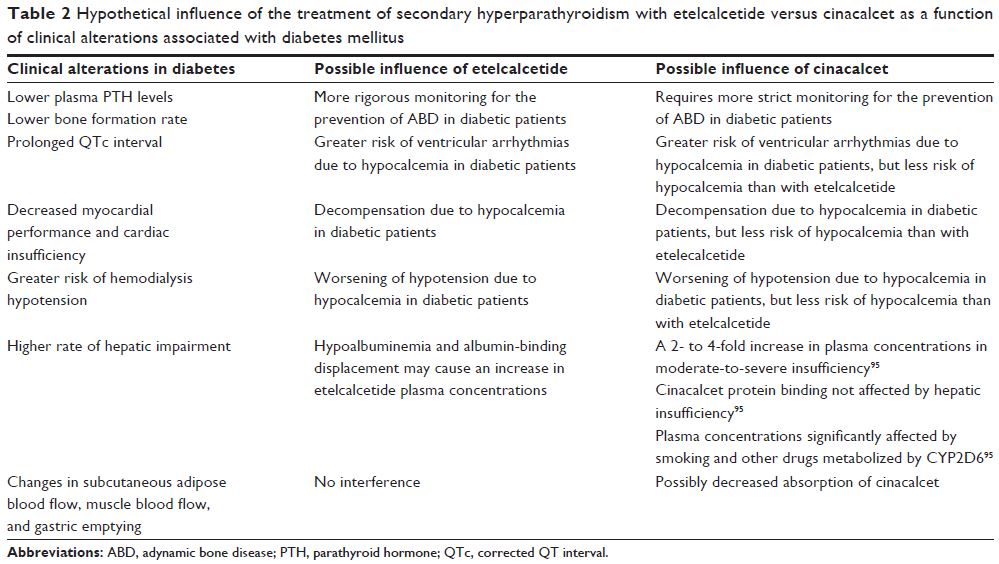
接受血液透析的糖尿病患者使用地泰卡汀的临床和药理学影响的理论概述
Authors Ye J, Deng G, Gao F
Received 19 December 2017
Accepted for publication 6 March 2018
Published 19 April 2018 Volume 2018:12 Pages 901—909
DOI https://doi.org/10.2147/DDDT.S160223
Checked for plagiarism Yes
Review by Single-blind
Peer reviewers approved by Dr Ashok Kumar Pandurangan
Peer reviewer comments 3
Editor who approved publication: Dr Anastasios Lymperopoulos
Abstract: Etelcalcetide is the first intravenous calcimimetic agent
authorized for the treatment of secondary hyperparathyroidism (sHPT) in
patients undergoing hemodialysis in Europe, the US, and Japan. The relationship
between sHPT and diabetes resides on complex, bidirectional effects and largely
unknown homeostatic mechanisms. Although 30% or more patients with end-stage
renal disease are diabetics and about the same percentage of those patients
suffer from sHPT associated with hemodialysis, no data on the specificities of
the use of etelcalcetide in such patients are available yet. Regarding
pharmacokinetic interactions, etelcalcetide may compete with oral hypoglycemics
recommended for use in patients undergoing hemodialysis and insulins detemir
and degludec, causing unexpected hypocalcemia or hypoglycemia. More
importantly, hypocalcemia, a common side effect of etelcalcetide, may cause
decompensation of preexisting cardiac insufficiency in diabetic patients or
worsen dialysis-related hypotension and lead to hypotension-related cardiac
events, such as myocardial ischemia. In diabetic patients, hypocalcemia may
lead to dangerous ventricular arrhythmias, as both insulin-related hypoglycemia
and hemodialysis prolong QT interval. Patients with diabetes, therefore, should
be strictly monitored for hypocalcemia and associated effects. Due to an
altered parathormone activity in this patient group, plasma calcium should be
the preferred indicator of etelcalcetide effects. Until more clinical
experience with etelcalcetide is available, the clinicians should be cautious
when using this calcimimetic in patients with diabetes.
Keywords: glucose intolerance, renal impairment, calcimimetic, type 2
diabetes, hyperparathyroidism, parathyroid hormone