115195
论文已发表
注册即可获取德孚的最新动态
IF 收录期刊
- 3.6 Breast Cancer (Dove Med Press)
- 4.3 Clin Epidemiol
- 2.6 Cancer Manag Res
- 3.2 Infect Drug Resist
- 4.1 Clin Interv Aging
- 6.1 Drug Des Dev Ther
- 4.1 Int J Chronic Obstr
- 8.7 Int J Nanomed
- 2.5 Int J Women's Health
- 3.2 Neuropsych Dis Treat
- 2.4 OncoTargets Ther
- 2.6 Patient Prefer Adher
- 2.6 Ther Clin Risk Manag
- 3.1 J Pain Res
- 3.5 Diabet Metab Synd Ob
- 4.5 Psychol Res Behav Ma
- 3.4 Nat Sci Sleep
- 2.4 Pharmgenomics Pers Med
- 2.6 Risk Manag Healthc Policy
- 4.6 J Inflamm Res
- 2.3 Int J Gen Med
- 3.9 J Hepatocell Carcinoma
- 3.3 J Asthma Allergy
- 2.5 Clin Cosmet Investig Dermatol
- 3.0 J Multidiscip Healthc

基于核磁共振的代谢组学方案测定大鼠对核壳结构 Fe3O4@SiO2-NH2 纳米颗粒的生物学反应
Authors Yuan ZX, Xu R, Li JQ, Chen YL, Wu BH, Feng JH, Chen Z
Received 24 November 2017
Accepted for publication 25 January 2018
Published 23 April 2018 Volume 2018:13 Pages 2447—2462
DOI https://doi.org/10.2147/IJN.S158022
Checked for plagiarism Yes
Review by Single-blind
Peer reviewers approved by Dr Govarthanan Muthusamy
Peer reviewer comments 2
Editor who approved publication: Dr Lei Yang
Background: Core–shell-structured nanoparticles (NPs) have attracted much
scientific attention due to their promising potential in biomedical fields in
recent years. However, their underlying mechanisms of action and potential
adverse effects following administration remain unknown.
Methods: In the present study, a 1H nuclear magnetic resonance-based metabonomic
strategy was applied to investigate the metabolic consequences in rats
following the intravenous administration of parent NPs of core–shell-structured
nanoparticles, Fe3O4@SiO2-NH2 (Fe@Si)
NPs.
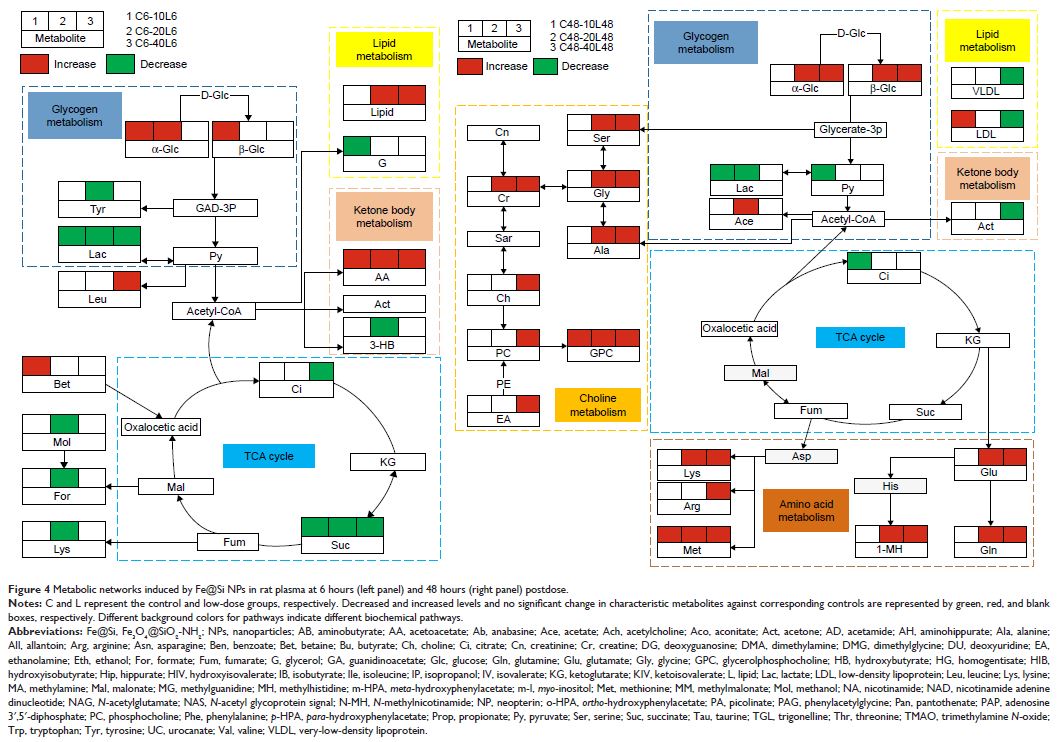
Results: Alterations reflected in plasma and urinary
metabonomes indicated that Fe@Si NPs induced metabolic perturbation in choline,
ketone-body, and amino-acid metabolism besides the common metabolic disorders
in tricarboxylic acid cycle, lipids, and glycogen metabolism often induced by
the exogenous agents. Additionally, intestinal flora metabolism and the urea
cycle were also influenced by Fe@Si NP exposure. Time-dependent biological
effects revealed obvious metabolic regression, dose-dependent biological
effects implied different biochemical mechanisms between low- and high-dose
Fe@Si NPs, and size-dependent biological effects provided potential windows for
size optimization.
Conclusion: Nuclear magnetic resonance-based metabonomic
analysis helps in understanding the biological mechanisms of Fe@Si NPs,
provides an identifiable ground for the selection of view windows, and further
serves the clinical translation of Fe@Si NP-derived and -modified bioprobes or
bioagents.
Keywords: core–shell
structure, biomedical nanoparticles, metabonomics, NMR, biological effects