115195
论文已发表
注册即可获取德孚的最新动态
IF 收录期刊
- 3.6 Breast Cancer (Dove Med Press)
- 4.3 Clin Epidemiol
- 2.6 Cancer Manag Res
- 3.2 Infect Drug Resist
- 4.1 Clin Interv Aging
- 6.1 Drug Des Dev Ther
- 4.1 Int J Chronic Obstr
- 8.7 Int J Nanomed
- 2.5 Int J Women's Health
- 3.2 Neuropsych Dis Treat
- 2.4 OncoTargets Ther
- 2.6 Patient Prefer Adher
- 2.6 Ther Clin Risk Manag
- 3.1 J Pain Res
- 3.5 Diabet Metab Synd Ob
- 4.5 Psychol Res Behav Ma
- 3.4 Nat Sci Sleep
- 2.4 Pharmgenomics Pers Med
- 2.6 Risk Manag Healthc Policy
- 4.6 J Inflamm Res
- 2.3 Int J Gen Med
- 3.9 J Hepatocell Carcinoma
- 3.3 J Asthma Allergy
- 2.5 Clin Cosmet Investig Dermatol
- 3.0 J Multidiscip Healthc

纳米二氧化钛诱导的卵巢早衰与雌性小鼠血清参数的异常有关
Authors Hong F, Wang L
Received 18 December 2017
Accepted for publication 17 February 2018
Published 27 April 2018 Volume 2018:13 Pages 2543—2549
DOI https://doi.org/10.2147/IJN.S151215
Checked for plagiarism Yes
Review by Single-blind
Peer reviewers approved by Dr Alexander Kharlamov
Peer reviewer comments 3
Editor who approved publication: Dr Linlin Sun
Background: Exposure
to titanium dioxide nanoparticles (TiO2 NPs) that are widely used in food, medicine, sunscreen products
and cosmetics is reported to cause ovarian damage and lower fertility in
animals. However, the potential effects of TiO2 NPs application on premature ovarian failure (POF) have rarely
been evaluated to date.
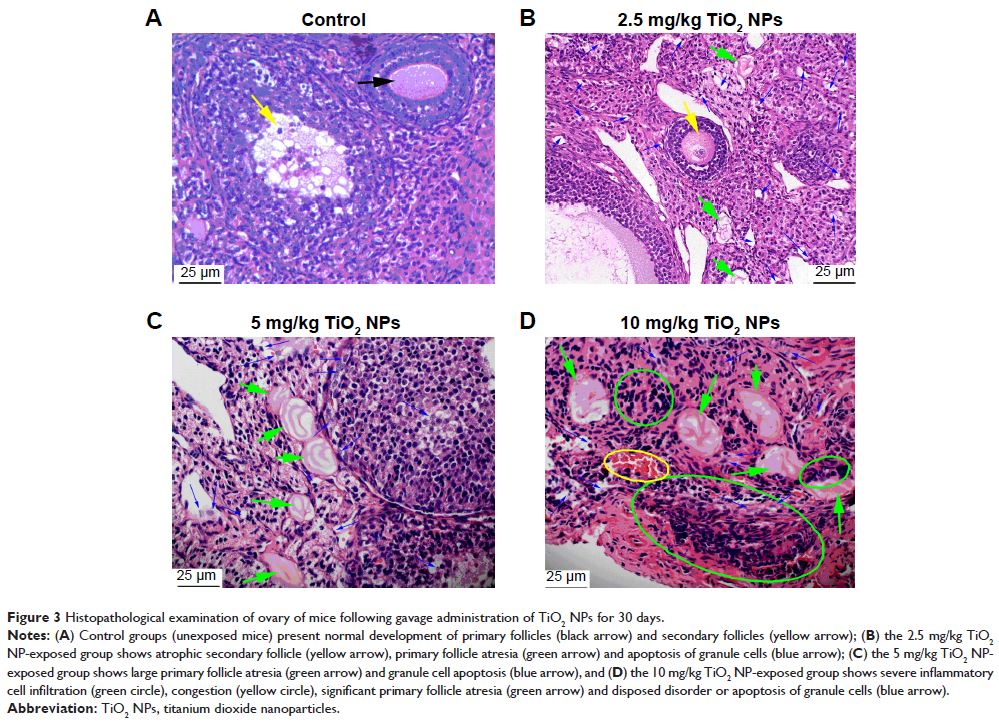
Methods: In this study, female mice were continuously exposed to TiO2 NPs at doses of 2.5, 5 or 10 mg/kg via gavage instillation for 30
days, and investigated the serum hormones and autoimmunity markers associated
with POF.
Results: Exposure to TiO2 NPs resulted in POF, reductions in the levels of estradiol,
progesterone and inhibin B and increases in luteinizing hormone,
follicle-stimulating hormone, follicle-stimulating hormone/luteinizing hormone
ratio, anti-Müllerian hormone, thyroid-stimulating hormone, free
triiodothyronine, free tetraiodothyronine, anti-nuclear antibody and
anti-thyroid peroxidase antibody levels in serum.
Conclusion: Exposure to TiO2 NPs induced POF triggered by alterations in hormones and
autoimmunity markers. Our findings highlight the necessity for significant
caution in handling and usage of TiO2 NPs by female consumers.
Keywords: titanium dioxide nanoparticles, mice, premature ovarian failure,
serum hormone levels, autoimmunity levels