115195
论文已发表
注册即可获取德孚的最新动态
IF 收录期刊
- 3.6 Breast Cancer (Dove Med Press)
- 4.3 Clin Epidemiol
- 2.6 Cancer Manag Res
- 3.2 Infect Drug Resist
- 4.1 Clin Interv Aging
- 6.1 Drug Des Dev Ther
- 4.1 Int J Chronic Obstr
- 8.7 Int J Nanomed
- 2.5 Int J Women's Health
- 3.2 Neuropsych Dis Treat
- 2.4 OncoTargets Ther
- 2.6 Patient Prefer Adher
- 2.6 Ther Clin Risk Manag
- 3.1 J Pain Res
- 3.5 Diabet Metab Synd Ob
- 4.5 Psychol Res Behav Ma
- 3.4 Nat Sci Sleep
- 2.4 Pharmgenomics Pers Med
- 2.6 Risk Manag Healthc Policy
- 4.6 J Inflamm Res
- 2.3 Int J Gen Med
- 3.9 J Hepatocell Carcinoma
- 3.3 J Asthma Allergy
- 2.5 Clin Cosmet Investig Dermatol
- 3.0 J Multidiscip Healthc

NOX 家族的成员在胃癌中的基因表达及预后
Authors You X, Ma M, Hou G, Hu Y, Shi X
Received 4 January 2018
Accepted for publication 27 March 2018
Published 24 May 2018 Volume 2018:11 Pages 3065—3074
DOI https://doi.org/10.2147/OTT.S161287
Checked for plagiarism Yes
Review by Single-blind
Peer reviewers approved by Dr Cristina Weinberg
Peer reviewer comments 2
Editor who approved publication: Dr Carlos Vigil Gonzales
Introduction: Nicotinamide adenine dinucleotide phosphate (NADPH) oxidases (NOX)
are frequently deregulated in several human malignancies, including gastric
cancer (GC). NOX-derived reactive oxygen species have been reported to
contribute to gastric carcinogenesis and cancer progression. However, the
expression and prognostic role of individual NOX in GC patients remain elusive.
Methods and materials: We investigated genetic alteration and mRNA
expression of NOX family in GC patients via the cBioPortal, Human Protein
Atlas, and Oncomine databases. Furthermore, we evaluated prognostic value of
distinct NOX in GC patients through “The Kaplan–Meier plotter” database.
Results: Our
analysis demonstrated that mRNA deregulation of NOX genes was common alteration
in GC patients. Compared with normal tissues, NOX1/2/4 mRNA expression levels
in GC tissues were higher, while NOX5 and DUOX1/2 expression levels were lower.
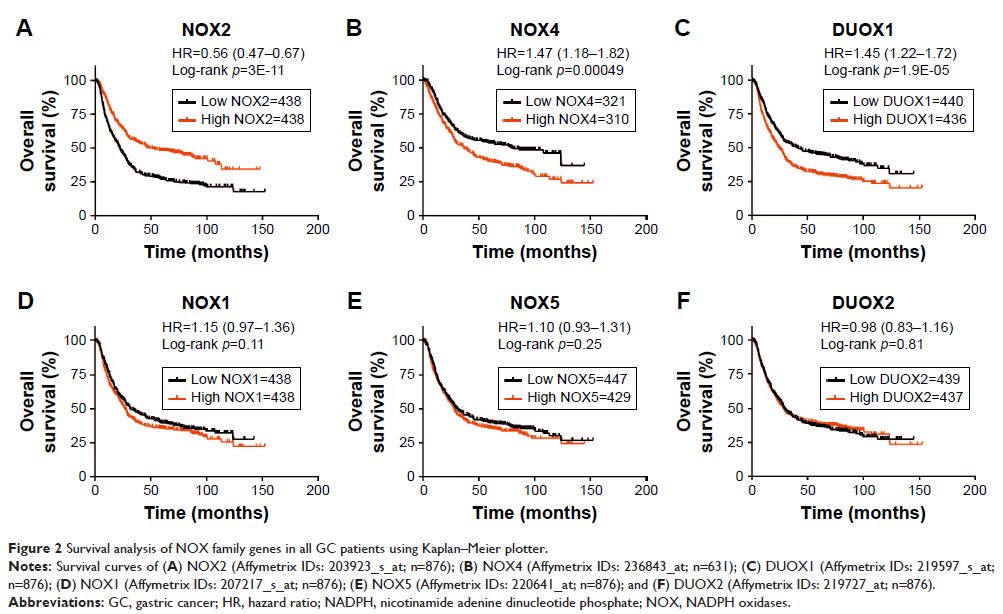
Importantly, our results indicated that high mRNA expression of NOX2 was
associated with better overall survival whereas NOX4 and DUOX1 were correlated
with worse overall survival in all GC patients, particularly in intestinal-type
GC patients. In addition, our data also shed light on the diverse roles of
individual NOX members in GC patients with different clinicopathological
features, including human epidermal growth factor receptor 2 status, clinical
stages, pathological grades, and different choices of treatments of GC
patients.
Conclusion: These
findings suggest that individual NOX family genes, especially NOX2/4, and
DUOX1, are potential prognostic markers in GC and implicate that the use of NOX
inhibitor targeting NOX4 and DUOX1 may be an effective strategy for GC therapy.
Keywords: NADPH oxidases,
stomach cancer, online database, prognosis, drug target