115195
论文已发表
注册即可获取德孚的最新动态
IF 收录期刊
- 3.6 Breast Cancer (Dove Med Press)
- 4.3 Clin Epidemiol
- 2.6 Cancer Manag Res
- 3.2 Infect Drug Resist
- 4.1 Clin Interv Aging
- 6.1 Drug Des Dev Ther
- 4.1 Int J Chronic Obstr
- 8.7 Int J Nanomed
- 2.5 Int J Women's Health
- 3.2 Neuropsych Dis Treat
- 2.4 OncoTargets Ther
- 2.6 Patient Prefer Adher
- 2.6 Ther Clin Risk Manag
- 3.1 J Pain Res
- 3.5 Diabet Metab Synd Ob
- 4.5 Psychol Res Behav Ma
- 3.4 Nat Sci Sleep
- 2.4 Pharmgenomics Pers Med
- 2.6 Risk Manag Healthc Policy
- 4.6 J Inflamm Res
- 2.3 Int J Gen Med
- 3.9 J Hepatocell Carcinoma
- 3.3 J Asthma Allergy
- 2.5 Clin Cosmet Investig Dermatol
- 3.0 J Multidiscip Healthc

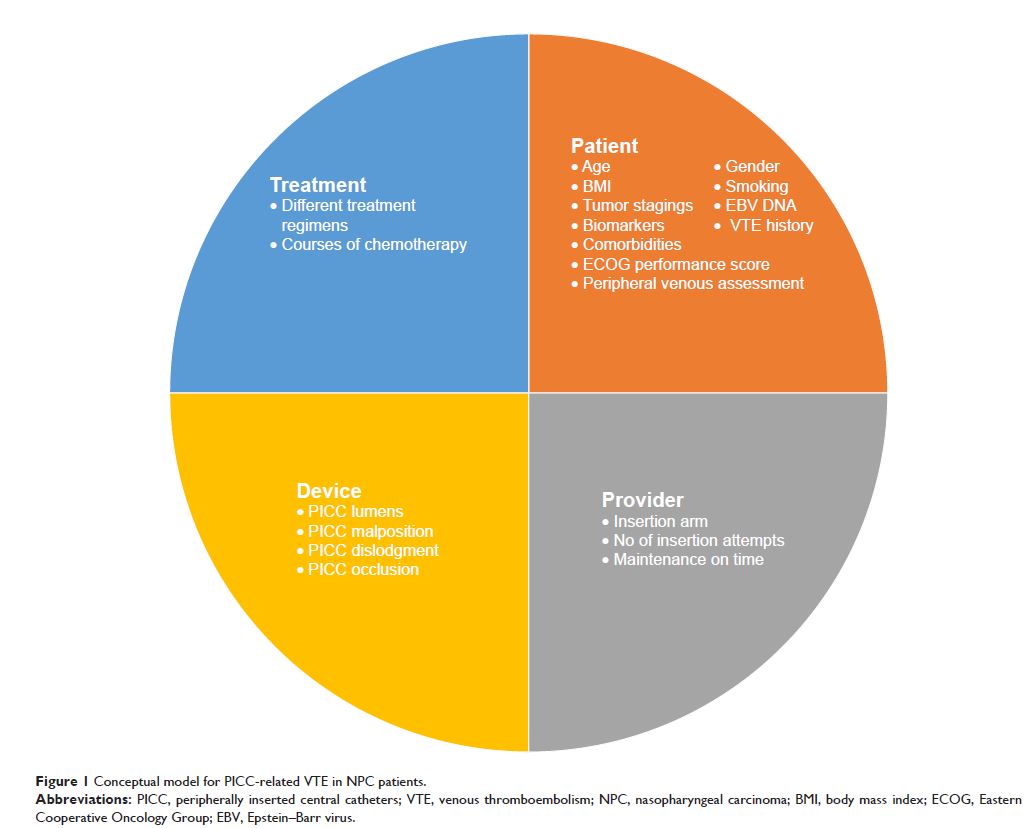
鼻咽癌患者经外周插入中心静脉导管相关的有症状的静脉血栓栓塞发生率及预测因素
Authors Liang YJ, He Y, Li JM, Chen LM, Chen LP, Wang C, Ji L, Li ZX, Tang LQ, Chen QY, Fan YY, Hu W
Received 6 February 2018
Accepted for publication 11 April 2018
Published 25 May 2018 Volume 2018:11 Pages 3119—3127
DOI https://doi.org/10.2147/OTT.S164723
Checked for plagiarism Yes
Review by Single-blind
Peer reviewers approved by Dr Justinn Cochran
Peer reviewer comments 2
Editor who approved publication: Dr Yao Dai
Background: Despite
wide usage, peripherally inserted central catheter (PICC)-related venous
thromboembolism (VTE) is common in nasopharyngeal carcinoma (NPC) patients.
Patients and
methods: This was a retrospective cohort
study of NPC patients with PICC insertions from February 2, 2007 to December
25, 2014 in Sun Yat-Sen University Cancer Centre. Univariable and multivariable
logistic regression analyses were used to estimate odds ratios (ORs) with 95%
confidence intervals (CIs) for the correlations between risk factors and
symptomatic PICC-VTE.
Results: Of the 1,363 NPC patients, 76 developed symptomatic VTE. In
univariable analysis, body mass index (BMI), Eastern Cooperative Oncology Group
(ECOG) score, metastasis stage (M stage), and VTE history were associated with
symptomatic PICC-VTE. Following multivariable adjustments, BMI (OR 0.900, p =0.007), ECOG score (OR
4.162, p =0.011), M stage (OR 2.717, p =0.019), and VTE history (OR 109.772, p <0.001) were still
statistically significant.
Conclusion: PICC-VTE is a common complication in NPC patients, with an
incidence of 5.6% in our analysis. Those with VTE history and lower BMI and
worse ECOG performance score metastatic NPC patients are more susceptible to
symptomatic PICC-related thrombosis and thus may require prophylactic
anticoagulation.
Keywords: symptomatic venous thromboembolism, peripherally inserted central
catheters, nasopharyngeal carcinoma