118473
论文已发表
注册即可获取德孚的最新动态
IF 收录期刊
- 3.6 Breast Cancer (Dove Med Press)
- 4.3 Clin Epidemiol
- 2.6 Cancer Manag Res
- 3.2 Infect Drug Resist
- 4.1 Clin Interv Aging
- 6.1 Drug Des Dev Ther
- 4.1 Int J Chronic Obstr
- 8.7 Int J Nanomed
- 2.5 Int J Women's Health
- 3.2 Neuropsych Dis Treat
- 2.4 OncoTargets Ther
- 2.6 Patient Prefer Adher
- 2.6 Ther Clin Risk Manag
- 3.1 J Pain Res
- 3.5 Diabet Metab Synd Ob
- 4.5 Psychol Res Behav Ma
- 3.4 Nat Sci Sleep
- 2.4 Pharmgenomics Pers Med
- 2.6 Risk Manag Healthc Policy
- 4.6 J Inflamm Res
- 2.3 Int J Gen Med
- 3.9 J Hepatocell Carcinoma
- 3.3 J Asthma Allergy
- 2.5 Clin Cosmet Investig Dermatol
- 3.0 J Multidiscip Healthc

医师共情能力对睾丸切除术治疗晚期前列腺癌患者细胞免疫功能的影响:患者的耻辱感、自我效能感和焦虑感的中介作用
Authors Yang N, Xiao H, Wang W, Li S, Yan H, Wang Y
Received 24 February 2018
Accepted for publication 14 May 2018
Published 24 July 2018 Volume 2018:12 Pages 1305—1314
DOI https://doi.org/10.2147/PPA.S166460
Checked for plagiarism Yes
Review by Single-blind
Peer reviewers approved by Dr Colin Mak
Peer reviewer comments 2
Editor who approved publication: Dr Naifeng Liu
Background: The empathy of doctors is closely related to patients’ outcomes.
This research aimed to examine whether patients’ stigma, self-efficacy, and
anxiety mediate the relationship between doctors’ empathy and cellular immunity
in patients with advanced prostate cancer treated by orchiectomy.
Participants
and methods: Data on the empathy of
doctors and the demographics, disease condition, stigma, self-efficacy, and
anxiety of patients were collected. Patients’ psychological indicators and
cellular immunity were measured at admission, after 14 days, and after
3 months. The variance analysis test was used to compare the immune
indices at the three time points. At T3, a multivariate linear regression model
was used to analyze the factors that influenced the immune index. Pearson
correlation analysis and structural equation modeling were used to examine the
relationships among patients’ stigma, self-efficacy, anxiety, and cellular immunity
and doctors’ empathy.
Results: At the three time points, all three psychological indicators of
the patients were statistically significant. Among the immune indices, only the
change in the percentage of NK cells (NK subset) was statistically significant,
while the changes in the percentages of CD3+, CD4+, CD8+, and B cells were not statistically significant. The doctors’ empathy
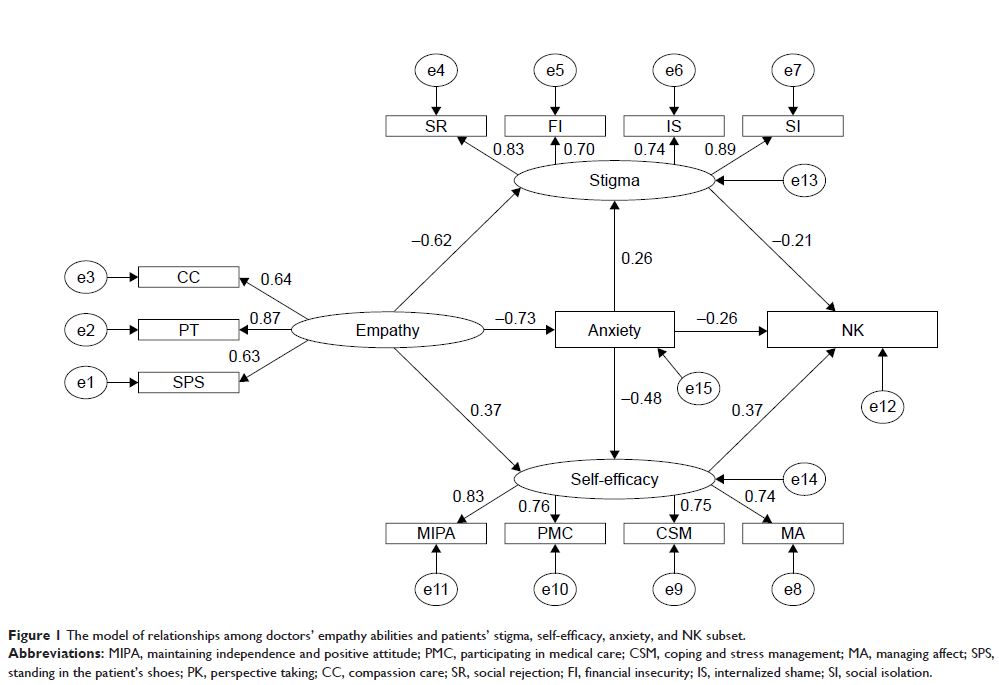
showed negative relationships with patients’ stigma and anxiety and a positive
relationship with patients’ self-efficacy. Patients’ stigma and anxiety were
negatively associated with NK subset, while patients’ self-efficacy showed a
positive relationship with NK subset. Anxiety was positively related to stigma
and negatively related to self-efficacy. Therefore, the effect of the doctors’
empathy on the patients’ NK subset was mediated by the patients’ stigma,
self-efficacy, and anxiety.
Conclusion: Doctors’ empathy affected the NK subset in advanced prostate
cancer patients and was related to the patients’ stigma, self-efficacy, and
anxiety. In addition, anxiety directly affected stigma and self-efficacy. Thus,
medical staff should focus on improving their empathy toward patients.
Interventions that focus on patients’ anxiety, stigma, and self-efficacy may be
helpful to improve immunity.
Keywords: empathy, prostate cancer, doctor, cellular immunity, stigma,
self-efficacy, anxiety