115195
论文已发表
注册即可获取德孚的最新动态
IF 收录期刊
- 3.6 Breast Cancer (Dove Med Press)
- 4.3 Clin Epidemiol
- 2.6 Cancer Manag Res
- 3.2 Infect Drug Resist
- 4.1 Clin Interv Aging
- 6.1 Drug Des Dev Ther
- 4.1 Int J Chronic Obstr
- 8.7 Int J Nanomed
- 2.5 Int J Women's Health
- 3.2 Neuropsych Dis Treat
- 2.4 OncoTargets Ther
- 2.6 Patient Prefer Adher
- 2.6 Ther Clin Risk Manag
- 3.1 J Pain Res
- 3.5 Diabet Metab Synd Ob
- 4.5 Psychol Res Behav Ma
- 3.4 Nat Sci Sleep
- 2.4 Pharmgenomics Pers Med
- 2.6 Risk Manag Healthc Policy
- 4.6 J Inflamm Res
- 2.3 Int J Gen Med
- 3.9 J Hepatocell Carcinoma
- 3.3 J Asthma Allergy
- 2.5 Clin Cosmet Investig Dermatol
- 3.0 J Multidiscip Healthc

来自黄连的总生物碱改善了 2 型糖尿病大鼠的认知缺陷
Authors Li JC, Shen XF, Shao JA, Tao MM, Gu J, Li J, Huang N
Received 13 April 2018
Accepted for publication 2 July 2018
Published 31 August 2018 Volume 2018:12 Pages 2695—2706
DOI https://doi.org/10.2147/DDDT.S171025
Checked for plagiarism Yes
Review by Single-blind
Peer reviewers approved by Dr Colin Mak
Peer reviewer comments 2
Editor who approved publication: Dr Qiongyu Guo
Background: Coptis chinensis Franch is extensively used in traditional Chinese medicine to treat diabetes and dementia. Alkaloids are the main active ingredients of C. chinensis .
Purpose: This study was designed to probe the effects and possible mechanisms of the total alkaloids from C. chinensis (TAC) on cognitive deficits in type 2 diabetic rats.
Methods: Cognitive deficits were induced in rats by streptozotocin and high glucose/high fat diet. After treatment with TAC (80, 120, and 180 mg/kg) for 24 weeks, the behavioral parameters of each rat were assessed by Morris water maze and Y-maze tests. The indexes of glucose and lipid metabolism, pathological changes of brain tissue, and the phosphorylation levels of insulin signaling related proteins were also evaluated.
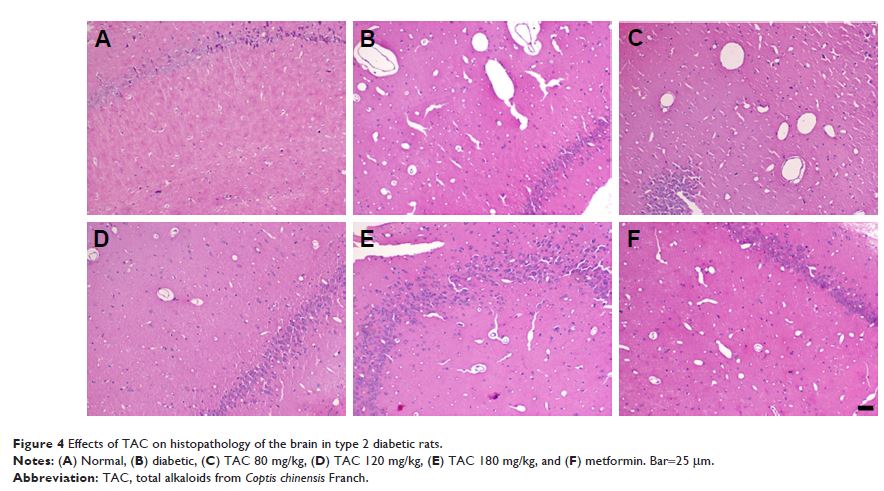
Results: The type 2 diabetic rats showed significantly elevated levels of fasting blood glucose, glycosylated hemoglobin and glycosylated serum protein, as well as apolipoprotein B, free fatty acid, triglyceride and total cholesterol but decreased the content of apolipoprotein A1, and TAC treatment dose-dependently reversed these abnormal changes. Furthermore, the behavioral results showed that TAC alleviated the cognitive deficits in type 2 diabetic rats. Moreover, immunohistochemical and histopathologic examinations indicated that the diabetic rats showed significant Aβ deposition, and neuronal damage and loss, which can be reversed by TAC treatment. The western blot results showed that TAC treatment markedly increased the phosphorylation of IRS, PI3K, and Akt, and inhibited the overactivation of GSK3β in the brain of type 2 diabetic rats.
Conclusion: These findings conclude that TAC prevents diabetic cognitive deficits, most likely by ameliorating the disorder of glucose and lipid metabolism, attenuating Aβ deposition, and enhancing insulin signaling.
Keywords: cognitive deficits, type 2 diabetes, Coptis chinensis Franch, total alkaloids, insulin signalling