115195
论文已发表
注册即可获取德孚的最新动态
IF 收录期刊
- 3.6 Breast Cancer (Dove Med Press)
- 4.3 Clin Epidemiol
- 2.6 Cancer Manag Res
- 3.2 Infect Drug Resist
- 4.1 Clin Interv Aging
- 6.1 Drug Des Dev Ther
- 4.1 Int J Chronic Obstr
- 8.7 Int J Nanomed
- 2.5 Int J Women's Health
- 3.2 Neuropsych Dis Treat
- 2.4 OncoTargets Ther
- 2.6 Patient Prefer Adher
- 2.6 Ther Clin Risk Manag
- 3.1 J Pain Res
- 3.5 Diabet Metab Synd Ob
- 4.5 Psychol Res Behav Ma
- 3.4 Nat Sci Sleep
- 2.4 Pharmgenomics Pers Med
- 2.6 Risk Manag Healthc Policy
- 4.6 J Inflamm Res
- 2.3 Int J Gen Med
- 3.9 J Hepatocell Carcinoma
- 3.3 J Asthma Allergy
- 2.5 Clin Cosmet Investig Dermatol
- 3.0 J Multidiscip Healthc

对芒果甙与多壁碳纳米管共轭通过在 HeLa 细胞中生成 ROS 来诱导细胞凋亡的初步研究
Authors Guo B, Liao C, Liu X, Yi J
Received 30 March 2018
Accepted for publication 2 July 2018
Published 7 September 2018 Volume 2018:12 Pages 2815—2826
DOI https://doi.org/10.2147/DDDT.S169767
Checked for plagiarism Yes
Review by Single-blind
Peer reviewers approved by Dr Colin Mak
Peer reviewer comments 2
Editor who approved publication: Dr Sukesh Voruganti
Background: The present work was conducted to prepare and evaluate multiwalled carbon nanotube–formononetin (MWCNT-FMN) composite for sustained delivery and inducing apoptosis via reactive oxygen species (ROS) production in HeLa cells.
Methods: The composite was prepared by solution mixing with short carboxylic group-functionalized multiwalled carbon nanotubes (MWCNT-COOH). Then the composite was characterized by laser particle size analysis, Fourier transform infrared spectrometry, X-ray diffractometry, differential scanning calorimetry, and scanning electron microscopy. Drug release rates in vitro were determined by dialysis method. The in vitro cytotoxicity study was performed using water soluble tetrazolium assay. The cellular apoptosis assay, ROS, and mitochondrial membrane potential (MMP) of HeLa cells were investigated by acridine orange and ethidium bromide double dye, 2',7'-dichlorodihydrofluorescein diacetate, and 5,5',6,6'-tetrachloro-1,1',3,3'-tetraethyl-imidacarbocyanine iodide probe, respectively.
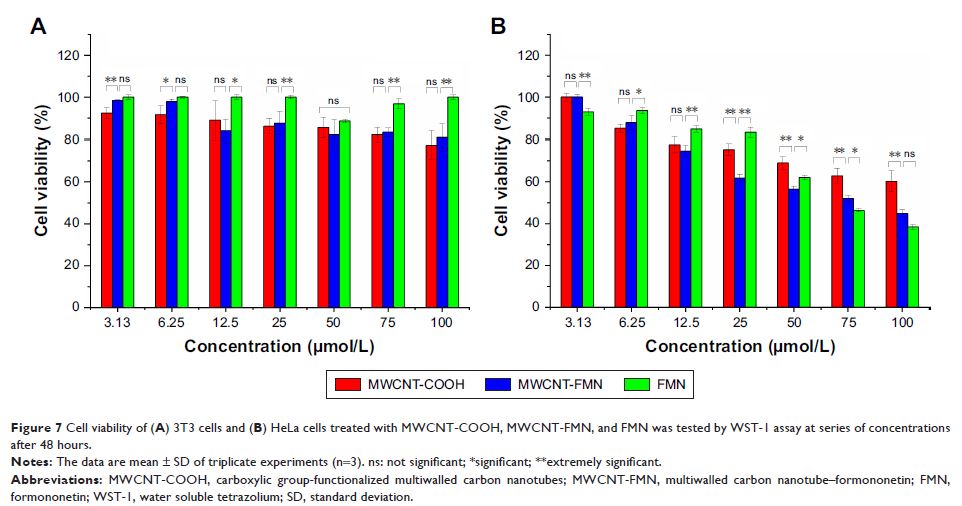
Results: The entrapment efficiency was 28.77%±0.15%, and the loading capacity was 12.05%±0.20%. The release of MWCNT-FMN was sustained, and the cumulative release rate of formononetin (FMN) from MWCNT-COOH was higher at pH 7.4 than at pH 5.3. The in vitro cytotoxicity assay demonstrated that FMN, MWCNT-COOH, and MWCNT-FMN had no significant effects on the proliferation and viability of mouse fibroblast 3T3 cells over 48 hours, while the cell growth inhibition of the three samples showed concentration-dependent for HeLa cells. Biological assay suggested FMN and MWCNT-FMN could induce apoptosis in HeLa cells, meanwhile the cells exhibited stronger ROS signal and more depolarized MMP than that of the control group.
Conclusion: These results preliminarily demonstrated that MWCNT-FMN exerted anticancer efficacy through cellular apoptosis induced by ROS-mediated mitochondrial dysfunctions in HeLa cells.
Keywords: multiwalled carbon nanotube, characterization, cytotoxicity, formononetin, apoptosis