115195
论文已发表
注册即可获取德孚的最新动态
IF 收录期刊
- 3.6 Breast Cancer (Dove Med Press)
- 4.3 Clin Epidemiol
- 2.6 Cancer Manag Res
- 3.2 Infect Drug Resist
- 4.1 Clin Interv Aging
- 6.1 Drug Des Dev Ther
- 4.1 Int J Chronic Obstr
- 8.7 Int J Nanomed
- 2.5 Int J Women's Health
- 3.2 Neuropsych Dis Treat
- 2.4 OncoTargets Ther
- 2.6 Patient Prefer Adher
- 2.6 Ther Clin Risk Manag
- 3.1 J Pain Res
- 3.5 Diabet Metab Synd Ob
- 4.5 Psychol Res Behav Ma
- 3.4 Nat Sci Sleep
- 2.4 Pharmgenomics Pers Med
- 2.6 Risk Manag Healthc Policy
- 4.6 J Inflamm Res
- 2.3 Int J Gen Med
- 3.9 J Hepatocell Carcinoma
- 3.3 J Asthma Allergy
- 2.5 Clin Cosmet Investig Dermatol
- 3.0 J Multidiscip Healthc

平足蛋白阳性癌症相关的成纤维细胞可预测肺癌患者的预后不良
Authors Hu G, Zhong K, Chen W, Wang S, Huang L
Received 28 May 2018
Accepted for publication 9 August 2018
Published 10 September 2018 Volume 2018:11 Pages 5607—5619
DOI https://doi.org/10.2147/OTT.S175566
Checked for plagiarism Yes
Review by Single-blind
Peer reviewers approved by Dr Colin Mak
Peer reviewer comments 3
Editor who approved publication: Dr XuYu Yang
Background: Cancer-associated fibroblasts (CAFs) are a heterogeneous population, and different subpopulations play differential roles in tumor microenvironment. However, the prognostic role of podoplanin-positive CAFs in human lung cancer still remains controversial.
Methods: Herein, we performed a meta-analysis including 12 published studies with 1,802 patients identified from PubMed and EBSCO to assess the prognostic impact of podoplanin-positive CAFs in lung cancer patients.
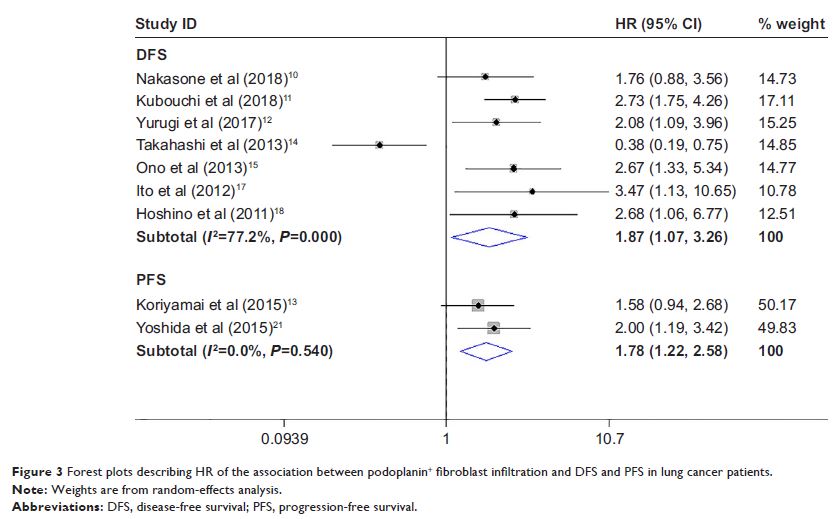
Results: We found that podoplanin+ fibroblast infiltration significantly decreased overall survival (OS), disease-free survival (DFS), and progression-free survival in patients. In stratified analyses, podoplanin+ fibroblast infiltration was significantly associated with worse OS and DFS in both squamous cell carcinoma and adenocarcinoma of lung. In addition, high density of podoplanin-positive CAFs significantly correlated with unfavorable clinicopathological features such as lymph node metastasis, and lymphatic, vascular, and pleural invasion of patients.
Conclusion: Podoplanin+ fibroblast infiltration leads to worse clinical outcome in lung cancer patients, implicating that it is a valuable prognostic biomarker and targeting it may have a potential for effective treatment.
Keywords: podoplanin-positive cancer-associated fibroblasts, worse outcome, lung cancer, meta-analysis