115195
论文已发表
注册即可获取德孚的最新动态
IF 收录期刊
- 3.6 Breast Cancer (Dove Med Press)
- 4.3 Clin Epidemiol
- 2.6 Cancer Manag Res
- 3.2 Infect Drug Resist
- 4.1 Clin Interv Aging
- 6.1 Drug Des Dev Ther
- 4.1 Int J Chronic Obstr
- 8.7 Int J Nanomed
- 2.5 Int J Women's Health
- 3.2 Neuropsych Dis Treat
- 2.4 OncoTargets Ther
- 2.6 Patient Prefer Adher
- 2.6 Ther Clin Risk Manag
- 3.1 J Pain Res
- 3.5 Diabet Metab Synd Ob
- 4.5 Psychol Res Behav Ma
- 3.4 Nat Sci Sleep
- 2.4 Pharmgenomics Pers Med
- 2.6 Risk Manag Healthc Policy
- 4.6 J Inflamm Res
- 2.3 Int J Gen Med
- 3.9 J Hepatocell Carcinoma
- 3.3 J Asthma Allergy
- 2.5 Clin Cosmet Investig Dermatol
- 3.0 J Multidiscip Healthc

半髋关节置换术治疗移位股骨颈骨折后的隐性失血及其危险因素:一个横断面研究
Authors Guo WJ, Wang JQ, Zhang WJ, Wang WK, Xu D, Luo P
Received 15 May 2018
Accepted for publication 7 August 2018
Published 10 September 2018 Volume 2018:13 Pages 1639—1645
DOI https://doi.org/10.2147/CIA.S174196
Checked for plagiarism Yes
Review by Single-blind
Peer reviewers approved by Dr Cristina Weinberg
Peer reviewer comments 3
Editor who approved publication: Dr Wu
Purpose: Several authors have reported the degree of total blood loss (TBL) following hemiarthroplasty for displaced femoral neck fracture; however, the research specifically investigating on hidden blood loss (HBL) after hip hemiarthroplasty is still lacking. The purpose of this study is to evaluate the HBL in patients who underwent hip hemiarthroplasty for displaced femoral neck fractures and to analyze its risk factors.
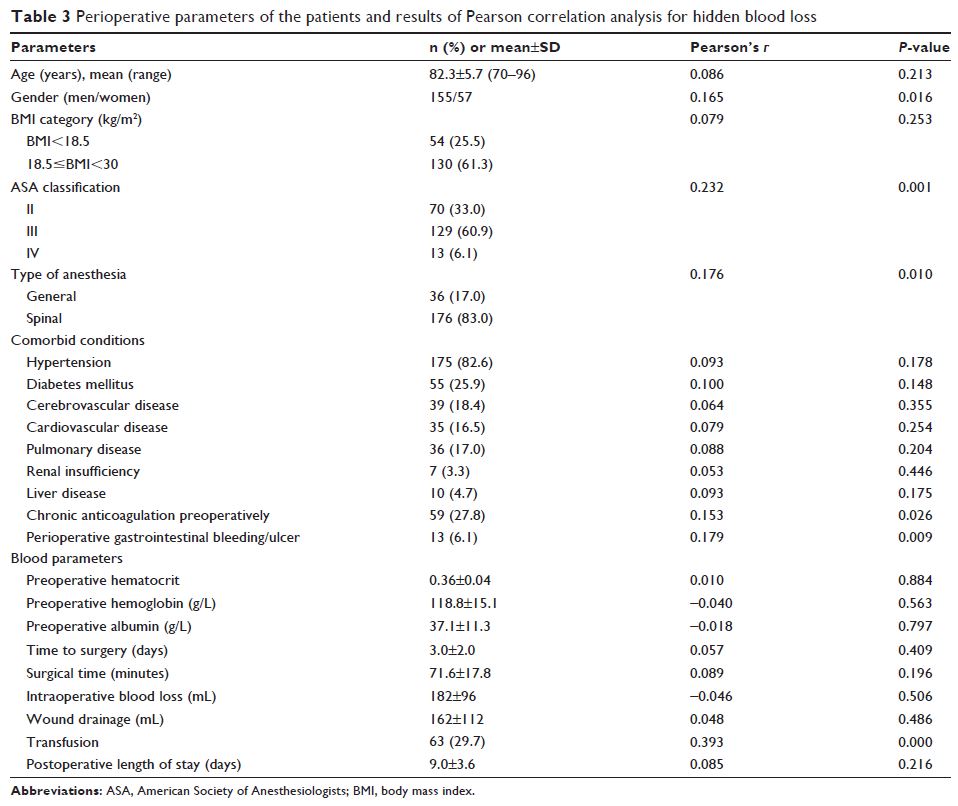
Patients and methods: From January 2015 to December 2016, 212 patients (57 males and 155 females) with displaced femoral neck fracture undergoing hip hemiarthroplasty were included in this study. The demographic and relevant clinical information of the patients were collected. According to the Gross’s formula, each patient’s height, weight, and preoperative and postoperative hematocrit were recorded and used for calculating the total perioperative blood loss and HBL. Risk factors were further analyzed by multivariate linear regression.
Results: The HBL was 525±217 mL, with 61.0%±13.6% in the total perioperative blood loss (859±289 mL), and the perioperative hemoglobin (Hb) loss was 23.8±7.4 g/L. Multivariate linear regression analysis revealed that HBL was positively associated with higher American Society of Anesthesiologists (ASA) classification (regression coefficient=62.169, 95% CI=15.616–108.722; P =0.009), perioperative gastrointestinal bleeding/ulcer (regression coefficient=155.589, 95% CI=38.095–273.083; P =0.010), and transfusion (regression coefficient=192.118, 95% CI=135.578–248.659; P <0.001). Compared with females, males had a risk of increased HBL (regression coefficient=87.414, 95% CI=28.547–146.280; P =0.004), and general anesthesia had an increased HBL compared with spinal anesthesia (regression coefficient=68.920, 95% CI=11.707–126.134; P =0.018).
Conclusion: HBL should not be ignored in patients who underwent hip hemiarthroplasty for displaced femoral neck fractures in the perioperative period, because it is a significant portion of TBL. Female patients, patients with higher ASA classification and perioperative gastrointestinal bleeding/ulcer, patients who were administered general anesthesia, or patients who underwent transfusion had a greater amount of HBL after hip hemiarthroplasty was performed. Having a correct understanding of HBL may help surgeons improve clinical assessment capabilities and ensure patients’ safety.
Keywords: hidden blood loss, risk factors, femoral neck fractures, hemiarthroplasty