115195
论文已发表
注册即可获取德孚的最新动态
IF 收录期刊
- 3.6 Breast Cancer (Dove Med Press)
- 4.3 Clin Epidemiol
- 2.6 Cancer Manag Res
- 3.2 Infect Drug Resist
- 4.1 Clin Interv Aging
- 6.1 Drug Des Dev Ther
- 4.1 Int J Chronic Obstr
- 8.7 Int J Nanomed
- 2.5 Int J Women's Health
- 3.2 Neuropsych Dis Treat
- 2.4 OncoTargets Ther
- 2.6 Patient Prefer Adher
- 2.6 Ther Clin Risk Manag
- 3.1 J Pain Res
- 3.5 Diabet Metab Synd Ob
- 4.5 Psychol Res Behav Ma
- 3.4 Nat Sci Sleep
- 2.4 Pharmgenomics Pers Med
- 2.6 Risk Manag Healthc Policy
- 4.6 J Inflamm Res
- 2.3 Int J Gen Med
- 3.9 J Hepatocell Carcinoma
- 3.3 J Asthma Allergy
- 2.5 Clin Cosmet Investig Dermatol
- 3.0 J Multidiscip Healthc

专门设计的有氧健身操舞对轻度认知障碍的缓解作用
Authors Zhu Y, Wu H, Qi M, Wang S, Zhang Q, Zhou L, Wang S, Wang W, Wu T, Xiao M, Yang S, Chen H, Zhang L, Zhang KC, Ma J, Wang T
Received 19 January 2018
Accepted for publication 18 May 2018
Published 11 September 2018 Volume 2018:13 Pages 1691—1700
DOI https://doi.org/10.2147/CIA.S163067
Checked for plagiarism Yes
Review by Single-blind
Peer reviewers approved by Dr Justinn Cochran
Peer reviewer comments 2
Editor who approved publication: Dr Wu
Background: Mild cognitive impairment (MCI) is known as a transitional stage or phase between normal aging and dementia. In addition, it is associated with an increased risk of dementia. Research has shown that moderate-intensity exercise is associated with a decreased risk of cognitive impairment. Two recent studies demonstrated that dance interventions are associated with improved cognitive function in the elderly with MCI.
Purpose: We evaluated the effect of a moderate-intensity aerobic dance routine on the cognitive function in patients with MCI.
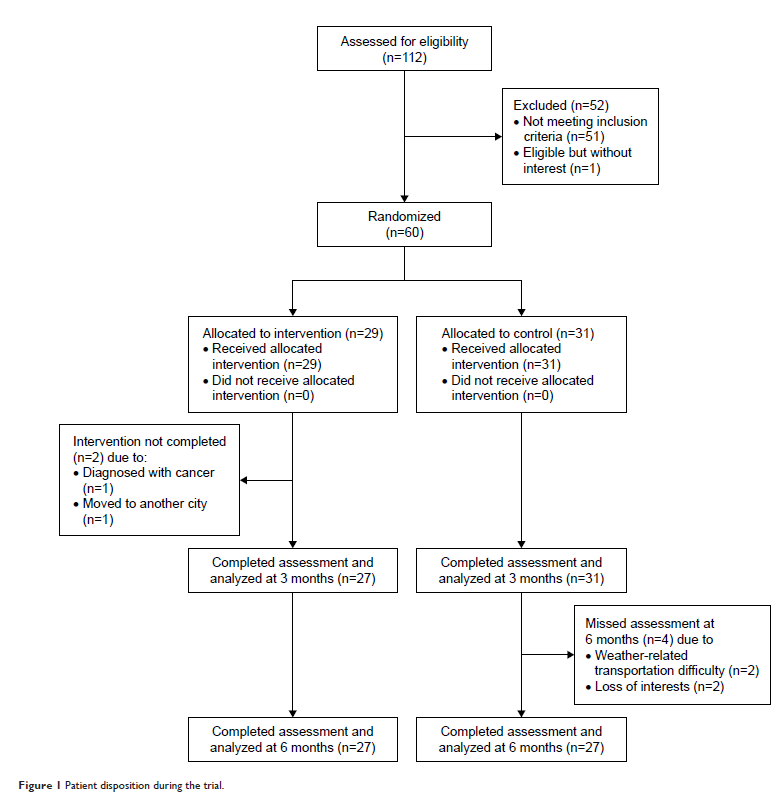
Patients and methods: This is a single-blind randomized controlled trial. Sixty MCI patients were randomized to receive either treatment (aerobic dance routine + usual care) or control (usual care only) for 3 months. All patients received usual care for an additional 3 months thereafter. The aerobic dance routine was a specially designed dance routine which involved cognitive effort for patients to memorize the complex movements. Wechsler memory scale-revised logical memory (WMS-R LM) and event-related evoked potentials (ERPs) P300 latency were used to assess patients’ cognitive function at baseline, 3 months, and 6 months.
Results: Twenty-nine patients received exercise therapy and 31 patients received usual care. Patients in the treatment group showed a greater improvement in memory (difference in WMS-R LM changes over 3 months 4.6; 95% CI 2.2, 7.0; p <0.001) and processing speed (difference in P300 latency changes over 6 months -20.0; 95% CI=-39.5, -0.4; p <0.05) compared to control.
Conclusion: This dance routine improves cognitive function, especially episodic memory and processing speed, in MCI patients and merits promotion in communities.
Keywords: mild cognitive impairment, dance, cognitive function, memory