115195
论文已发表
注册即可获取德孚的最新动态
IF 收录期刊
- 3.6 Breast Cancer (Dove Med Press)
- 4.3 Clin Epidemiol
- 2.6 Cancer Manag Res
- 3.2 Infect Drug Resist
- 4.1 Clin Interv Aging
- 6.1 Drug Des Dev Ther
- 4.1 Int J Chronic Obstr
- 8.7 Int J Nanomed
- 2.5 Int J Women's Health
- 3.2 Neuropsych Dis Treat
- 2.4 OncoTargets Ther
- 2.6 Patient Prefer Adher
- 2.6 Ther Clin Risk Manag
- 3.1 J Pain Res
- 3.5 Diabet Metab Synd Ob
- 4.5 Psychol Res Behav Ma
- 3.4 Nat Sci Sleep
- 2.4 Pharmgenomics Pers Med
- 2.6 Risk Manag Healthc Policy
- 4.6 J Inflamm Res
- 2.3 Int J Gen Med
- 3.9 J Hepatocell Carcinoma
- 3.3 J Asthma Allergy
- 2.5 Clin Cosmet Investig Dermatol
- 3.0 J Multidiscip Healthc

重症患者的液体复苏:系统回顾和网络汇总分析
Authors Liu C, Mao Z, Hu P, Hu X, Kang H, Hu J, Yang Z, Ma P, Zhou F
Received 23 May 2018
Accepted for publication 15 July 2018
Published 12 September 2018 Volume 2018:14 Pages 1701—1709
DOI https://doi.org/10.2147/TCRM.S175080
Checked for plagiarism Yes
Review by Single-blind
Peer reviewers approved by Dr Justinn Cochran
Peer reviewer comments 3
Editor who approved publication: Professor Deyun Wang
Objective: The aim of this study was to compare the effectiveness of different fluids on critically ill patients who need fluid resuscitation through a systematic review and network meta-analysis (NMA).
Data sources: Electronic databases were searched up to March 2018 for randomized controlled trials comparing the effectiveness of different fluids in critically ill patients. The primary outcome was mortality, and the secondary outcomes were the incident of acute kidney injury (AKI) and risk of receiving renal replacement therapy (RRT). A Bayesian NMA was conducted, and the quality of evidence contributing to each network estimate was assessed using the Grading of Recommendations Assessment, Development and Evaluation (GRADE) Working Group criteria.
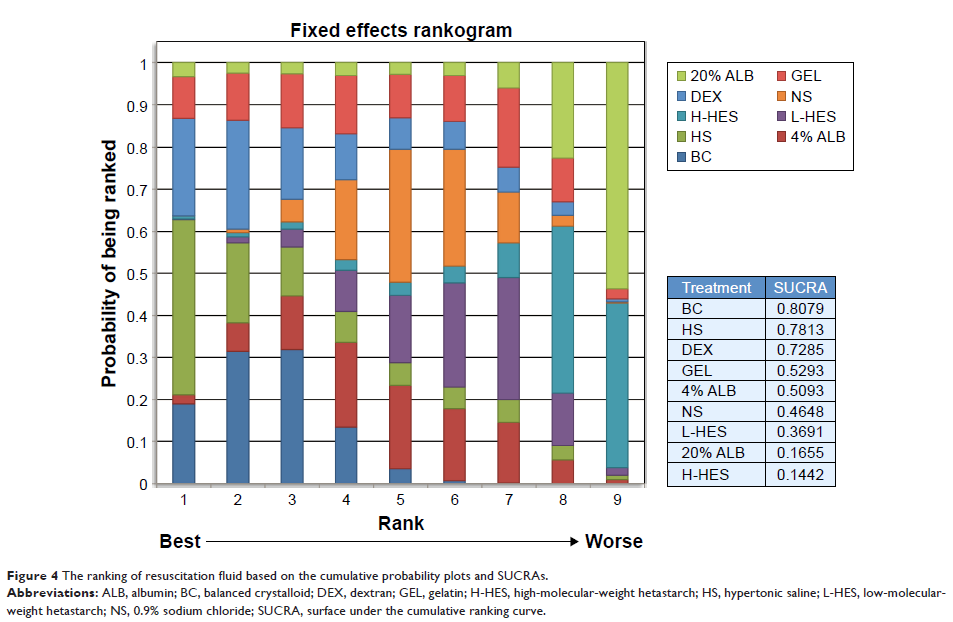
Results: We deemed 49 trials eligible, including 40,910 participants. The quality of evidence was rated as moderate in most comparisons. There was no significant difference among resuscitation fluids in mortality. NMA at the 9-node level showed the most effective fluid was balanced crystalloid (BC) (80.79%, the ranking of resuscitation fluid based on cumulative probability plots and surface under the cumulative ranking curves [SUCRAs]). NMA at the 10-node level showed that the most effective fluid was Plasma-Lyte (77.52%). Results of sensitivity analyses in mortality did not reveal any significant changes in the findings for primary outcomes. High-molecular-weight hetastarch (H-HES) was associated with an increased incidence of AKI when compared with gelatin (odds ratio [OR], 0.43; 95% credibility interval [CrI], 0.19–0.94), low-molecular-weight hetastarch (L-HES; OR, 0.50; 95% CrI, 0.30–0.87), BC (OR, 0.55; 95% CrI, 0.34–0.88), and normal saline (OR, 0.56; 95% CrI, 0.34–0.93). Meanwhile, H-HES was also associated with an increased risk of receiving RRT when compared with BC (OR, 0.51; 95% CrI, 0.27–0.93) and normal saline (OR, 0.52; 95% CrI, 0.24–0.96).
Conclusion: BCs, especially the Plasma-Lyte, are presumably the best choice for most critically ill patients who need fluid resuscitation. Meanwhile, the use of H-HES was associated with an increased incidence of AKI and risk of receiving RRT.
Registration: PROSPERO (CRD42017072728).
Keywords: fluid resuscitation, critically ill, crystalloids, colloids, systematic review, network meta-analysis