115195
论文已发表
注册即可获取德孚的最新动态
IF 收录期刊
- 3.6 Breast Cancer (Dove Med Press)
- 4.3 Clin Epidemiol
- 2.6 Cancer Manag Res
- 3.2 Infect Drug Resist
- 4.1 Clin Interv Aging
- 6.1 Drug Des Dev Ther
- 4.1 Int J Chronic Obstr
- 8.7 Int J Nanomed
- 2.5 Int J Women's Health
- 3.2 Neuropsych Dis Treat
- 2.4 OncoTargets Ther
- 2.6 Patient Prefer Adher
- 2.6 Ther Clin Risk Manag
- 3.1 J Pain Res
- 3.5 Diabet Metab Synd Ob
- 4.5 Psychol Res Behav Ma
- 3.4 Nat Sci Sleep
- 2.4 Pharmgenomics Pers Med
- 2.6 Risk Manag Healthc Policy
- 4.6 J Inflamm Res
- 2.3 Int J Gen Med
- 3.9 J Hepatocell Carcinoma
- 3.3 J Asthma Allergy
- 2.5 Clin Cosmet Investig Dermatol
- 3.0 J Multidiscip Healthc

非小细胞肺癌 7-microRNA 预后特征的建立和验证
Authors Wang N, Guo H, Dong Z, Chen Q, Zhang X, Shen W, Bao Y, Wang X
Received 9 April 2018
Accepted for publication 11 June 2018
Published 12 September 2018 Volume 2018:10 Pages 3463—3471
DOI https://doi.org/10.2147/CMAR.S170481
Checked for plagiarism Yes
Review by Single-blind
Peer reviewers approved by Dr Justinn Cochran
Peer reviewer comments 2
Editor who approved publication: Professor Kenan Onel
Purpose: A series of microRNAs (miRNAs) have been identified as associated with the survival of patients with non-small-cell lung cancer (NSCLC). The aim of the present study was to explore whether combination of these experimentally validated individual miRNA biomarkers could be used to further increase their prognostic power in NSCLC.
Patients and methods: Based on previously validated NSCLC prognostic miRNAs, gene signatures that could discriminate high-risk subgroups with poor clinical outcome in four NSCLC miRNA expression datasets (GSE13937, GSE16025, The Cancer Genome Atlas Lung Adenocarcinoma, and TCGA lung squamous cell carcinoma) were developed using the SurvMicro tool. The potential of the miRNA signature established was validated by quantitative real-time PCR analysis of clinical NSCLC samples, and its prognostic power evaluated using the survivalROC method.
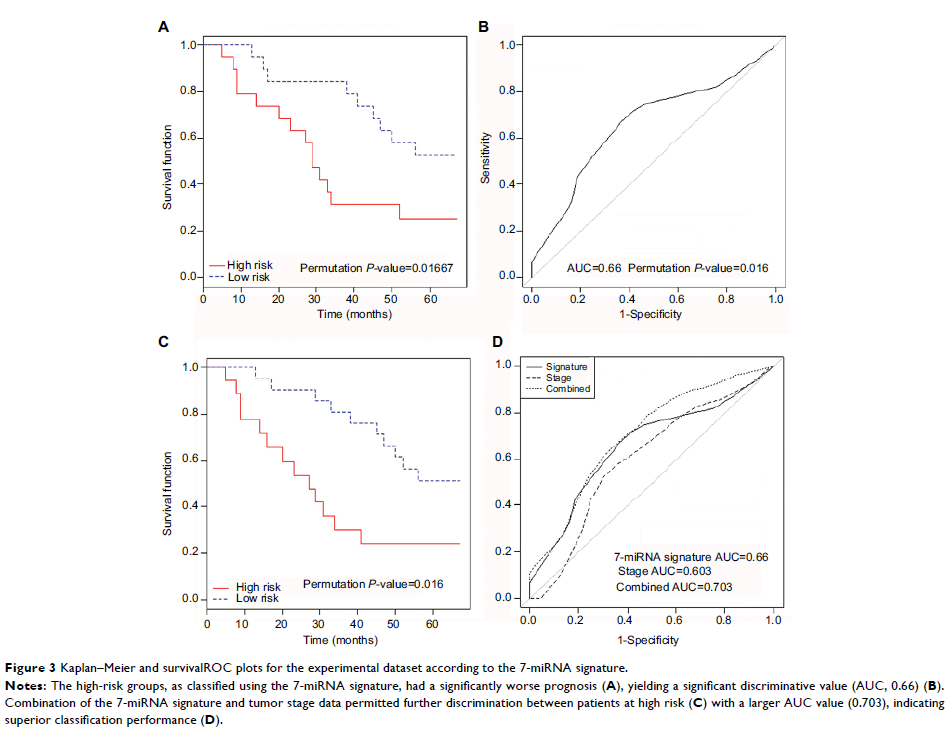
Results: We developed two miRNA signatures with prognostic significance for NSCLC, comprising 12- and 7-miRNAs. The 7-miRNA signature (miR-148b, miR-365, miR-32, miR-375, miR-21, miR-125b, and miR-155) was a subset of a 12-miRNA set that retained prognostic power across NSCLC cohorts. Compared with previously established miRNA signatures, our 7-miRNA signature has similar potential, while comprising fewer miRNA components. The prognostic ability of the 7-miRNA signature was validated experimentally in an independent NSCLC cohort using real-time PCR (HR=3.4847, 95% CI=1.3693–8.8680, P =0.0092), and this signature, combined with tumor pathological stage, had superior prognostic ability compared with tumor stage alone.
Conclusion: Our data indicate that the established 7-miRNA signature is simple, robust, and may have greater clinical prognostic utility for patients with NSCLC.
Keywords: lung cancer, gene signature, overall survival, The Cancer Genome Atlas, TCGA, risk classification