115195
论文已发表
注册即可获取德孚的最新动态
IF 收录期刊
- 3.6 Breast Cancer (Dove Med Press)
- 4.3 Clin Epidemiol
- 2.6 Cancer Manag Res
- 3.2 Infect Drug Resist
- 4.1 Clin Interv Aging
- 6.1 Drug Des Dev Ther
- 4.1 Int J Chronic Obstr
- 8.7 Int J Nanomed
- 2.5 Int J Women's Health
- 3.2 Neuropsych Dis Treat
- 2.4 OncoTargets Ther
- 2.6 Patient Prefer Adher
- 2.6 Ther Clin Risk Manag
- 3.1 J Pain Res
- 3.5 Diabet Metab Synd Ob
- 4.5 Psychol Res Behav Ma
- 3.4 Nat Sci Sleep
- 2.4 Pharmgenomics Pers Med
- 2.6 Risk Manag Healthc Policy
- 4.6 J Inflamm Res
- 2.3 Int J Gen Med
- 3.9 J Hepatocell Carcinoma
- 3.3 J Asthma Allergy
- 2.5 Clin Cosmet Investig Dermatol
- 3.0 J Multidiscip Healthc

Use of technology for care coordination initiatives for patients with mental health issues: a systematic literature review
Authors Falconer E, Kho D, Docherty JP
Received 2 May 2018
Accepted for publication 1 August 2018
Published 13 September 2018 Volume 2018:14 Pages 2337—2349
DOI https://doi.org/10.2147/NDT.S172810
Checked for plagiarism Yes
Review by Single-blind
Peer reviewers approved by Dr Justinn Cochran
Peer reviewer comments 3
Editor who approved publication: Dr Roger Pinder
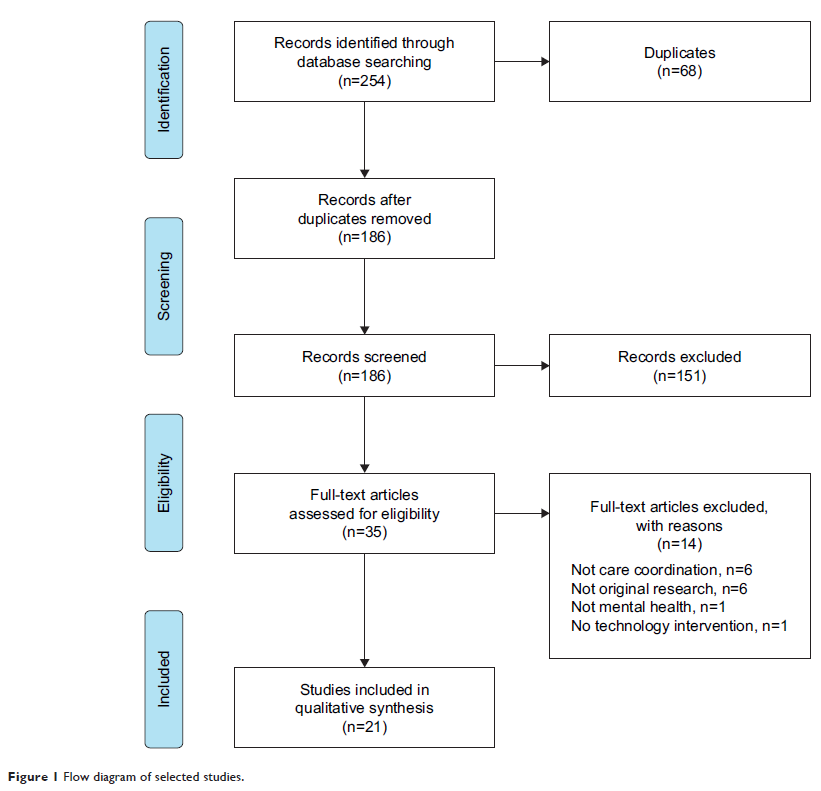
Abstract: This systematic literature review investigates the use of technology for the coordination and management of mental health care with an emphasis on outcomes. Searches of MEDLINE/PubMed, Scopus, and EMBASE were conducted between January 1, 2003, and January 4, 2018, to identify articles that assessed patient outcomes associated with care coordination, evaluated technology to improve care, or discussed management of mental health care using technology. A total of 21 articles were included in a qualitative review based on the recommendations set forth by the PRISMA statement. Among the various health technologies, electronic health records were most commonly used for care coordination, with primary care being the most frequent setting. Care coordination was shown to provide easier patient access to health care providers and to improve communication between caregiver and patient, especially in cases where geographic location or distance is a challenge. Barriers to coordinated care included, but were not limited to, insufficient funding for health information technology, deficient reimbursement plans, limited access to technologies, cultural barriers, and underperforming electronic health record templates. In conclusion, many studies showed the benefit of coordinated and collaborative care through the use of technology; however, further research and development efforts are needed to continue technological innovation for advanced patient care.
Keywords: serious mental illness, schizophrenia, depression, collaborative care, behavioral health, health information technology