115195
论文已发表
注册即可获取德孚的最新动态
IF 收录期刊
- 3.6 Breast Cancer (Dove Med Press)
- 4.3 Clin Epidemiol
- 2.6 Cancer Manag Res
- 3.2 Infect Drug Resist
- 4.1 Clin Interv Aging
- 6.1 Drug Des Dev Ther
- 4.1 Int J Chronic Obstr
- 8.7 Int J Nanomed
- 2.5 Int J Women's Health
- 3.2 Neuropsych Dis Treat
- 2.4 OncoTargets Ther
- 2.6 Patient Prefer Adher
- 2.6 Ther Clin Risk Manag
- 3.1 J Pain Res
- 3.5 Diabet Metab Synd Ob
- 4.5 Psychol Res Behav Ma
- 3.4 Nat Sci Sleep
- 2.4 Pharmgenomics Pers Med
- 2.6 Risk Manag Healthc Policy
- 4.6 J Inflamm Res
- 2.3 Int J Gen Med
- 3.9 J Hepatocell Carcinoma
- 3.3 J Asthma Allergy
- 2.5 Clin Cosmet Investig Dermatol
- 3.0 J Multidiscip Healthc

红细胞分布增加的宽度预示口腔鳞状细胞癌患者的预后不良
Authors Ge W, Xie J, Chang L
Received 3 June 2018
Accepted for publication 12 July 2018
Published 17 September 2018 Volume 2018:10 Pages 3611—3618
DOI https://doi.org/10.2147/CMAR.S176200
Checked for plagiarism Yes
Review by Single-blind
Peer reviewers approved by Dr Cristina Weinberg
Peer reviewer comments 2
Editor who approved publication: Dr Luzhe Sun
Introduction: Although red blood cell distribution width (RDW) has been reported
to reflect inflammation and nutritional status and to predict prognosis in
several different types of cancer, little is known about how RDW might be
related to oral squamous cell carcinoma (OSCC). The present study aimed to
investigate the prognostic value of preoperative RDW in OSCC patients.
Materials and
methods: We included 236 OSCC patients from
Jinan Stomatological Hospital (Shandong, People’s Republic of China) in this
retrospective study. All enrolled patients were divided into 2 groups: high RDW
(≥15%) and low RDW (<15%) according to the detected RDW values. The
correlation of RDW and clinical characteristics was explored, and the
prognostic significance of RDW evaluated using Kaplan–Meier curves, log-rank
analysis, and the Cox proportional hazards model.
Results: The pretreatment median RDW among all OSCC patients was 14.4%,
with a range from 11.6% to 24.5%. The RDW was found to be significantly
correlated with node metastasis, tumor length, and TNM stage (P <0.05 for all). As for
biochemical parameters, the results showed that higher RDW values were
significantly associated with hemoglobin, mean corpuscular volume, white blood
cell count, albumin, and C-reactive protein (P <0.01 for all).
A significant association of RDW with the tumor marker cytokeratin 19 fragments
(CYFRA21-1) and squamous cell carcinoma antigen (SCC-Ag) was also observed (P =0.02, and P =0.03; respectively). Moreover,
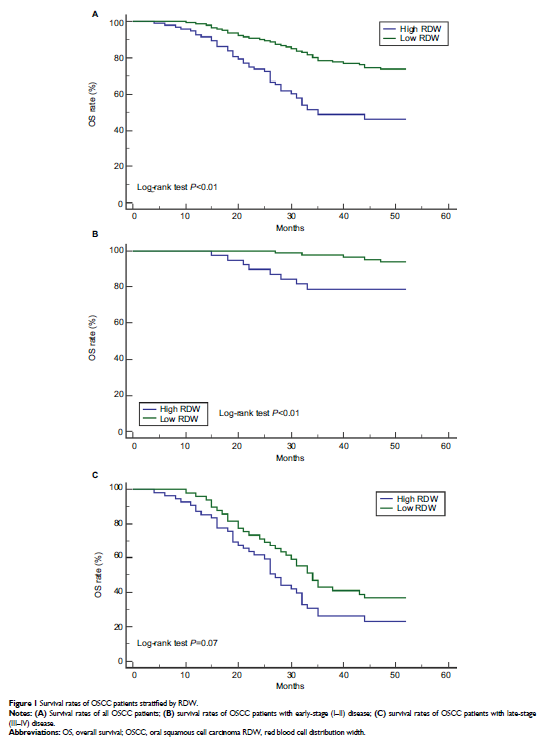
patients with higher RDW were more likely to receive postoperative therapy (P =0.02). Kaplan–Meier survival
curves showed that a high RDW was significantly associated with poor overall
survival (OS) (P <0.01), especially in the
early stages (I–II). Multivariate analysis revealed that an elevated RDW at
diagnosis was an independent prognostic factor for shorter OS (HR =1.46, 95%
CI: 1.13–2.86) after adjustment for other cancer-related prognostic factors.
Conclusion: These data suggest that an elevated preoperative RDW (≥15%) at
diagnosis may independently predict poorer OS in patients with OSCC, but
better-designed studies in the future should be performed to further confirm
the value of monitoring RDW.
Keywords: oral squamous cell carcinoma, prognosis, RDW