115195
论文已发表
注册即可获取德孚的最新动态
IF 收录期刊
- 3.6 Breast Cancer (Dove Med Press)
- 4.3 Clin Epidemiol
- 2.6 Cancer Manag Res
- 3.2 Infect Drug Resist
- 4.1 Clin Interv Aging
- 6.1 Drug Des Dev Ther
- 4.1 Int J Chronic Obstr
- 8.7 Int J Nanomed
- 2.5 Int J Women's Health
- 3.2 Neuropsych Dis Treat
- 2.4 OncoTargets Ther
- 2.6 Patient Prefer Adher
- 2.6 Ther Clin Risk Manag
- 3.1 J Pain Res
- 3.5 Diabet Metab Synd Ob
- 4.5 Psychol Res Behav Ma
- 3.4 Nat Sci Sleep
- 2.4 Pharmgenomics Pers Med
- 2.6 Risk Manag Healthc Policy
- 4.6 J Inflamm Res
- 2.3 Int J Gen Med
- 3.9 J Hepatocell Carcinoma
- 3.3 J Asthma Allergy
- 2.5 Clin Cosmet Investig Dermatol
- 3.0 J Multidiscip Healthc

Prevalence and risk factors of community-associated methicillin-resistant Staphylococcus aureus carriage in Asia-Pacific region from 2000 to 2016: a systematic review and meta-analysis
Authors Wong JWH, Ip M, Tang A, Wei VWI, Wong SYS, Riley S, Read JM, Kwok KO
Received 24 December 2017
Accepted for publication 8 March 2018
Published 12 October 2018 Volume 2018:10 Pages 1489—1501
DOI https://doi.org/10.2147/CLEP.S160595
Checked for plagiarism Yes
Review by Single-blind
Peer reviewers approved by Dr Amy Norman
Peer reviewer comments 2
Editor who approved publication: Professor Irene Petersen
Objective: Community-associated methicillin-resistant Staphylococcus aureus (CA-MRSA)
is an emerging global public health threat. In response to a highlighted
strategic priority of the World Health Organization Global Action Plan on
Antimicrobial Resistance, to “strengthen the knowledge and evidence base
through surveillance and research”, we synthesized published articles to
estimate CA-MRSA carriage prevalence in the Asia-Pacific region.
Methods: A systematic review was conducted following the
Preferred Reporting Items for Systematic Reviews and Meta-Analyses guidelines
(PROSPERO CRD:42017067399). We searched MEDLINE, EMBASE, and PubMed for
articles published from 1 January 2000 to 19 May 2017, which reported CA-MRSA
carriage (defined as either colonization or infection) in Asia-Pacific region from
2000 to 2016. Studies were stratified according to settings (community or
hospital where CA-MRSA was isolated) and study populations (general public or
subpopulations with specified characteristics). Ranges of CA-MRSA carriage
prevalence were reported for study groups.
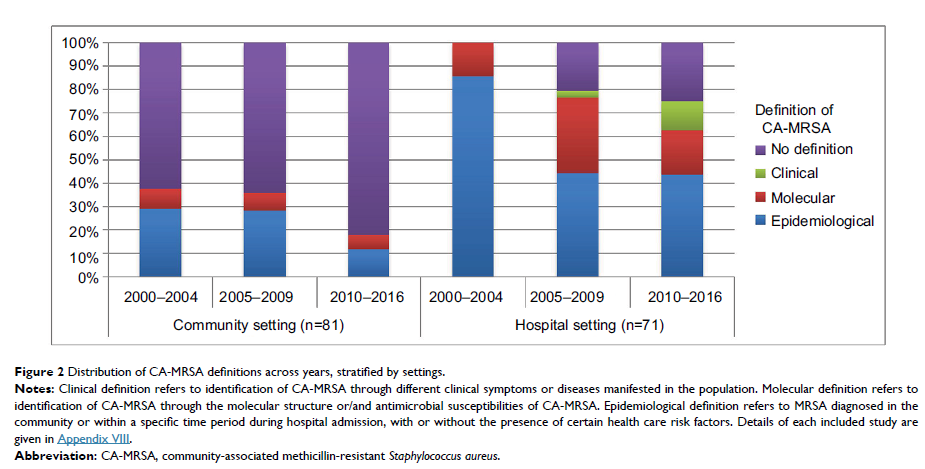
Results: In total, 152 studies were identified. Large
diversity was observed among studies in most study groups. In community-level
studies, the CA-MRSA carriage prevalence among the general public ranged from
0% to 23.5%, whereas that ranged from 0.7% to 10.4% in hospital settings. From
community-level studies, countries with the highest prevalence were India
(16.5%–23.5%), followed by Vietnam (7.9%) and Taiwan (3.5%–3.8%). Children aged
≤6 (range: 0.5%–40.3%) and household members of CA-MRSA carriers (range:
13.0%–26.4%) are subgroups without specific health conditions but with much
higher CA-MRSA carriage when compared to the general population.
Conclusion: Our CA-MRSA prevalence estimates serve as the
baseline for future national and international surveillance. The ranges of
prevalence and characteristics associated with CA-MRSA carriage can inform
health authorities to formulate infection control policies for high-risk
subgroups. Future studies should explore the heterogeneities in CA-MRSA
carriage prevalence among subgroups and countries to clarify the predominant
transmission mechanisms in Asia-Pacific and other regions.
Keywords: antimicrobial
resistance, emerging global health threat, population studies,
methicillin-resistant Staphylococcus aureus