115195
论文已发表
注册即可获取德孚的最新动态
IF 收录期刊
- 3.6 Breast Cancer (Dove Med Press)
- 4.3 Clin Epidemiol
- 2.6 Cancer Manag Res
- 3.2 Infect Drug Resist
- 4.1 Clin Interv Aging
- 6.1 Drug Des Dev Ther
- 4.1 Int J Chronic Obstr
- 8.7 Int J Nanomed
- 2.5 Int J Women's Health
- 3.2 Neuropsych Dis Treat
- 2.4 OncoTargets Ther
- 2.6 Patient Prefer Adher
- 2.6 Ther Clin Risk Manag
- 3.1 J Pain Res
- 3.5 Diabet Metab Synd Ob
- 4.5 Psychol Res Behav Ma
- 3.4 Nat Sci Sleep
- 2.4 Pharmgenomics Pers Med
- 2.6 Risk Manag Healthc Policy
- 4.6 J Inflamm Res
- 2.3 Int J Gen Med
- 3.9 J Hepatocell Carcinoma
- 3.3 J Asthma Allergy
- 2.5 Clin Cosmet Investig Dermatol
- 3.0 J Multidiscip Healthc

体积调制电弧疗法和调强放疗医治宫颈癌患者的剂量学比较:一项综合分析
Authors Bai W, Kou C, Yu W, Li Y, Hua W, Yu L, Wang J
Received 27 June 2018
Accepted for publication 3 October 2018
Published 18 October 2018 Volume 2018:11 Pages 7179—7186
DOI https://doi.org/10.2147/OTT.S178336
Checked for plagiarism Yes
Review by Single-blind
Peer reviewers approved by Dr Cristina Weinberg
Peer reviewer comments 2
Editor who approved publication: Dr Leo Jen-Liang Su
Background: Intensity-modulated radiation therapy (IMRT) and volumetric-modulated
arc therapy (VMAT) are two of the main treatment techniques for cervical
cancer. Whether either technique significantly reduces irradiated volumes of
organs at risk (OARs) remains controversial. The aim of this study was to
explore which of these treatment paradigms is the superior technique in
cervical treatment, taking clinical outcomes and treatment efficiency from
published findings into consideration.
Materials and
methods: PubMed, EMBASE, and Cochrane
Library databases were utilized. The average percent irradiated volumes of OAR
were extracted from all included studies. Dual arc results were extracted due
to their superiority to single arc methods in terms of plan quality. Standard
mean deviations and 95% CIs were calculated for delivery time, monitor units,
and average percent irradiated volumes of OAR. Assessment of publication bias
and sensitivity analyses were performed. All statistical analyses were
conducted using R 3.5.0 software.
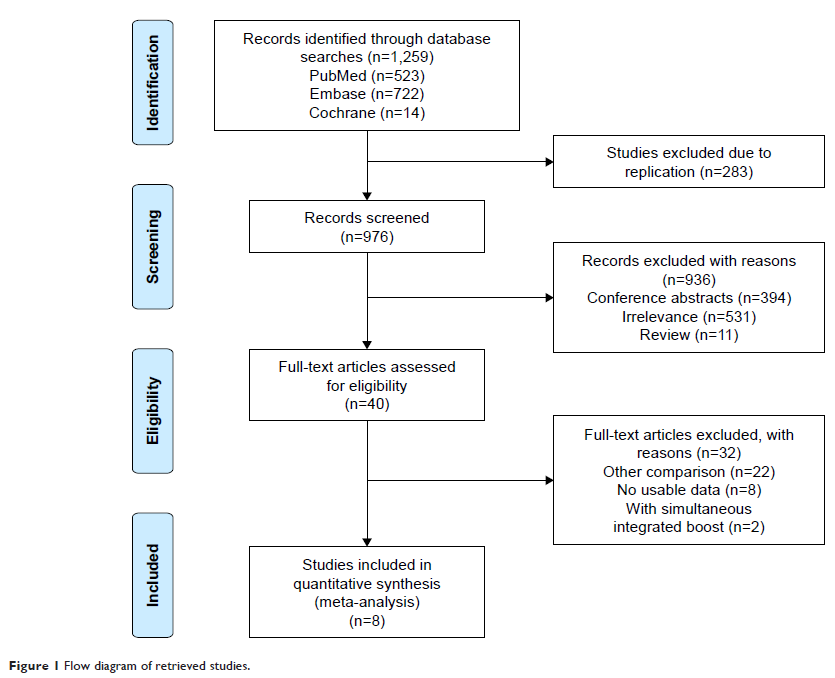
Results: Eight studies were included in this meta-analysis. For irradiated
volumes of OARs, irradiated volume of rectum receiving 40 Gy (rectum V40) was
significantly decreased in VMAT compared with IMRT. However, no significant
differences were observed between IMRT and VMAT plans in bladder V40 or small
bowel V40/V30. In addition, delivery times and monitor units were significantly
lower in the VMAT plan than in the IMRT plan.
Conclusion: Compared with IMRT, VMAT is significantly more protective for the
rectum, suggesting that it may be an optional therapy technique for patients
with cervical cancer.
Keywords: VMAT, IMRT, cervical cancer, meta-analysis