115195
论文已发表
注册即可获取德孚的最新动态
IF 收录期刊
- 3.6 Breast Cancer (Dove Med Press)
- 4.3 Clin Epidemiol
- 2.6 Cancer Manag Res
- 3.2 Infect Drug Resist
- 4.1 Clin Interv Aging
- 6.1 Drug Des Dev Ther
- 4.1 Int J Chronic Obstr
- 8.7 Int J Nanomed
- 2.5 Int J Women's Health
- 3.2 Neuropsych Dis Treat
- 2.4 OncoTargets Ther
- 2.6 Patient Prefer Adher
- 2.6 Ther Clin Risk Manag
- 3.1 J Pain Res
- 3.5 Diabet Metab Synd Ob
- 4.5 Psychol Res Behav Ma
- 3.4 Nat Sci Sleep
- 2.4 Pharmgenomics Pers Med
- 2.6 Risk Manag Healthc Policy
- 4.6 J Inflamm Res
- 2.3 Int J Gen Med
- 3.9 J Hepatocell Carcinoma
- 3.3 J Asthma Allergy
- 2.5 Clin Cosmet Investig Dermatol
- 3.0 J Multidiscip Healthc

依从性差是导致慢性乙型肝炎患者病毒反弹的原因之一
Authors Wang L, Chen P, Zheng C
Received 6 September 2018
Accepted for publication 28 September 2018
Published 8 November 2018 Volume 2018:11 Pages 2179—2185
DOI https://doi.org/10.2147/IDR.S186719
Checked for plagiarism Yes
Review by Single-blind
Peer reviewers approved by Dr Amy Norman
Peer reviewer comments 2
Editor who approved publication: Professor Suresh Antony
Objective: The objective of this study was to explore the risk factors of poor
adherence of nucleoside analogs (NUC) treatment in chronic hepatitis B (CHB)
patients and the virological changes in patients with poor adherence.
Subjects and
methods: A total of 205 CHB patients were
enrolled. The patients’ demographic data and family history were collected. NUC
adherence was calculated every 12 weeks as follows: number of NUC tablets taken
by the patients was divided by the number of NUC tablets prescribed. NUC
adherence > 90% was defined as good adherence of NUC treatment.
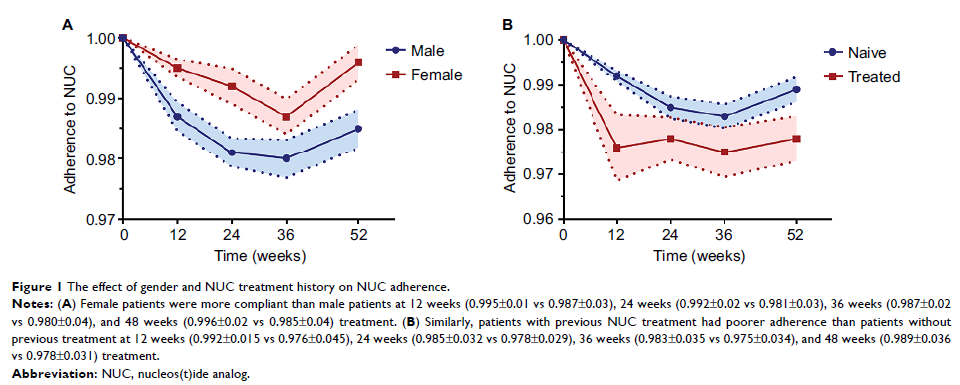
Results: NUC adherence of male patients was significantly lower than that
of female patients. Adherence among patients with previous NUC treatment was
poorer than that of patients without previous NUC treatment. Multivariate
analysis indicated that female gender (OR =0.367, P =0.013) was the protective factor
for NUC adherence in CHB patients, while pretreatment with NUC was the risk
factor for NUC adherence (OR =3.209, P =0.002). A total
of six patients in the good adherence group experienced virological
breakthroughs while 15 of 77 patients in the poor adherence group experienced
virological breakthroughs (P =0.001). Similar
trends were observed in NUC resistance. Four of the 128 patients with good
adherence developed NUC resistance while nine of the 77 patients with poor
adherence developed resistance (P =0.015).
Multivariate analysis suggested that pretreatment with NUC (OR =3.133, P =0.031), NUC drugs (OR =
3.951, P =0.010), and adherence (OR
=2.749, P =0.046) were independent risk
factors associated with virological breakthroughs and that NUC drugs (OR
=7.083, P =0.005) and poor adherence (OR
=4.951, P =0.009) were independent risk
factors for NUC resistance.
Conclusion: Male gender and pretreatment with NUC were risk factors associated with
NUC adherence. Poor NUC adherence is more likely to induce virological
breakthroughs and NUC resistance. For patients with poor NUC adherence, it is
necessary to give timely education to improve treatment adherence.
Keywords: chronic hepatitis B, adherence, nucleoside analogs, virological
breakthroughs, risk factors