115195
论文已发表
注册即可获取德孚的最新动态
IF 收录期刊
- 3.6 Breast Cancer (Dove Med Press)
- 4.3 Clin Epidemiol
- 2.6 Cancer Manag Res
- 3.2 Infect Drug Resist
- 4.1 Clin Interv Aging
- 6.1 Drug Des Dev Ther
- 4.1 Int J Chronic Obstr
- 8.7 Int J Nanomed
- 2.5 Int J Women's Health
- 3.2 Neuropsych Dis Treat
- 2.4 OncoTargets Ther
- 2.6 Patient Prefer Adher
- 2.6 Ther Clin Risk Manag
- 3.1 J Pain Res
- 3.5 Diabet Metab Synd Ob
- 4.5 Psychol Res Behav Ma
- 3.4 Nat Sci Sleep
- 2.4 Pharmgenomics Pers Med
- 2.6 Risk Manag Healthc Policy
- 4.6 J Inflamm Res
- 2.3 Int J Gen Med
- 3.9 J Hepatocell Carcinoma
- 3.3 J Asthma Allergy
- 2.5 Clin Cosmet Investig Dermatol
- 3.0 J Multidiscip Healthc

Notch 抑制剂通过下调严重创伤性脑损伤后的 NOX2-ROS 使表观弥散系数下降并改善神经功能
Authors Zhang HM, Chen W, Liu RN, Zhao Y
Received 13 May 2018
Accepted for publication 10 August 2018
Published 8 November 2018 Volume 2018:12 Pages 3847—3854
DOI https://doi.org/10.2147/DDDT.S174037
Checked for plagiarism Yes
Review by Single-blind
Peer reviewers approved by Dr Cristina Weinberg
Peer reviewer comments 2
Editor who approved publication: Dr Anastasios Lymperopoulos
Introduction: Secondary brain injury is a major factor that affects the prognosis and
outcome of traumatic brain injury (TBI) patients. Secondary brain edema is
considered to be an initiating factor in secondary brain injury after TBI. A
previous study has indicated that Notch signaling activation contributes to
neuron death in mice affected by stroke; however, its role in neuronal
oxidation stress for brain edema after TBI is not well established. Apparent
diffusion coefficient (ADC) values can represent the brain edema after
TBI.
Methods: We established a rat model of acute craniocerebral injury, using
functional MRI to evaluate the ADC and cerebral blood flow values. The present
study was designed to determine the effect of Notch inhibitor DAPT upon
oxidation stress for brain edema after TBI. Rats were randomly distributed into
five groups, control group, severe TBI group, severe TBI + vehicle group,
severe TBI + DAPT group, and severe TBI + DPI group. All rats were sacrificed
at 24 hours after TBI.
Results: Our data indicated that Notch signaling inhibitor DAPT
significantly reduced the ADC values and improved the neurological function
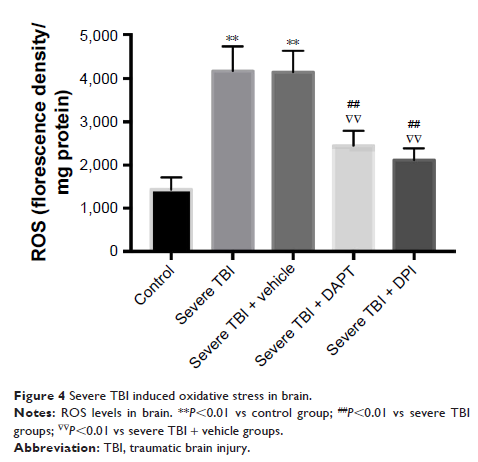
after TBI. In addition, DAPT decreased NOX2 levels and the ROS levels.
Furthermore, DPI can decrease NOX2 levels and ROS levels.
Conclusion: This study indicated that DAPT Notch signal inhibitors can inhibit
NOX2-ROS generation, reduce the ADC values, relieve cerebral edema, and improve
nerve function.
Keywords: traumatic brain injury, secondary brain injury, apparent diffusion
coefficient, Notch, cerebral blood flow