115195
论文已发表
注册即可获取德孚的最新动态
IF 收录期刊
- 3.6 Breast Cancer (Dove Med Press)
- 4.3 Clin Epidemiol
- 2.6 Cancer Manag Res
- 3.2 Infect Drug Resist
- 4.1 Clin Interv Aging
- 6.1 Drug Des Dev Ther
- 4.1 Int J Chronic Obstr
- 8.7 Int J Nanomed
- 2.5 Int J Women's Health
- 3.2 Neuropsych Dis Treat
- 2.4 OncoTargets Ther
- 2.6 Patient Prefer Adher
- 2.6 Ther Clin Risk Manag
- 3.1 J Pain Res
- 3.5 Diabet Metab Synd Ob
- 4.5 Psychol Res Behav Ma
- 3.4 Nat Sci Sleep
- 2.4 Pharmgenomics Pers Med
- 2.6 Risk Manag Healthc Policy
- 4.6 J Inflamm Res
- 2.3 Int J Gen Med
- 3.9 J Hepatocell Carcinoma
- 3.3 J Asthma Allergy
- 2.5 Clin Cosmet Investig Dermatol
- 3.0 J Multidiscip Healthc

二级颅内室管膜瘤患儿术后放疗的作用:基于人群的倾向评分匹配研究
Authors Deng X, Lin D, Yu L, Xu X, Zhang N, Zhou H, Sheng H, Yin B, Lin F, Xu S, Li DD, Fang J, Lu X, Lin J
Received 31 July 2018
Accepted for publication 8 October 2018
Published 8 November 2018 Volume 2018:10 Pages 5515—5524
DOI https://doi.org/10.2147/CMAR.S181900
Checked for plagiarism Yes
Review by Single-blind
Peer reviewers approved by Dr Amy Norman
Peer reviewer comments 3
Editor who approved publication: Professor Kenan Onel
Purpose: The main objectives of this study were to clarify the efficacy of
postoperative radiotherapy (PORT) for pediatric intracranial grade II
ependymomas (EPNs) and to explore whether various characteristics are
associated with different outcomes in patients with and without PORT.
Patients and
methods: Data from patients younger than 18
years diagnosed with grade II intracranial EPNs and treated by surgery, with or
without PORT, were obtained from the Surveillance, Epidemiology, and End
Results (SEER) database (1973–2013 data set). Propensity score-matched analysis
was conducted to balance clinical variables. Patient characteristics were
stratified and analyzed.
Results: In total, data from 632 patients with grade II EPNs treated by
cancer-directed surgery with or without PORT were obtained from the SEER database.
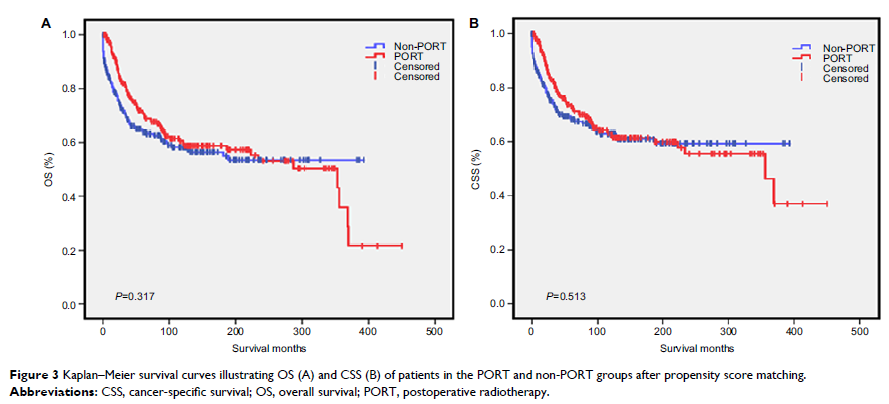
Multivariable Cox analysis in the matched cohort suggested that undergoing PORT
(overall survival [OS], P =0.020;
cancer-specific survival [CSS], P =0.031),
undergoing gross total resection (GTR; subtotal resection [STR] vs GTR;
OS, P <0.001; CSS, P <0.001), and older age
(OS, P <0.001; CSS, P <0.001) were the independent
predictors of superior prognosis. Stratified analysis demonstrated that patient
characteristics, including infratentorial location, younger age, and STR, were
associated with benefit from PORT, while the survival advantage was not
detected in patients who underwent GTR.
Conclusion: Propensity score-matched analysis using SEER data indicates
survival advantages of PORT. Given the strong prognostic associations with
extent of resection and patient age, we recommend PORT for younger patients
treated by STR.
Keywords: pediatric, oncology, SEER, radiotherapy