115195
论文已发表
注册即可获取德孚的最新动态
IF 收录期刊
- 3.6 Breast Cancer (Dove Med Press)
- 4.3 Clin Epidemiol
- 2.6 Cancer Manag Res
- 3.2 Infect Drug Resist
- 4.1 Clin Interv Aging
- 6.1 Drug Des Dev Ther
- 4.1 Int J Chronic Obstr
- 8.7 Int J Nanomed
- 2.5 Int J Women's Health
- 3.2 Neuropsych Dis Treat
- 2.4 OncoTargets Ther
- 2.6 Patient Prefer Adher
- 2.6 Ther Clin Risk Manag
- 3.1 J Pain Res
- 3.5 Diabet Metab Synd Ob
- 4.5 Psychol Res Behav Ma
- 3.4 Nat Sci Sleep
- 2.4 Pharmgenomics Pers Med
- 2.6 Risk Manag Healthc Policy
- 4.6 J Inflamm Res
- 2.3 Int J Gen Med
- 3.9 J Hepatocell Carcinoma
- 3.3 J Asthma Allergy
- 2.5 Clin Cosmet Investig Dermatol
- 3.0 J Multidiscip Healthc

加载 Tf-修饰的雷公藤的薏苡仁种子油微乳液增强了抗宫颈癌治疗的效果
Authors Chen Y, Qu D, Fu R, Guo M, Qin Y, Guo J, Chen Y
Received 3 August 2018
Accepted for publication 9 October 2018
Published 8 November 2018 Volume 2018:13 Pages 7275—7287
DOI https://doi.org/10.2147/IJN.S182475
Checked for plagiarism Yes
Review by Single-blind
Peer reviewers approved by Dr Govarthanan Muthusamy
Peer reviewer comments 3
Editor who approved publication: Dr Linlin Sun
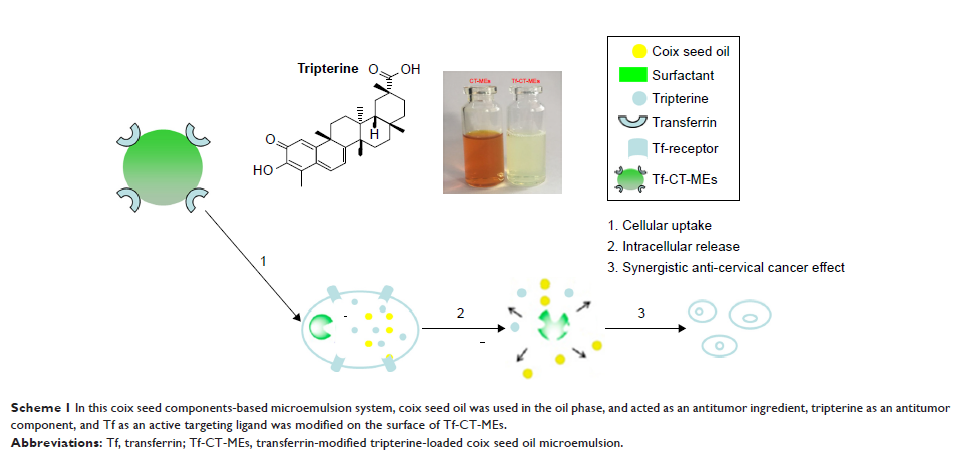
Purpose: A transferrin-modified microemulsion carrying coix seed oil and
tripterine (Tf-CT-MEs) was developed for improved tumor-specific accumulation
and penetration to enhance cervical cancer treatment.
Materials and
methods: Tripterine-loaded coix seed oil
microemulsion (CT-MEs) was prepared through one-step emulsion method. The
morphology, size, and zeta potential of CT-MEs and Tf-CT-MEs were examined by
transmission electron microscopy and dynamic light scattering. The cellular
uptake and mechanisms of HeLa cells were investigated by flow cytometry.
Intratumor penetration was investigated using a HeLa three-dimensional (3D)
tumor spheroid as the model. The cytotoxicity of the CT-MEs and Tf-CT-MEs
against HeLa cells were evaluated by the MTT assay. Additionally, the apoptotic
rate of CT-MEs and Tf-CT-MEs inducing apoptosis in HeLa cells was evaluated.
Results: In the physicochemical characterization, coix seed oil and CT-MEs
exhibited a small size (32.47±0.15 nm) and nearly neutral surface charge
(-0.36±0.11 mV). After modification with transferrin, the particle size of
Tf-CT-MEs slightly increased to 40.02±0.21 nm, but the zeta potential decreased
remarkably to -13.63±1.31 mV. The IC50 of Tf-CT-MEs against HeLa cells was 0.7260 µM, which was 2.58-fold
lower than that of CT-MEs. In cellular studies, the intracellular fluorescence
intensity of fluorescein isothiocyanate (FITC)-labeled Tf-CT-MEs
(FITC/Tf-CT-MEs) was 2.28-fold higher than that of FITC-labeled CT-MEs
(FITC/CT-MEs). The fluorescence signal of Tf-CT-MEs was observed at 350 µm
below the surface of the 3D tumor spheroid. The apoptotic rate of cells treated
with Tf-CT-MEs was 1.73- and 2.77-fold higher than that of cells treated with
CT-MEs and tripterine, respectively, which was associated with
mitochondrial-targeted delivery of tripterine. Moreover, Tf-CT-MEs was capable
of significantly downregulating the cellular level of antiapoptotic proteins
and arrested cell proliferation in the G2/M phase.
Conclusion: Taken together, Tf-CT-MEs holds promising potential to be an
efficient drug delivery system for combinational therapy of cervical cancer.
Keywords: tripterine, coix seed oil, microemulsion, deep penetration,
anti-cervical cancer