115195
论文已发表
注册即可获取德孚的最新动态
IF 收录期刊
- 3.6 Breast Cancer (Dove Med Press)
- 4.3 Clin Epidemiol
- 2.6 Cancer Manag Res
- 3.2 Infect Drug Resist
- 4.1 Clin Interv Aging
- 6.1 Drug Des Dev Ther
- 4.1 Int J Chronic Obstr
- 8.7 Int J Nanomed
- 2.5 Int J Women's Health
- 3.2 Neuropsych Dis Treat
- 2.4 OncoTargets Ther
- 2.6 Patient Prefer Adher
- 2.6 Ther Clin Risk Manag
- 3.1 J Pain Res
- 3.5 Diabet Metab Synd Ob
- 4.5 Psychol Res Behav Ma
- 3.4 Nat Sci Sleep
- 2.4 Pharmgenomics Pers Med
- 2.6 Risk Manag Healthc Policy
- 4.6 J Inflamm Res
- 2.3 Int J Gen Med
- 3.9 J Hepatocell Carcinoma
- 3.3 J Asthma Allergy
- 2.5 Clin Cosmet Investig Dermatol
- 3.0 J Multidiscip Healthc

lncRNA 分化拮抗非蛋白编码 RNA 过表达可加速胰腺导管腺癌发展并预测其预后不良
Authors Chen L, Liu J, Tang T, Zhang Y, Liu M, Xu L, Zhang J
Received 2 March 2018
Accepted for publication 2 July 2018
Published 9 November 2018 Volume 2018:11 Pages 7955—7965
DOI https://doi.org/10.2147/OTT.S167065
Checked for plagiarism Yes
Review by Single-blind
Peer reviewers approved by Dr Colin Mak
Peer reviewer comments 2
Editor who approved publication: Dr Jianmin Xu
Background: lncRNA differentiation antagonizing nonprotein coding RNA (lncRNA DANCR)
has been suggested to play an oncogenic role in multiple cancers. However, to
the best of our knowledge, the clinical significance and role of DANCR in
pancreatic ductal adenocarcinoma (PDAC) has not been illuminated till now. The
present study aims to identify the functional role of DANCR in PDAC.
Methods: The expression of DANCR was detected in PDAC
cells and tissues. The correlation of DANCR expression and PDAC
clinicopahological features was analysed. Kaplan-Meier method was used to
depict the overall survival (OS) rate and shorter progression-free survival
(PFS) of PDAC patients, and Log-rank test was performed to analyse the
difference. Univariate and multivariate COX regression model were utilized to
analyse the risk factors for prognosis. Transwell assay and Matrigel assay were
conducted to detect the effect of DANCR on the migration and invasion of PDAC
cells, respectively. Colony formation assay and Cell Counting Kit-8 (CCK-8)
assay were performed to evaluate the function of DANCR on proliferation. The
mechanisms of DANCR exerting its function were also explored.
Results: DANCR was revealed to promote PDAC progression,
with relatively higher expression levels in PDAC cell lines and tissues.
Correlation analysis of the clinicopathological features and DANCR expression
found that high DANCR expression was statistically correlated with vascular
invasion (P =0.013), advanced T stage (P =0.005), lymph node metastasis (P <0.001) and advanced TNM stage
(P <0.001). Notably, survival
analysis discovered that high DANCR expression predicted lower OS rate and
shorter PFS period. In addition, high DANCR expression was identified as an
independent risk factor for poor OS (HR=1.199, 95% CI=1.113–1.290, P <0.001) and PFS (HR=1.199, 95%
CI=1.114–1.290, P <0.001) of
PDAC. Moreover, in vitro assays detected that the migration and invasion of
Panc1 cells with DANCR deficiency were significantly suppressed in the
Transwell assay and the Matrigel assay. However, the motility of BxPC3 cells
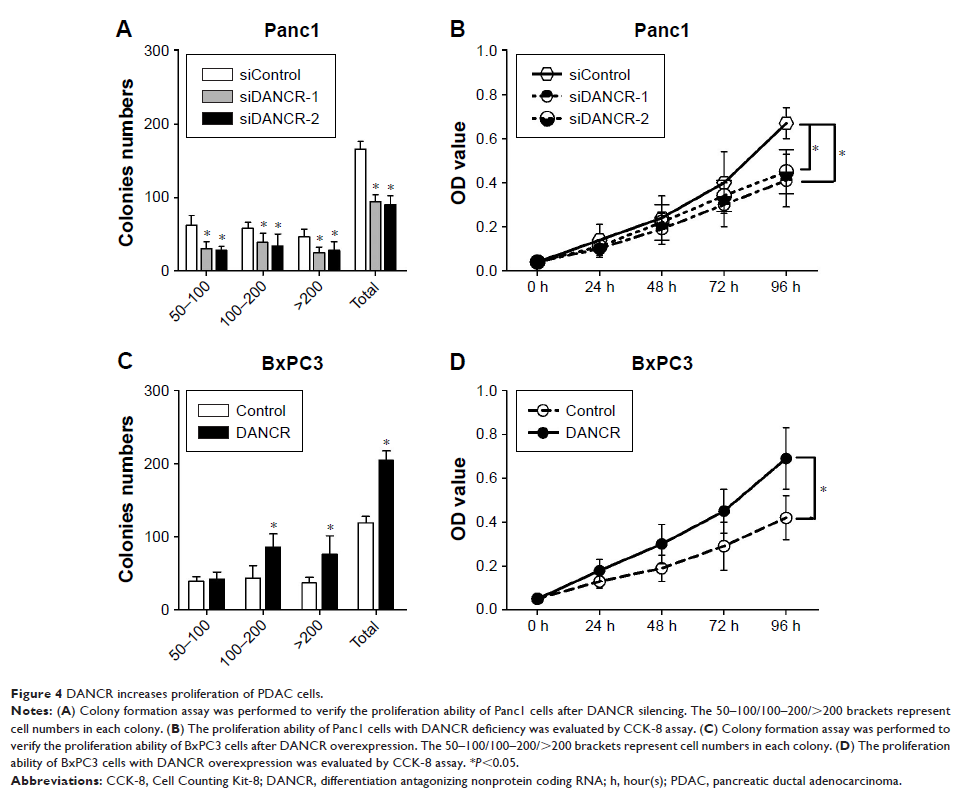
with DANCR overexpression was obviously increased. In addition, the loss of
DANCR suppressed the proliferation of Panc1 cells in the CCK-8 assay and the
colony formation assay, while ectopic expression of DANCR in BxPC3 cells
promoted the proliferation. Besides, microRNA-33a-5p/AXL signaling pathway may
be involved in mediating the function of DANCR.
Conclusion: Overexpression of lncRNA DANCR in PDAC is
associated with cancer progression and predicts poor OS and PFS. DANCR could
promote the proliferation and metastasis of PDAC cells. DANCR may serve as a
potential prognostic marker and therapeutic target in PDAC.
Keywords: lncRNA DANCR,
pancreatic cancer, prognosis, proliferation, metastasis