115195
论文已发表
注册即可获取德孚的最新动态
IF 收录期刊
- 3.6 Breast Cancer (Dove Med Press)
- 4.3 Clin Epidemiol
- 2.6 Cancer Manag Res
- 3.2 Infect Drug Resist
- 4.1 Clin Interv Aging
- 6.1 Drug Des Dev Ther
- 4.1 Int J Chronic Obstr
- 8.7 Int J Nanomed
- 2.5 Int J Women's Health
- 3.2 Neuropsych Dis Treat
- 2.4 OncoTargets Ther
- 2.6 Patient Prefer Adher
- 2.6 Ther Clin Risk Manag
- 3.1 J Pain Res
- 3.5 Diabet Metab Synd Ob
- 4.5 Psychol Res Behav Ma
- 3.4 Nat Sci Sleep
- 2.4 Pharmgenomics Pers Med
- 2.6 Risk Manag Healthc Policy
- 4.6 J Inflamm Res
- 2.3 Int J Gen Med
- 3.9 J Hepatocell Carcinoma
- 3.3 J Asthma Allergy
- 2.5 Clin Cosmet Investig Dermatol
- 3.0 J Multidiscip Healthc

COPD 患者循环 endocan 水平升高与肺功能下降的关系
Authors Dai L, He J, Chen J, Wang T, Liu L, Shen Y, Chen L, Wen F
Received 27 May 2018
Accepted for publication 13 September 2018
Published 9 November 2018 Volume 2018:13 Pages 3699—3706
DOI https://doi.org/10.2147/COPD.S175461
Checked for plagiarism Yes
Review by Single-blind
Peer reviewers approved by Dr Colin Mak
Peer reviewer comments 2
Editor who approved publication: Professor Chunxue Bai
Background: Endocan is thought to be a novel inflammatory marker that is
associated with a variety of inflammatory diseases. However, its role in the
pathogenesis of COPD remains unclear. This study aims to explore the potential
role of endocan in COPD.
Methods: In total, 27 healthy volunteers, 55 COPD patients and 36 acute
exacerbation of chronic obstructive pulmonary disease (AECOPD) patients were
included in the study. Basic demographic characteristics, clinical features and
blood samples were collected. Magnetic luminex screening assays were used to
detect the concentration of endocan, Fas and Fas ligand (Fas-L) in plasma.
Differences between groups were compared using an Independent sample t -test, Welch’s t -test, chi-squared test and
Wilcoxon rank sum test. The correlations of plasma endocan with lung function
parameters, Fas and Fas-L were analyzed by Pearson’s partial correlation test
(adjusted for age, gender, body mass index and smoking history) and multiple
linear regression.
Results: Plasma endocan levels in COPD patients were significantly higher
than those in healthy volunteers (509.7±18.25 pg/mL vs 434.8±18.98 pg/mL (P =0.0124)), and AECOPD patients
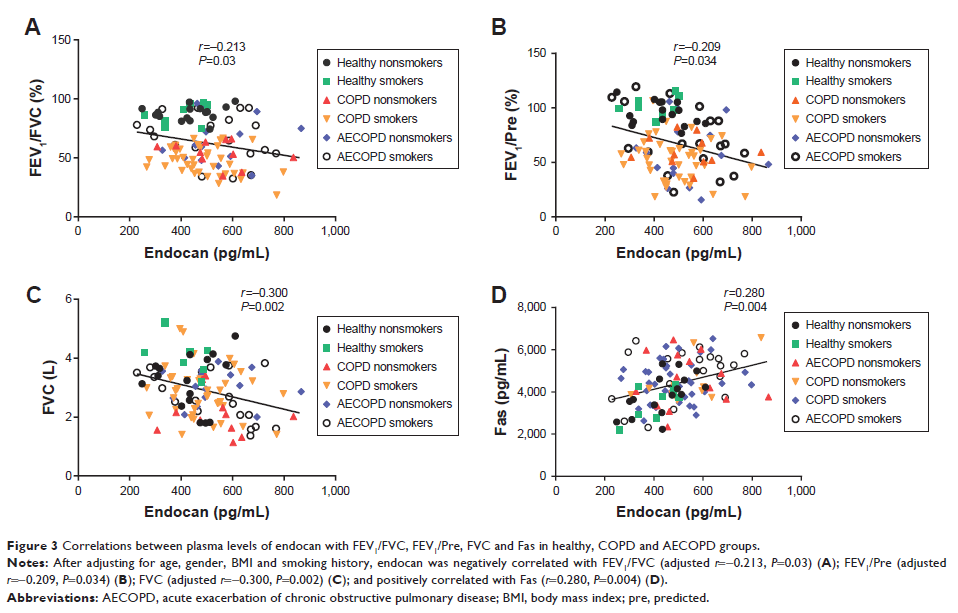
had the highest levels of endocan (524.7±27.18 pg/mL). Correlation analysis
showed that circulating endocan had a negative correlation to FEV1/FVC, FEV1/ predictive and FVC
(adjusted r =-0.213, P =0.03; adjusted r =-0.209, P =0.034; and adjusted r =-0.300, P =0.002, respectively), and had a
positive correlation to Fas (adjusted r =0.280, P =0.004).
Conclusion: Our study shows that elevated circulating endocan levels are
associated with reduced lung ventilation function in COPD and AECOPD patients.
In addition, endocan may influence apoptosis in COPD, suggesting that endocan
may play a role in COPD pathogenesis.
Keywords: endocan, COPD, lung function, apoptosis