115195
论文已发表
注册即可获取德孚的最新动态
IF 收录期刊
- 3.6 Breast Cancer (Dove Med Press)
- 4.3 Clin Epidemiol
- 2.6 Cancer Manag Res
- 3.2 Infect Drug Resist
- 4.1 Clin Interv Aging
- 6.1 Drug Des Dev Ther
- 4.1 Int J Chronic Obstr
- 8.7 Int J Nanomed
- 2.5 Int J Women's Health
- 3.2 Neuropsych Dis Treat
- 2.4 OncoTargets Ther
- 2.6 Patient Prefer Adher
- 2.6 Ther Clin Risk Manag
- 3.1 J Pain Res
- 3.5 Diabet Metab Synd Ob
- 4.5 Psychol Res Behav Ma
- 3.4 Nat Sci Sleep
- 2.4 Pharmgenomics Pers Med
- 2.6 Risk Manag Healthc Policy
- 4.6 J Inflamm Res
- 2.3 Int J Gen Med
- 3.9 J Hepatocell Carcinoma
- 3.3 J Asthma Allergy
- 2.5 Clin Cosmet Investig Dermatol
- 3.0 J Multidiscip Healthc

RALY 的过度表达促进迁移并预测肝细胞癌的预后不良
Authors Zhu Z, Zhang Y, Huang CS, Tang Y, Sun C, Ju W, He X
Received 7 August 2018
Accepted for publication 26 September 2018
Published 9 November 2018 Volume 2018:10 Pages 5559—5572
DOI https://doi.org/10.2147/CMAR.S182996
Checked for plagiarism Yes
Review by Single-blind
Peer reviewers approved by Dr Cristina Weinberg
Peer reviewer comments 6
Editor who approved publication: Dr Beicheng Sun
Introduction: RALY plays a critical role in promoting invasiveness and is
associated with poor prognosis in different types of cancers. However, the
prognostic value of RALY and its precise role in hepatocellular carcinoma (HCC)
remain unknown.
Materials and
methods: We detected the expression of RALY
in 127 clinical HCC tissue samples and seven HCC cell lines by
immunohistochemical staining and Western blotting. The prognostic value of RALY
expression was assessed using the Kaplan–Meier method. The expression and
prognostic value of RALY were also studied by bioinformatics analysis of data
from the Gene Expression Omnibus and The Cancer Genome Atlas. The biological
influence of RALY on HCC cell lines was studied using proliferation, transwell
migration, and invasion assays in vitro.
Results: The expression of RALY in HCC tissues was significantly higher
than that in adjacent normal liver tissues. Abnormally high expression of RALY
was associated with tumor size (P =0.031), TNM stage
(P =0.026), presurgical serum AFP
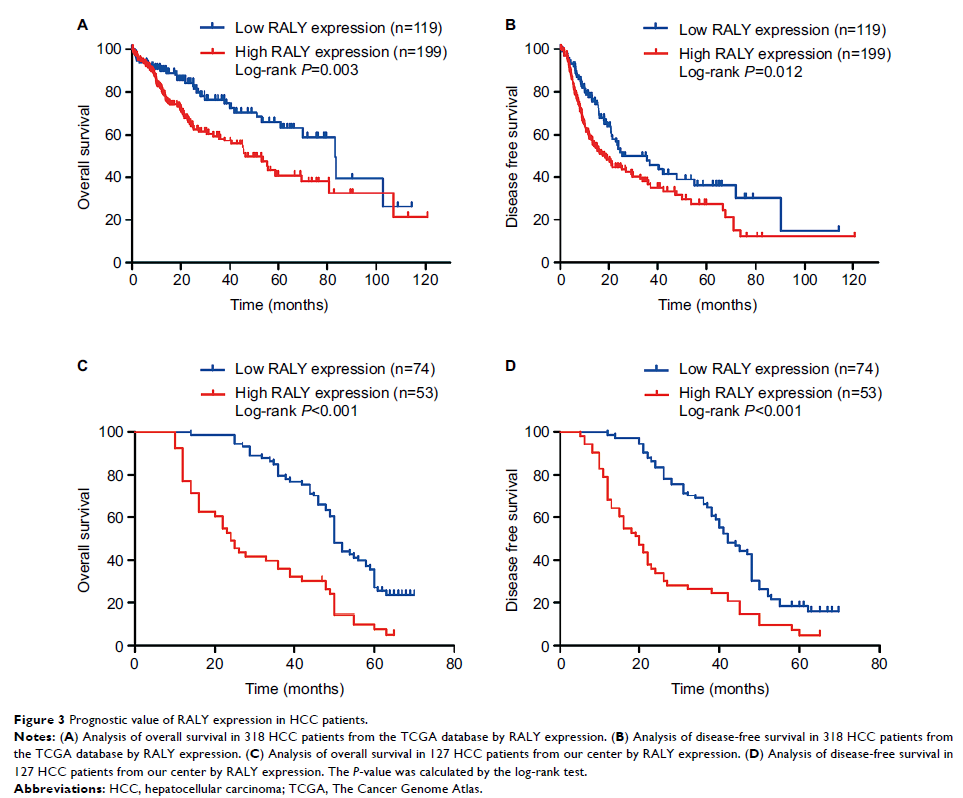
levels (P =0.025), and vascular invasion (P =0.001). Kaplan–Meier analysis
demonstrated that higher expression of RALY correlated with poorer overall
survival and disease-free survival in HCC patients. High RALY expression was an
independent adverse prognostic factor for overall survival (HR =2.559, 95% CI:
1.710–3.827, P <0.001) and
disease-free survival (HR =2.053, 95% CI: 1.384–3.047, P <0.001) in HCC. Moreover,
knockdown of RALY expression using a specific shRNA suppressed the
proliferation, migration, and invasion capabilities of HCC cells in vitro.
Knockdown of RALY expression in HCC cell lines resulted in upregulation of
E-cadherin and downregulation of N-cadherin, vimentin, and snail.
Conclusion: Taken together, our results indicate that RALY represents a
biomarker for the prognosis of patients with HCC and highlight the importance
of RALY as an oncogene in HCC.
Keywords: RALY, hepatocellular carcinoma, migration, invasion