115195
论文已发表
注册即可获取德孚的最新动态
IF 收录期刊
- 3.6 Breast Cancer (Dove Med Press)
- 4.3 Clin Epidemiol
- 2.6 Cancer Manag Res
- 3.2 Infect Drug Resist
- 4.1 Clin Interv Aging
- 6.1 Drug Des Dev Ther
- 4.1 Int J Chronic Obstr
- 8.7 Int J Nanomed
- 2.5 Int J Women's Health
- 3.2 Neuropsych Dis Treat
- 2.4 OncoTargets Ther
- 2.6 Patient Prefer Adher
- 2.6 Ther Clin Risk Manag
- 3.1 J Pain Res
- 3.5 Diabet Metab Synd Ob
- 4.5 Psychol Res Behav Ma
- 3.4 Nat Sci Sleep
- 2.4 Pharmgenomics Pers Med
- 2.6 Risk Manag Healthc Policy
- 4.6 J Inflamm Res
- 2.3 Int J Gen Med
- 3.9 J Hepatocell Carcinoma
- 3.3 J Asthma Allergy
- 2.5 Clin Cosmet Investig Dermatol
- 3.0 J Multidiscip Healthc

纳米系统作为对抗金黄色葡萄球菌感染的有效方法的综述
Authors Zhou KX, Li C, Chen DM, Pan YH, Tao YF, Qu W, Liu ZL, Wang XF, Xie SY
Received 2 April 2018
Accepted for publication 24 July 2018
Published 9 November 2018 Volume 2018:13 Pages 7333—7347
DOI https://doi.org/10.2147/IJN.S169935
Checked for plagiarism Yes
Review by Single-blind
Peer reviewers approved by Dr Colin Mak
Peer reviewer comments 2
Editor who approved publication: Dr Linlin Sun
Abstract: Staphylococcus aureus (S. aureus ) is an important zoonotic
bacteria and hazardous for the health of human beings and livestock globally.
The characteristics like biofilm forming, facultative intracellular survival,
and growing resistance of S. aureus pose a great challenge
to its use in therapy. Nanoparticles are considered as a promising way to
overcome the infections’ therapeutic problems caused by S. aureus . In this paper, the present
progress and challenges of nanoparticles in the treatment of S. aureus infection are focused
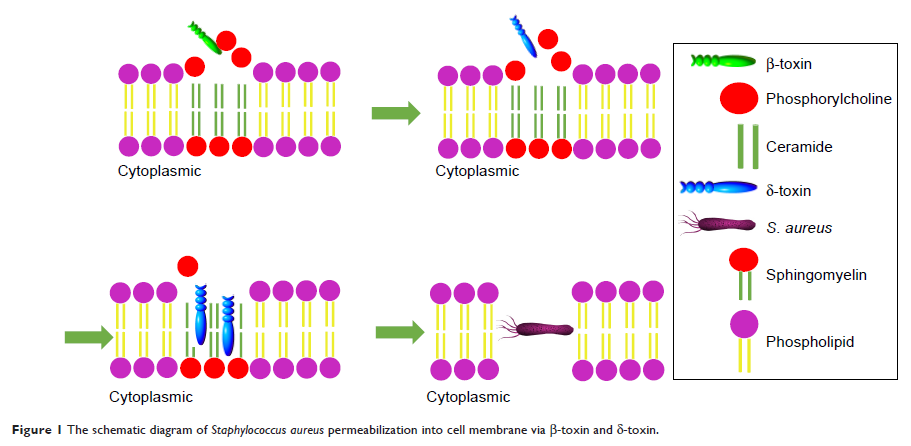
on stepwise. First, the survival and infection mechanism of S. aureus are analyzed. Second,
the treatment challenges posed by S. aureus are provided, which is
followed by the third step including the advantages of nanoparticles in
improving the penetration and accumulation ability of their payload antibiotics
into cell, inhibiting S. aureus biofilm formation, and
enhancing the antibacterial activity against resistant isolates. Finally, the
challenges and future perspective of nanoparticles for S. aureus infection therapy are
introduced. This review will help the readers to realize that the nanosystems
can effectively fight against the S. aureus infection by
inhibiting biofilm formation, enhancing intracellular delivery, and improving
activity against methicillin-resistant S. aureus and small colony
variant phenotypes as well as aim to help researchers looking for more
efficient nanosystems to combat the S. aureus infections.
Keywords: Staphylococcus aureus , infection
mechanism, resistance, antibiotics, nanoparticles