115195
论文已发表
注册即可获取德孚的最新动态
IF 收录期刊
- 3.6 Breast Cancer (Dove Med Press)
- 4.3 Clin Epidemiol
- 2.6 Cancer Manag Res
- 3.2 Infect Drug Resist
- 4.1 Clin Interv Aging
- 6.1 Drug Des Dev Ther
- 4.1 Int J Chronic Obstr
- 8.7 Int J Nanomed
- 2.5 Int J Women's Health
- 3.2 Neuropsych Dis Treat
- 2.4 OncoTargets Ther
- 2.6 Patient Prefer Adher
- 2.6 Ther Clin Risk Manag
- 3.1 J Pain Res
- 3.5 Diabet Metab Synd Ob
- 4.5 Psychol Res Behav Ma
- 3.4 Nat Sci Sleep
- 2.4 Pharmgenomics Pers Med
- 2.6 Risk Manag Healthc Policy
- 4.6 J Inflamm Res
- 2.3 Int J Gen Med
- 3.9 J Hepatocell Carcinoma
- 3.3 J Asthma Allergy
- 2.5 Clin Cosmet Investig Dermatol
- 3.0 J Multidiscip Healthc

二氧化硅纳米粒子在体内和体外引发肝脏脂质代谢紊乱
Authors Duan J, Liang S, Feng L, Yu Y, Sun Z
Received 26 August 2018
Accepted for publication 6 October 2018
Published 9 November 2018 Volume 2018:13 Pages 7303—7318
DOI https://doi.org/10.2147/IJN.S185348
Checked for plagiarism Yes
Review by Single-blind
Peer reviewers approved by Dr Govarthanan Muthusamy
Peer reviewer comments 2
Editor who approved publication: Dr Mian Wang
Background: As a promising nanocarrier in biomedical fields, silica nanoparticles
(SiNPs) could transfer from the circulatory system to multiple organs. Among
these, blood–liver molecular exchange is a critical factor in biological
response to NPs. However, the potential effect of SiNPs on hepatic lipid
metabolism is unclear. In this study, we employed three models to attempt
discover whether and how SiNPs disturb hepatic lipid metabolism in vivo and in
vitro.
Methods: Firstly we used ICR mice models to evaulated the effects of SiNPs on the
serum and hepatic lipid levels through repeated intravenous administration,
meanwhile, the protein expressions of protein markers of lipogenesis (ACC1 and
FAS ), the key enzyme of fatty acid β-oxidation, CPT1A,and leptin levels in
liver were detected by western blot. For verification studies, the model
organism zebrafish and cultured hepatic L02 cells were further performed. The
TLR5 and adipocytokine-signaling pathway were verified.
Results: Inflammatory cell infiltration and mild steatosis induced by SiNPs
were observed in the liver. Cholesterol, triglyceride, and low-density
lipoprotein cholesterol levels were elevated significantly in both blood serum
and liver tissue, whereas the ratio of high-density:low-density lipoprotein
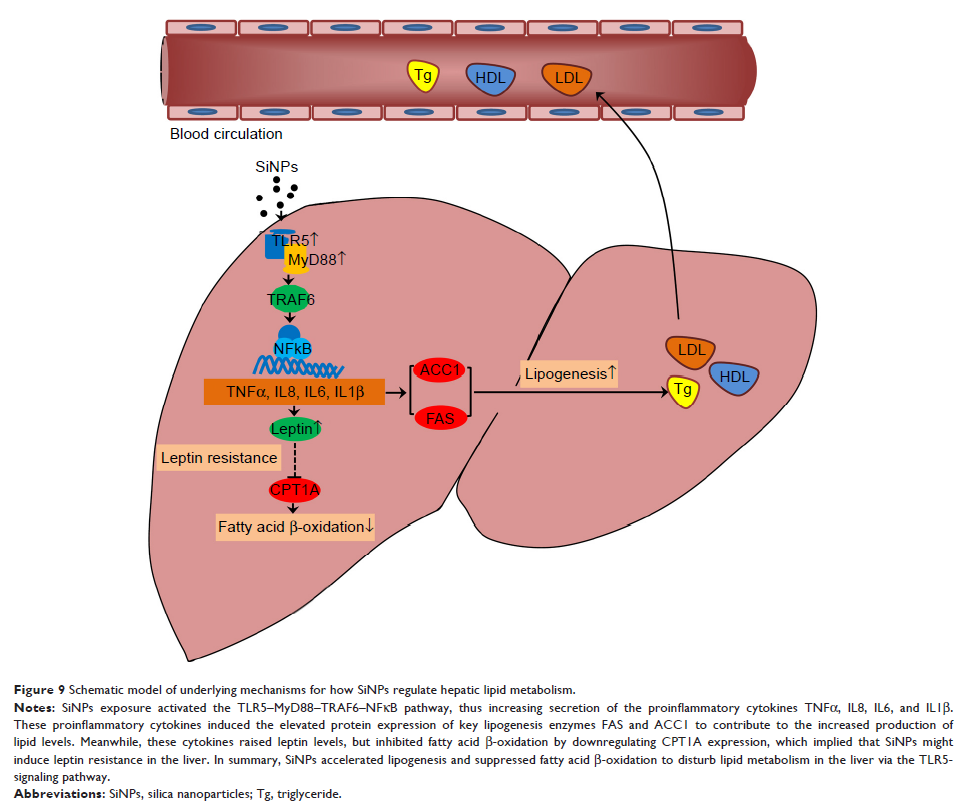
cholesterol was markedly decreased. Protein markers of lipogenesis (ACC1 and
FAS) were elevated significantly in liver tissue, whereas the key enzyme of
fatty acid β-oxidation, CPT1A, was decreased significantly. Interestingly,
leptin levels in the SiNP-treated group were also elevated markedly. In
addition, SiNPs caused hepatic damage and steatosis in zebrafish and enhanced
hyperlipemia in high-cholesterol diet zebrafish. Similarly, SiNPs increased the
release of inflammatory cytokines (IL1β, IL6, IL8, and TNFα) and activated the
TLR5-signaling pathway in hepatic L02 cells.
Conclusion: In summary, our study found that SiNPs triggered hyperlipemia and
hepatic steatosis via the TLR5-signaling pathway. This suggests that regulation
of TLR5 could be a novel therapeutic target to reduce side effects of NPs in
living organisms.
Keywords: silica nanoparticles, hyperlipemia, hepatic steatosis, hepatic lipid
metabolism, TLR5-signaling pathway