115195
论文已发表
注册即可获取德孚的最新动态
IF 收录期刊
- 3.6 Breast Cancer (Dove Med Press)
- 4.3 Clin Epidemiol
- 2.6 Cancer Manag Res
- 3.2 Infect Drug Resist
- 4.1 Clin Interv Aging
- 6.1 Drug Des Dev Ther
- 4.1 Int J Chronic Obstr
- 8.7 Int J Nanomed
- 2.5 Int J Women's Health
- 3.2 Neuropsych Dis Treat
- 2.4 OncoTargets Ther
- 2.6 Patient Prefer Adher
- 2.6 Ther Clin Risk Manag
- 3.1 J Pain Res
- 3.5 Diabet Metab Synd Ob
- 4.5 Psychol Res Behav Ma
- 3.4 Nat Sci Sleep
- 2.4 Pharmgenomics Pers Med
- 2.6 Risk Manag Healthc Policy
- 4.6 J Inflamm Res
- 2.3 Int J Gen Med
- 3.9 J Hepatocell Carcinoma
- 3.3 J Asthma Allergy
- 2.5 Clin Cosmet Investig Dermatol
- 3.0 J Multidiscip Healthc

Impact of opioid dose reduction on individuals with chronic pain: results of an online survey
Authors Twillman RK, Hemmenway N, Passik SD, Thompson CA, Shrum M, DeGeorge MK
Received 26 May 2018
Accepted for publication 9 August 2018
Published 8 November 2018 Volume 2018:11 Pages 2769—2779
DOI https://doi.org/10.2147/JPR.S175402
Checked for plagiarism Yes
Review by Single-blind
Peer reviewers approved by Dr Amy Norman
Peer reviewer comments 4
Editor who approved publication: Dr E Alfonso Romero-Sandoval
Background: In 2016, the Centers for Disease Control and Prevention (CDC) released a
guideline on opioid prescribing for primary care physicians. Patients with
chronic pain receiving long-term opioid therapy were surveyed to assess the
incidence and impact of opioid dose reduction following this guideline’s
promulgation.
Methods: Members of an advocacy organization for people with chronic pain
were invited to participate in a 16-item, anonymous, online survey conducted in
September/October 2017. Eligibility requirements included current treatment of
≥7 months’ duration for chronic pain with the same extended-release (ER)/long-acting
(LA) opioid. The final sample consisted of respondents who reported being on
the same ER/LA opioid for ≥1 year and excluded respondents whose 1) ER/LA
opioid dose increased; 2) ER/LA opioid dose decreased and immediate-release
(IR) opioid dose increased; and 3) ER/LA opioid dose was unchanged and IR
opioid dose was changed. Survey results were analyzed using z-test to ascertain
differences between proportion of responses for ER/LA opioid dose decreased vs
dose unchanged groups.
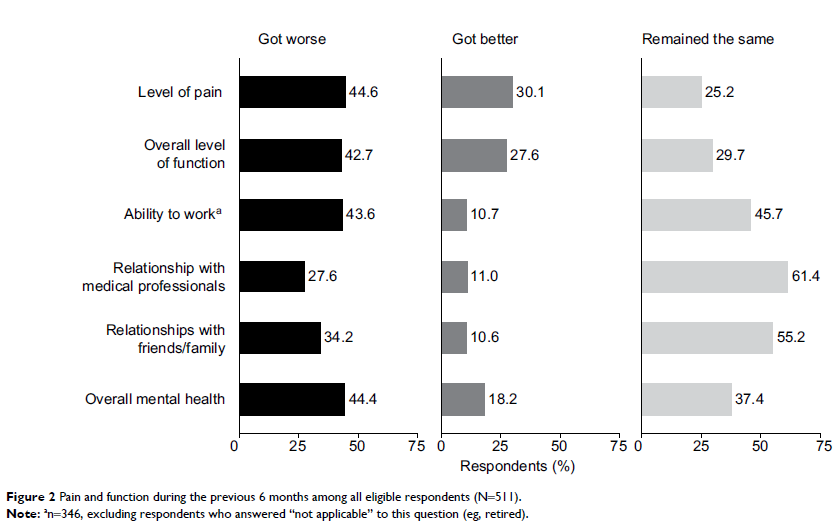
Results: Of the 511 eligible respondents, 362 respondents were included in
the final sample. In the final sample, the subgroup with decreased ER/LA opioid
dose (n=149) was significantly more likely (P ≤ 0.05) than those
who reported no dose change (n=213) to rate their condition as “worse” for
level of pain (73.2 vs 33.3%), level of function (67.8 vs 31.5%), mental health
(64.4 vs 32.9%), ability to work (62.9% of 97 respondents vs 33.8% of 145
respondents), and interpersonal relationships (48.3 vs 25.8%) during the previous
6 months.
Conclusion: In this Internet-based survey of people with chronic pain,
reduction of ER/LA opioid dose was associated with reduced pain control and
diminished function. These results indicate a need for further guidance on how
to apply the CDC guideline to patients with chronic pain who are stable on
long-term opioid therapy.
Keywords: CDC guideline, chronic pain, long-term opioid therapy, survey