115195
论文已发表
注册即可获取德孚的最新动态
IF 收录期刊
- 3.6 Breast Cancer (Dove Med Press)
- 4.3 Clin Epidemiol
- 2.6 Cancer Manag Res
- 3.2 Infect Drug Resist
- 4.1 Clin Interv Aging
- 6.1 Drug Des Dev Ther
- 4.1 Int J Chronic Obstr
- 8.7 Int J Nanomed
- 2.5 Int J Women's Health
- 3.2 Neuropsych Dis Treat
- 2.4 OncoTargets Ther
- 2.6 Patient Prefer Adher
- 2.6 Ther Clin Risk Manag
- 3.1 J Pain Res
- 3.5 Diabet Metab Synd Ob
- 4.5 Psychol Res Behav Ma
- 3.4 Nat Sci Sleep
- 2.4 Pharmgenomics Pers Med
- 2.6 Risk Manag Healthc Policy
- 4.6 J Inflamm Res
- 2.3 Int J Gen Med
- 3.9 J Hepatocell Carcinoma
- 3.3 J Asthma Allergy
- 2.5 Clin Cosmet Investig Dermatol
- 3.0 J Multidiscip Healthc

纳米粒子修饰的壳聚糖 - 琼脂糖 - 明胶支架用于 SDF-1 和 BMP-2 的持续释放
Authors Wang B, Guo Y, Chen X, Zeng C, Hu Q, Yin W, Li W, Xie H, Zhang B, Huang X, Yu F
Received 19 July 2018
Accepted for publication 3 October 2018
Published 12 November 2018 Volume 2018:13 Pages 7395—7408
DOI https://doi.org/10.2147/IJN.S180859
Checked for plagiarism Yes
Review by Single-blind
Peer reviewers approved by Dr Alexander Kharlamov
Peer reviewer comments 4
Editor who approved publication: Dr Linlin Sun
Background: Stromal cell-derived factor 1 (SDF-1) is
an important chemokine for stem cell mobilization, and plays a critical role in
mobilization of mesenchymal stem cells (MSCs). Bone morphogenetic protein 2
(BMP-2) plays a critical role in osteogenesis of MSCs. However, the use of
SDF-1 and BMP-2 in bone tissue engineering is limited by their short half-lives
and rapid degradation in vitro and in vivo.
Methods: The
chitosan oligosaccharide/ heparin nanoparticles (CSO/H NPs) were first prepared
via self-assembly. Chitosan-agarose-gelatin (CAG) Scaffolds were then
synthesized via gelation technology using cross-linked chitosan, agarose, and
gelatin, and were modified by CSO/H NPs. The encapsulation efficiency and
release kinetics of SDF-1 and BMP-2 were quantified using an enzyme-linked
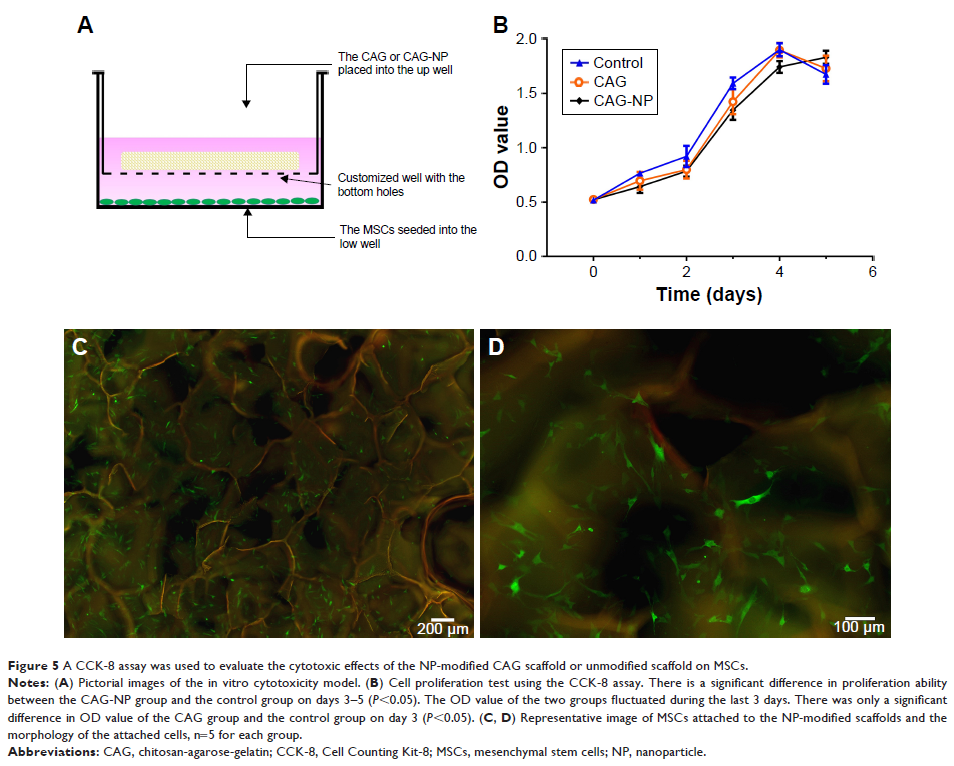
immunosorbent assay. A CCK-8 assays were used to evaluate biocompatibility of
NP-modified scaffolds. The biological activity of the loaded SDF-1 and BMP-2
was evaluated using the transwell migration assay and osteogenic induction
assay. An animal MSC recruitment model was used to study the ability of SDF-1
released from NP-modified scaffolds to induce migration of MSCs.
Results: In
this study, we developed a novel nanoparticle-modified CAG scaffold for the
delivery of SDF-1 and BMP-2. CCK-8 assays demonstrated excellent
biocompatibility of NP-modified scaffolds. In addition, we investigated the
release of SDF-1 and BMP-2 from NP-modified scaffolds, and evaluated the effect
of released SDF-1 on MSC migration. The effect of released BMP-2 on MSC osteogenesis
was also examined. In vitro cell migration assays showed that SDF-1 released
from NP-modified scaffolds retained its migration activity; osteogenesis
studies demonstrated that released BMP-2 exhibited a strong ability to induce
differentiation towards osteoblasts. Our in vivo recruitment assays showed
continuous chemotactic response of MSCs to SDF-1 released from the NP-modified
scaffold.
Conclusion: The
simplicity of synthesizing CSO/H NP-modified CAG scaffolds, combined with its
high cytokine loading capacity and sustained release effect, renders
NP-modified CAG scaffold an attractive candidate for sustained release of SDF-1
and BMP-2 to promote bone repair and regeneration.
Keywords: cytokine
delivery system, nanoparticles, chitosan-agarose-gelatin scaffold, stromal
cell-derived factor-1, bone morphogenetic protein-2