115195
论文已发表
注册即可获取德孚的最新动态
IF 收录期刊
- 3.6 Breast Cancer (Dove Med Press)
- 4.3 Clin Epidemiol
- 2.6 Cancer Manag Res
- 3.2 Infect Drug Resist
- 4.1 Clin Interv Aging
- 6.1 Drug Des Dev Ther
- 4.1 Int J Chronic Obstr
- 8.7 Int J Nanomed
- 2.5 Int J Women's Health
- 3.2 Neuropsych Dis Treat
- 2.4 OncoTargets Ther
- 2.6 Patient Prefer Adher
- 2.6 Ther Clin Risk Manag
- 3.1 J Pain Res
- 3.5 Diabet Metab Synd Ob
- 4.5 Psychol Res Behav Ma
- 3.4 Nat Sci Sleep
- 2.4 Pharmgenomics Pers Med
- 2.6 Risk Manag Healthc Policy
- 4.6 J Inflamm Res
- 2.3 Int J Gen Med
- 3.9 J Hepatocell Carcinoma
- 3.3 J Asthma Allergy
- 2.5 Clin Cosmet Investig Dermatol
- 3.0 J Multidiscip Healthc

神经内分泌肿瘤患者的预后:SEER 数据库分析
Authors Man D, Wu J, Shen Z, Zhu X
Received 22 May 2018
Accepted for publication 30 August 2018
Published 13 November 2018 Volume 2018:10 Pages 5629—5638
DOI https://doi.org/10.2147/CMAR.S174907
Checked for plagiarism Yes
Review by Single-blind
Peer reviewers approved by Dr Colin Mak
Peer reviewer comments 3
Editor who approved publication: Professor Nakshatri
Background: Neuroendocrine
tumors (NETs) are a group of heterogeneous cancers arising from a variety of
anatomic sites. Their incidence has increased in recent years. This study aimed
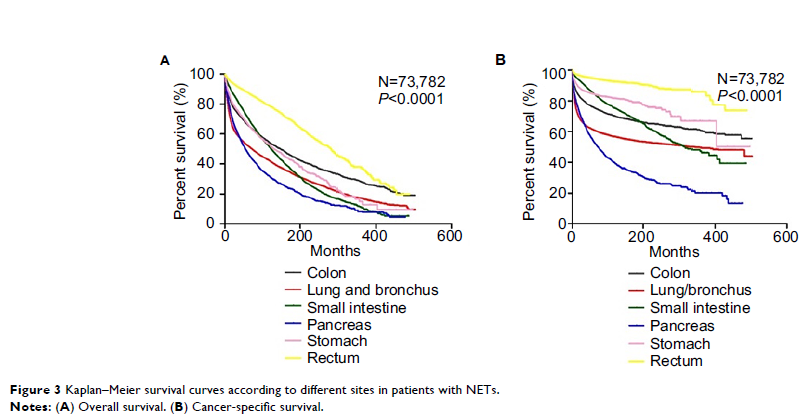
to analyze the prognosis of NETs originating from different anatomic sites.
Methods: We
identified 73,782 patients diagnosed with NETs from the Surveillance Epidemiology
and Ends Results (SEER) database from 1973 to 2014. Clinical data were compared
between patients with different primary tumor sites using the chi-squared test.
Differences in survival among NET patients with different tumor sites were
compared by Kaplan–Meier analysis. Cox proportional hazard models were
performed to identify the prognostic factors of overall survival.
Results: In this cohort,
the lung/bronchus was the most common site of NETs, accounting for 30.6%,
followed by the small intestine (22.2%), rectum (16.2%), colon (13.4%),
pancreas (10.8%), and stomach (6.8%). Totally, 73,782 patients were selected
for this cohort from 1973 to 2014. The median survival duration was 41 months.
The 1-, 3-, 5-, and 10-year overall survival rates for patients with NETs were
72.8%, 52.7%, 39.4%, and 18.1%, respectively. Patients with NETs located in the
rectum had the best prognosis, followed by those with NETs in the small
intestine (HR, 1.660, 95% CI, 1.579, 1.744), lung/bronchus (HR, 1.786, 95% CI,
1.703, 1.874), stomach (HR, 1.865, 95% CI, 1.755, 1.982), and colon (HR, 1.896,
95% CI, 1.799, 1.999). Patients with NETs in the pancreas had the highest risk
of mortality (HR, 2.034, 95% CI, 1.925, 2.148).
Conclusion: Significant
differences in survival were found among various primary tumor sites. NETs in
the rectum had the best prognosis, while those in the pancreas had the worst.
Primary tumor sites might be one of the most useful outcome predictors in
patients with NETs.
Keywords: neuroendocrine
tumor, SEER program, survival analysis, primary tumor sites