115195
论文已发表
注册即可获取德孚的最新动态
IF 收录期刊
- 3.6 Breast Cancer (Dove Med Press)
- 4.3 Clin Epidemiol
- 2.6 Cancer Manag Res
- 3.2 Infect Drug Resist
- 4.1 Clin Interv Aging
- 6.1 Drug Des Dev Ther
- 4.1 Int J Chronic Obstr
- 8.7 Int J Nanomed
- 2.5 Int J Women's Health
- 3.2 Neuropsych Dis Treat
- 2.4 OncoTargets Ther
- 2.6 Patient Prefer Adher
- 2.6 Ther Clin Risk Manag
- 3.1 J Pain Res
- 3.5 Diabet Metab Synd Ob
- 4.5 Psychol Res Behav Ma
- 3.4 Nat Sci Sleep
- 2.4 Pharmgenomics Pers Med
- 2.6 Risk Manag Healthc Policy
- 4.6 J Inflamm Res
- 2.3 Int J Gen Med
- 3.9 J Hepatocell Carcinoma
- 3.3 J Asthma Allergy
- 2.5 Clin Cosmet Investig Dermatol
- 3.0 J Multidiscip Healthc

肿瘤周围植入含水凝胶的纳米粒和氯沙坦可增强纳米粒子的渗透和抗肿瘤作用
Authors Shen H, Gao Q, Ye Q, Yang S, Wu Y, Huang Q, Wang X, Sun Z
Received 3 July 2018
Accepted for publication 9 October 2018
Published 13 November 2018 Volume 2018:13 Pages 7409—7426
DOI https://doi.org/10.2147/IJN.S178585
Checked for plagiarism Yes
Review by Single-blind
Peer reviewers approved by Dr Govarthanan Muthusamy
Peer reviewer comments 2
Editor who approved publication: Dr Linlin Sun
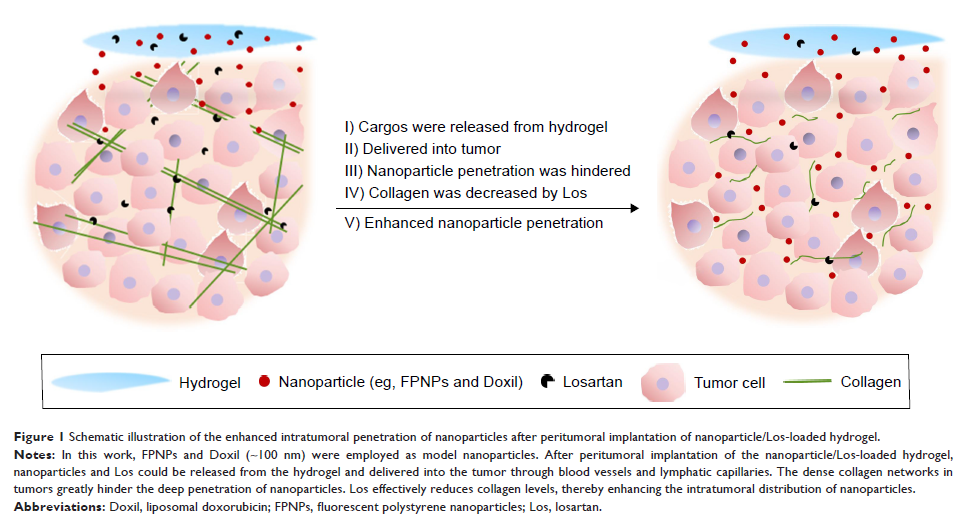
Background and purpose: Nanoparticle-loaded
hydrogels – localized drug delivery devices containing a combination of
therapeutic nanoparticles and implantable hydrogel – have been recipients of
increased focus and interest for cancer treatment. However, it is difficult for
the released nanoparticles to penetrate deeply into tumors because of the dense
collagen network in the tumor extracellular matrix, which greatly limits their
antitumor effect. We hypothesized that the implantation of a hydrogel loaded
with both nanoparticles and losartan (Los) might enhance penetration because
Los has been proven to effectively reduce collagen levels in various tumors.
Herein, we developed a nanoparticle/Los-loaded hydrogel system and evaluated
the intratumoral distribution and anticancer effect after peritumoral
implantation of nanoparticles.
Methods: Fluorescent
polystyrene nanoparticles (FPNPs, size ~100 nm) and Los were simultaneously
encapsulated in a polyethylene glycol (PEG) hydrogel to form the
FPNP/Los-loaded hydrogel. After peritumoral implantation in 4T1 tumor-bearing
mice for 2 weeks, intratumoral distributions of FPNPs and collagen level were
determined. Based on the results, liposomal doxorubicin (Doxil, ~100 nm) was
subsequently substituted for FPNPs in the hydrogel. The cellular uptake and
cytotoxicity of the Doxil/Los-loaded hydrogel were studied, and the in vivo
antitumor efficacy after peritumoral implantation was evaluated.
Results: Compared
with a standard FPNP-loaded hydrogel, the FPNP/Los-loaded hydrogel resulted in
enhanced penetration and reduced collagen levels after implantation.
Thereafter, the potential of a Doxil/Los-loaded hydrogel for cancer treatment
was studied. Doxorubicin was released from the hydrogel and induced effective
cytotoxicity against 4T1 cells. The Doxil/Los-loaded hydrogel showed
synergistic antitumor effects in 4T1 tumor-bearing mice and was more effective
at tumor inhibition than the Doxil-loaded hydrogel.
Conclusion: This
study provides a proof of principle that the implantation of
nanoparticles/Los-loaded hydrogel can increase the intratumoral distribution
and antitumor efficacy of nanoparticles, owing to collagen depletion by Los.
Future studies may build on this strategy for enhanced tumor penetration of
nanoparticles.
Keywords: localized
drug delivery, tumor penetration, tumor extracellular matrix, collagen, matrix
metalloproteinase, breast cancer